Hello everybody!
This is my first post so here it goes:
I recenly got a nice old columbia table top model (not sure what the model isnor do I have the means to post a picture, though it has a lid, three needle cups, the tone arm is rear right rather than rear center, dark finish, two motor board screws near the front, adjustable slats for volume).
Anyhoo, the real question isn't what the model is, it has to do with records. Is it true that you should not play the later 78's on one of these older machines?
I have some newer records that play fine albeit they tend to be louder and shake the speaker more than older ones. There also dfoes not seem to be anymore dust left on the needles as compaired to the older disks. I've also noticed that columbia records tend to shake the speaker more than Victor disks (of course it could be the ones I own rather than a general rule). I plan on getting some soft tone needles for the louder disks (I only have medium right now).
Sorry about the length,
Imperial Guardsman20

Later 78's on an older Columbia
Q&A about Talking Machines from the pre-electronic era (approx. 1885-1928).
-
Imperial Guardsman20
Topic author - Junior Member
- Posts: 10
- Joined: Tue Jul 31, 2012 3:29 am
Imperial Guardsman20
~Also a member of Catholic Answers Forum and The High Road Forum~
~Also a member of Catholic Answers Forum and The High Road Forum~
-
Joe_DS
- Forum Moderator
- Posts: 1056
- Joined: Thu Jun 08, 2006 4:23 pm
- Location: San Francisco, California, USA
The Columbia phonograph you described was probably made during the teens to the mid-1920s.
Is it similar in style to this one? >>>
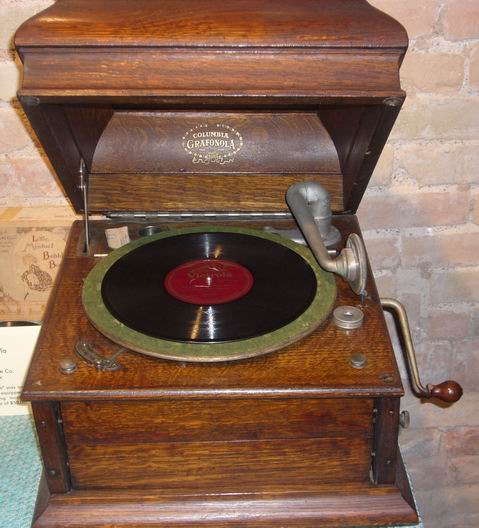
I take it, the sound box or reproducer is fitted with a mica diaphragm? After 1925, Columbia produced the Viva-Tonal series, both in the US and the UK, to compete with the Orthophonic Victrola and HMV "Improved Gramophones" designed to play the newly introduced electrical recordings, which hit the market in mid-to-late 1925. The early UK produced Viva-Tonal models use cabinets similar to the older ones, but the sound boxes are equipped with aluminum diaphragms, and the tone arms are not the straight, bayonet type as in the photo above.
Most collectors I know would discourage playing later 78s, especially those made after about 1940, on a gramophone of this type. (Many, in fact, cite a cut off date of about 1932-1933.) There are a number of reasons for this. In some cases, records produced by certain manufacturers--especially after about 1940--did not have playing surfaces sufficiently hard to withstand the heavy, older acoustic sound boxes and tonearms. Also, the reproducer, itself, is often not compliant enough to track the record groove efficiently.
That said, I've played some later 78s--those made up to about 1945--on both my Victor V, which has an Exhibition sound box, as well as my VV-4-40 (Orthophonic Victrola). But in both cases, the reproducer has been rebuilt and tuned to ensure maximum performance and efficiency. Also, when playing later records, because of the amplitude of the cut, I always use soft tone needles, which minimize distortion.
As a bottom line, I'd say if these records are not considered rare or valuable, and could easily be replaced if worn or broken, then go for it, as long as the reproducer has been rebuilt with fresh, soft gaskets and properly tuned. This takes for granted that the records you want to play are shellac based and NOT vinyl, which started to take over from shellac in the late 1940s.
HTH,
Joe_DS
Is it similar in style to this one? >>>
I take it, the sound box or reproducer is fitted with a mica diaphragm? After 1925, Columbia produced the Viva-Tonal series, both in the US and the UK, to compete with the Orthophonic Victrola and HMV "Improved Gramophones" designed to play the newly introduced electrical recordings, which hit the market in mid-to-late 1925. The early UK produced Viva-Tonal models use cabinets similar to the older ones, but the sound boxes are equipped with aluminum diaphragms, and the tone arms are not the straight, bayonet type as in the photo above.
Most collectors I know would discourage playing later 78s, especially those made after about 1940, on a gramophone of this type. (Many, in fact, cite a cut off date of about 1932-1933.) There are a number of reasons for this. In some cases, records produced by certain manufacturers--especially after about 1940--did not have playing surfaces sufficiently hard to withstand the heavy, older acoustic sound boxes and tonearms. Also, the reproducer, itself, is often not compliant enough to track the record groove efficiently.
That said, I've played some later 78s--those made up to about 1945--on both my Victor V, which has an Exhibition sound box, as well as my VV-4-40 (Orthophonic Victrola). But in both cases, the reproducer has been rebuilt and tuned to ensure maximum performance and efficiency. Also, when playing later records, because of the amplitude of the cut, I always use soft tone needles, which minimize distortion.
As a bottom line, I'd say if these records are not considered rare or valuable, and could easily be replaced if worn or broken, then go for it, as long as the reproducer has been rebuilt with fresh, soft gaskets and properly tuned. This takes for granted that the records you want to play are shellac based and NOT vinyl, which started to take over from shellac in the late 1940s.
HTH,
Joe_DS
-
Imperial Guardsman20
Topic author - Junior Member
- Posts: 10
- Joined: Tue Jul 31, 2012 3:29 am
That looks identical to my Columbia, thanks! The diaphram is mica. It plays very well though the reproducer has not been rebuilt. Is there any added danger if the reproducer is not rebuilt? As I said earlier, I did not see any difference in the amount of residue (dust, etc.) on the needles. That's not to say that damage is not occuring though.
Imperial Guardsman20
~Also a member of Catholic Answers Forum and The High Road Forum~
~Also a member of Catholic Answers Forum and The High Road Forum~
-
Joe_DS
- Forum Moderator
- Posts: 1056
- Joined: Thu Jun 08, 2006 4:23 pm
- Location: San Francisco, California, USA
Most collectors--myself included--recommend that the sound box be overhauled before too many records are played.
Hard or frozen gaskets restrict the movement of the needle-bar/diaphragm and limit the needle's ability accurately track the record groove. This adds to record surface wear, overall. When soft gaskets are installed, a greater area of the diaphragm is able to plunge back and forth with the movement of the needle. In terms of sound quality, what was high-pitched or harsh or blasting becomes full sounding. Buzzing and rattling all but disappear. This is especially true for sound boxes with larger diaphragms such as those made by Columbia, which do a pretty decent job of handling the heavy bass of most early electrical recordings, though they are still a poor match for the Orthophonic/Viva-Tonal models.
HTH,
Joe_DS
Hard or frozen gaskets restrict the movement of the needle-bar/diaphragm and limit the needle's ability accurately track the record groove. This adds to record surface wear, overall. When soft gaskets are installed, a greater area of the diaphragm is able to plunge back and forth with the movement of the needle. In terms of sound quality, what was high-pitched or harsh or blasting becomes full sounding. Buzzing and rattling all but disappear. This is especially true for sound boxes with larger diaphragms such as those made by Columbia, which do a pretty decent job of handling the heavy bass of most early electrical recordings, though they are still a poor match for the Orthophonic/Viva-Tonal models.
HTH,
Joe_DS
-
Imperial Guardsman20
Topic author - Junior Member
- Posts: 10
- Joined: Tue Jul 31, 2012 3:29 am
In that case, is there a business that you would recomend to have my reproducer rebuilt? I'd rather have someone else do it as I worry that I could have a mishap with the pot metal contruction.
Imperial Guardsman20
~Also a member of Catholic Answers Forum and The High Road Forum~
~Also a member of Catholic Answers Forum and The High Road Forum~
-
Joe_DS
- Forum Moderator
- Posts: 1056
- Joined: Thu Jun 08, 2006 4:23 pm
- Location: San Francisco, California, USA
Imperial Guardsman20 wrote:In that case, is there a business that you would recomend to have my reproducer rebuilt? I'd rather have someone else do it as I worry that I could have a mishap with the pot metal contruction.
If you're located in the US, there are a number of shops, I know of that do good work I could recommend. Prices for standard rebuilds are pretty reasonable. I'm afraid I've never dealt with any repair shops in the UK or Europe.
JDS
-
Imperial Guardsman20
Topic author - Junior Member
- Posts: 10
- Joined: Tue Jul 31, 2012 3:29 am
I'm in the US, Oregon to be exact. It would be nice if they had a website, though that is no deal breaker.
Imperial Guardsman20
~Also a member of Catholic Answers Forum and The High Road Forum~
~Also a member of Catholic Answers Forum and The High Road Forum~
-
Joe_DS
- Forum Moderator
- Posts: 1056
- Joined: Thu Jun 08, 2006 4:23 pm
- Location: San Francisco, California, USA
Here are a few that I've dealt with in the past. All provide good service --
Great Lakes Antique Phonograph -- http://www.victroladoctor.com/
Antique Phonograph Supply Company -- http://www.antiquephono.com/
Victrola Repair Service -- http://www.victrolarepairservice.com/
Hawthorn's Antique Audio -- http://www.thoseoldrecords.com/phonorep.html
Here are some others that have been recommended by fellow collectors --
http://www.shenandoahrestoration.com/
http://www.wyattsmusical.com/
HTH,
Joe_DS
Great Lakes Antique Phonograph -- http://www.victroladoctor.com/
Antique Phonograph Supply Company -- http://www.antiquephono.com/
Victrola Repair Service -- http://www.victrolarepairservice.com/
Hawthorn's Antique Audio -- http://www.thoseoldrecords.com/phonorep.html
Here are some others that have been recommended by fellow collectors --
http://www.shenandoahrestoration.com/
http://www.wyattsmusical.com/
HTH,
Joe_DS
-
Joe_DS
- Forum Moderator
- Posts: 1056
- Joined: Thu Jun 08, 2006 4:23 pm
- Location: San Francisco, California, USA
I forgot to mention in my last post, since you live in Oregon, you might find this group of interest:
The Oregon Territory Antique Phonograph Society - OTAPS -- http://otaps.org/index.php
HTH,
Joe_DS
The Oregon Territory Antique Phonograph Society - OTAPS -- http://otaps.org/index.php
HTH,
Joe_DS
-
Imperial Guardsman20
Topic author - Junior Member
- Posts: 10
- Joined: Tue Jul 31, 2012 3:29 am
Thanks! These will be really helpful. I just got a suitcase Silvertone that needs restoring and thses links seem to answer that as well.
Imperial Guardsman20
~Also a member of Catholic Answers Forum and The High Road Forum~
~Also a member of Catholic Answers Forum and The High Road Forum~
Who is online
Users browsing this forum: No registered users and 1 guest
It is currently Thu Oct 06, 2016 9:50 am
