Philco 118 floor model is smoking
Posted: Tue Dec 23, 2014 3:45 am
by WB2HTO
At 80 years old, I know it's old enough to smoke

Fixed a B+ short by replacing the electrolytics (great advice from members here) but now after about 30 seconds (just as I start to hear audio from local stations) I smell and see a wisp of smoke. Someone suggested shotgunning the resisters but my thought is that something is causing the resister to smoke, I need to find that.
I don't have a lot of experience with this old a rig, any thoughts where best to start tracing/measuring? jpeg of schematic attached...
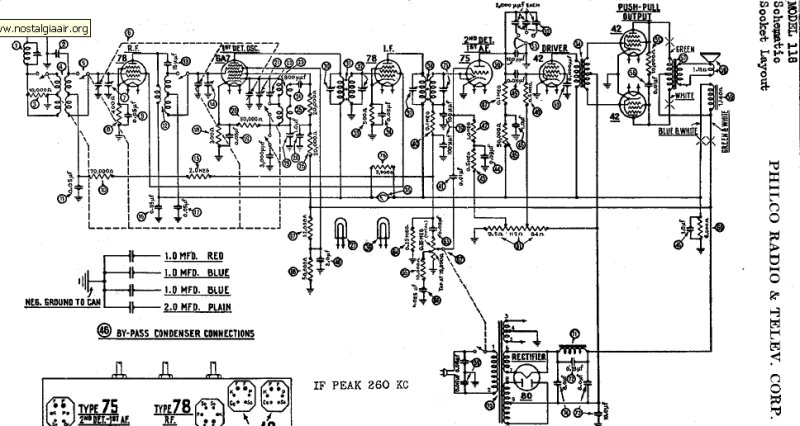
- Philco118.jpg (86.45 KiB) Viewed 844 times
Re: Philco 118 floor model is smoking
Posted: Tue Dec 23, 2014 8:28 pm
by MattTech
Your first problem was using this radio before its had a full and complete electronic restoration.
I've said this numerous times, in the hope that people will realize it's not safe nor smart to power up these old sets "as is".
Now, most likely, other components have failed, possibly transformers, other tubes, who knows.
I cannot diagnose things from miles away - it's silly to try.
And I've been doing it for decades now... but..
...It's got to be on my bench at work, for me to determine the damage now done.
Best advice I can give you is to locate someone reputable who specializes in restorations.
And be prepared to spend some money on it.
The good thing is - it'll only hurt once.
Re: Philco 118 floor model is smoking
Posted: Tue Dec 23, 2014 8:33 pm
by WB2HTO
Well, the only way I will learn is by doing - and possibly making it worse. Besides, I wouldn't buy a an radio just to have someone else fix it. Fifty or so radios into this hobby and this is my first real challenge, which I am relishing. Have re-capped and checked all the tubes, maybe I missed a grounded cap or there's something else. Got some friends who have offered to help and teach me...
Re: Philco 118 floor model is smoking
Posted: Wed Dec 24, 2014 1:59 am
by Ron Rich
Guyz,
I writ this way back in 2007--but I think it is still true today--Merry Christmas, Happy new year to ALL !!
> I have a new theory on how "Electrick Stuff"
> works. This theory was called to my attention by
> the
> teller at my local bank. I'm not sure what prompted
> our conversation, but she mentioned her idea that
> all
> "Electrick Stuff" works on the fact that when these
> components "smoke" they are no longer any good. I
> then
> remembered that many components are made in a room
> where the air is tightly controlled. I explained to
> her that the air was clean so that no "dirt" could
> contaminate the product. We then went on to
> speculate
> as to how the smoke would get into the products. It
> was my theory that just the right amount of
> "smoke" must be introduced into the product at the
> time it was put into the heater for final
> assembly,
> after all, everything I can think of is heated to
> one
> degree or another. No ! , you say ? How about caps,
> you say. Yes ! I say. All caps have heat shrink on
> them---or a hot poured mylar--or how 'bout the
> "paper"
> style--no heat here, you say. O.K., but they had to
> press the ends together--that's gotta cause some
> heat,
> and, besides, those were made in the old days when
> they used a fireplace to heat the room. Maybe they
> blew just the correct amount of smoke into those
> things--how else would they be able to control the
> amount of microfarad's they put into them?
>
> Anyway all this discussion lead to the "smoke
> test" discussion. Somehow I began to explain
> that some people in my business would occasionally
> put
> an over sized fuse in a circuit, and apply power,
> in
> the effort to find the problem in that circuit. She
> asked "whats that ? I asked "what's what"? She said
> "over sized fuse"? I said "any fuse that is larger
> then the circuit is designed to have". She said
> "--it
> won't fit if it's too big". I said "no, I mean
> electrically too large". She contended that if the
> fuse would fit into the holder, it MUST be the
> right size.
>
> Fortunately for me, another customer entered
> the bank about this time, and even more
> fortunately,
> he stepped up behind me. I said "good by" and left
> the
> bank, as fast as I could.
>
> But, I have been thinking' this whole weekend
> about that conversation--and you know, the more I
> think about it, the "righter" it seems! The "smoke
> test" is sure based on this theory! I mean, why
> else
> would this test work? There must be some smoke
> inside
> of every electronic component! I can't think of
> one
> type of component that I have not seen in a
> "burned"
> condition. And I think that "Murphy's Law" may also
> apply here. Why else would it work fine in the shop
> (with the big fuse in it), and then "smoke" when
> the
> customer gets it (with the big fuse in it that you
> forgot to change )?
>
> This all leads to this conclusion (bet you
> are
> glad to see that, after having read this far!).
>
> ALL "LETRICK STUFF" OPERATES ON SMOKE. ONCE YOU
> LET THE SMOKE ESCAPE, THE "STUFF" (or whatever you
> want to call it) AIN'T NO MORE GOOD !!!
>
>
> Ron Rich