Page 1 of 2
Values Not Provided
Posted: Sat Jan 31, 2015 4:53 pm
by ds100h
Hello
Just going over the parts list for a Seeburg WSR3-L6 Receiver. I notice that some items like C2a merely show (1 mfd. Condenser) while other items are complete like C3 (5.0 mfd. 300 v. Condenser) or R7(3 OHM Resistor) and R1 (.1 meg 10% 1/2 w. Resistor)
For Ca how do you determine the voltage needed?
Likewise forR7 how do you determine the % and what watt is needed?
The better question is why didn't Seeburg include those values to begin with?
Thank you for any enlightenment you can offer.
Best
Darrell
Re: Values Not Provided
Posted: Sat Jan 31, 2015 6:08 pm
by Ron Rich
Hi Darrell,
C2 is the motor run "AC cap"--voltage should be marked right on the cap--(370--I THINK)
On the resistor, just need to look at the size of it--someone just goofed, or maybe it was not determined at the time the manual was written ?
Later manuals have a note as to resistor wattage. Ron Rich
Re: Values Not Provided
Posted: Sat Jan 31, 2015 6:40 pm
by ds100h
Morning Ron
Thanks for the heads up. I am attempting to gert supplies from Mouser and so far they have not been able to supply "C3" which shows as being 5.0 mfd 300 v. Condenser and the say the highest voltage they carry for 5uf is 50V. So I guess I need to find a supplier with a 5uf 300V condenser or find some kind of work around.
Best
Darrell
Re: Values Not Provided
Posted: Sat Jan 31, 2015 7:52 pm
by Ron Rich
Hi Darrell,
I gottem ! That's the stepper supply cap--no need to change it if you are not using a WOM--
Ron
Re: Values Not Provided
Posted: Mon Feb 02, 2015 2:40 am
by ds100h
Morning Ron
You said "On the resistor, just need to look at the size of it--". Ok, I guess I am dense, I looked at it and all I can determine is what the ohms are?
When I attempt to buy them they want to know the % and the wattage and the manual does not show this in all cases, for example:
R1 .1 meg 10% 1/2 w.
R2 10,00 ohm10% 1/2 w.
R3 47,00 ohm10% 1/2 w.
R4 47 ohm10% 1 w.
R5 3 ohm10% w. w. (What does w.w. mean as far as wattage size?)
R6 18 ohm10% 1/2 w.
R7 3 ohm (Do I assume this is the same as R5?)
R8 47,00 ohm10% 1/2 w.
Best
Darrell
Re: Values Not Provided
Posted: Mon Feb 02, 2015 5:28 am
by Ken Layton
W.w. means Wire Wound.
Re: Values Not Provided
Posted: Mon Feb 02, 2015 5:34 pm
by Ron Rich
Hi Darrell,
Ask Ken rit--"w.w." meanz wire wound--
Unfortunately, when the WSR-3 was built, Seeburg was using some "surplus" resistors, that did not conform to any "standards".
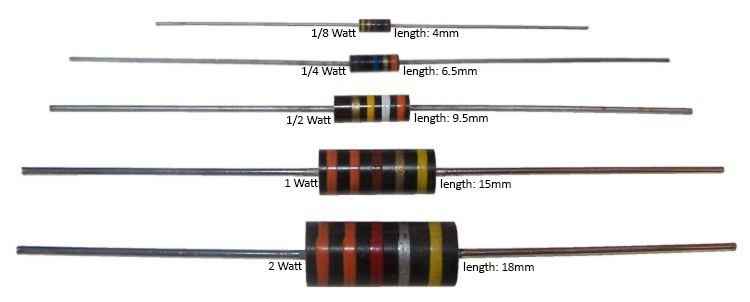
Look at the physical size of the 3 ohm resistors, and compare them to ones they used that are marked "1/2 watt". If they look to be the same physical size, they are probably 1/2 watt. If they are larger, they are probably 1 watt. "New standards" dictate that a ww resistor should have the first color band double the size of the rest.
Questions---Why are you axking this--are you planning to change them--and why bother, if they measure 3 ohms ?
Ron Rich
Re: Values Not Provided
Posted: Mon Feb 02, 2015 6:01 pm
by ds100h
Thanks Ron & Ken. My thought on the resistors is that since I am ordering capacitors and resistors are so cheap, I would pick up a set of resistors just in case any are bad, then I would not end up pay two shipping charges. Can't hurt having spare parts available

Best
Darrell
Re: Values Not Provided
Posted: Mon Feb 02, 2015 6:34 pm
by Ron Rich
Darrell,
Just measure them first--resistors in the WSR, other then the one (100 ohm--I think) on the tube, rarely fail----
Hint: I like to use a 1/2 watt carbon resistor there as a fuse--saves the coil from burning should the stepper ever "stick"--
Ron Rich
Re: Values Not Provided
Posted: Tue Feb 03, 2015 6:04 pm
by mdmccool
Hi Darrell-
Maybe this chart will help. Keep in mind there will be physical size variations between manufacturers as there was no size standard, but it should get you in the ball park. Wire-wound resistors were often used in power supplies and voltage divider networks and are usually capable of handling more power, generally for applications requiring 5 or more watt values. Keep in mind though, that it is the value and wattage that are important, not necessarily the physical construction. If a circuit shows a 300 ohm 5 watt W.W. resistor and you have a 300 ohm 5 watt metal film resistor, you'll be fine.
In most of my recent projects, I am finding that about 75% of these old carbon composition resistors measure well over their stated tolerance value and warrant replacement. Gone are the days of just a recap.
Hope all is well,
Matt
Re: Values Not Provided
Posted: Wed Feb 04, 2015 12:17 am
by ds100h
Matt
That is very helpful, thank you.
Best
Darrell
Re: Values Not Provided
Posted: Wed Feb 04, 2015 5:25 am
by ds100h
If all resistors looked like the ones in the picture that Matt shared life would be simple. This 3 Ohm resistor is about 1 3/4 inchs in length. Any way to guess what would the wattage be on this resistor?
Best
Darrell
Re: Values Not Provided
Posted: Wed Feb 04, 2015 5:42 am
by Rob-NYC
That 3-ohm will be 10 watt. It, and other wire-wound types seldom need replacement. They are either open or good.
Rob/NYC
Re: Values Not Provided
Posted: Wed Feb 04, 2015 5:45 am
by Ron Rich
Darrell,
If on the CCU connector, it's a 4 watt resistor--Ron Rich
Re: Values Not Provided
Posted: Wed Feb 04, 2015 8:23 am
by MattTech
mdmccool wrote: I am finding that about 75% of these old carbon composition resistors measure well over their stated tolerance value and warrant replacement. Gone are the days of just a recap.
Hope all is well,
Matt
LOL!
The
"RECAP" rage started by someone, somewhere, and proliferated wildly over the internet, amused me, but more importantly irritated me, due to its largely non-professional implimentation in repairing electronics.
It also interfered with my dealings with a couple of customers, them believing that "it's something simple - so I don't want to pay a lot" for services.
These internet-keen individuals sourced out actual costs of these miracle devices, and attempted to clamp my fees, which only led them out my shop door for their ignorance.
Good riddance, I don't need the aggrevation.
Having said that, there's always been a lot more to successful servicing, and going way beyond mere capacitors, resistors, and such, the job itself requires skills and education rarely talked about, but strongly ignored, due to its complexity and depth.
For the internet's masses, it's just too bothersome to deal with, and arguments of its worthiness are often challenged.
So the "DIY" crowd will continue to make those stupid mistakes, and rely on others across a screen who know just as little, to haphazardly inch through a project and endless pages of endless threads, and hope they get lucky.
I put the gas in the gas tank before I expected the car to start and get me somewhere.