Hello
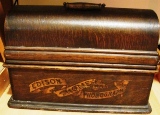
I am new to this site, I have been trying to research a Thomas Edison Home Phonograph I found in my grandmother's attic. I have found a little bit of information but not enough. I know it is a model C and I can read most of the serial number but that's about it. I am still searching the attic for the original horn but at this time have not aquired it. The label on the front is clearly ledgable but has some fading possibly just dirty. I know that it works because I pushed a lever and it started running. Here is what I would like to know, if anyone is willing to help. I would like to know if I should clean it and if so, what should I use to do so? The inside of the box is pretty dirty also, can this be taken apart and cleaned? Are there instruction manuals on the operation of this piece? I don't know what the value of this is and would like to know what it would be worth in it's current state compared to having it restored. Lastly, there are dozens of old records still in the attic but there is also another console type phonograph in the attic, did this machine play the records or would those belong to the other machine? Thank you in advance for any information you can give me!!

Phonograph find!
Q&A about Talking Machines from the pre-electronic era (approx. 1885-1928).
-
katschultz
Topic author - Junior Member
- Posts: 3
- Joined: Mon May 12, 2008 3:13 am
Hi.
What you actually have is an Edison "home" model A. The model C is the reproducer used to play 2 minute wax cylinders. Here's a link to an on-line instruction manual. You should be able to print it out.
http://nipperhead.com/old/ed_home.htm
Here's another link to some info on cleaning, lubricating & maintaining your phonograph. The model shown is the smaller Standard, but will apply to your Home as well.
http://www.intertique.com/EdisonPhonographRepair.html
The Model A Home was introduced in the form you have, in 1901, and were made until the end of 1905 when the model B replaced it.
Being in a different country to you, I can't really advise on the value, but if you keep an eye on ebay, it should give an idea as to the value where you live. The model A originally only played 2 minute records, but in 1908 4 minute records became available, and kits were sold to convert 2 min only machines to 2 & 4 min. Machines that play both cylinders are more valuable, but also need a Model H reproducer to play 4 minute cylinders.
There's a product available at auto stores in the USA called Gojo, which many collectors use to clean both the cabinet & works on these old machines. You need to get the non-pumice gojo, and simply rub it onto the cabinet using your hand, and wipe it off with paper towels. Once the cabinet & upper works are clean, you just give it a coat of furniture wax, and it should look as good as new.
You will need to lubricate the motor, which should be covered in the above link, but it's probably a good idea to have the mainspring regreased, as dried old grease can cause the spring to break. You might like to contact George Vollema of Great Lakes Antique Phonographs to have this done. He's got a great rep amongst collectors, and his charges are more than reasonable.
http://www.victroladoctor.com/
Update:
Actually, looking at the picture again, I think it may be an early model B.
The early model A's had the banner decal on the lid. In 1901, a new cabinet design was introduced, and the decal was moved from the lid to the front of the cabinet as on yours. At the same time, these new cabinets were finished in a colour called green oak. The wood had a very yellow look to it, with a slightly green tinge, almost as if the grain had been filled with green paint.
When the Model B was introduced at the end of 1905, the main difference was the colour of the cabinet & the decal. The cabinets were finished in "Antique Oak", which is the colour of your cabinet. Half way through 1906, the large banner transfer was replaced by a small "Edison" decal, like the one pictured below on my 1907 Edison Home model B.

What you actually have is an Edison "home" model A. The model C is the reproducer used to play 2 minute wax cylinders. Here's a link to an on-line instruction manual. You should be able to print it out.
http://nipperhead.com/old/ed_home.htm
Here's another link to some info on cleaning, lubricating & maintaining your phonograph. The model shown is the smaller Standard, but will apply to your Home as well.
http://www.intertique.com/EdisonPhonographRepair.html
The Model A Home was introduced in the form you have, in 1901, and were made until the end of 1905 when the model B replaced it.
Being in a different country to you, I can't really advise on the value, but if you keep an eye on ebay, it should give an idea as to the value where you live. The model A originally only played 2 minute records, but in 1908 4 minute records became available, and kits were sold to convert 2 min only machines to 2 & 4 min. Machines that play both cylinders are more valuable, but also need a Model H reproducer to play 4 minute cylinders.
There's a product available at auto stores in the USA called Gojo, which many collectors use to clean both the cabinet & works on these old machines. You need to get the non-pumice gojo, and simply rub it onto the cabinet using your hand, and wipe it off with paper towels. Once the cabinet & upper works are clean, you just give it a coat of furniture wax, and it should look as good as new.
You will need to lubricate the motor, which should be covered in the above link, but it's probably a good idea to have the mainspring regreased, as dried old grease can cause the spring to break. You might like to contact George Vollema of Great Lakes Antique Phonographs to have this done. He's got a great rep amongst collectors, and his charges are more than reasonable.
http://www.victroladoctor.com/
Update:
Actually, looking at the picture again, I think it may be an early model B.
The early model A's had the banner decal on the lid. In 1901, a new cabinet design was introduced, and the decal was moved from the lid to the front of the cabinet as on yours. At the same time, these new cabinets were finished in a colour called green oak. The wood had a very yellow look to it, with a slightly green tinge, almost as if the grain had been filled with green paint.
When the Model B was introduced at the end of 1905, the main difference was the colour of the cabinet & the decal. The cabinets were finished in "Antique Oak", which is the colour of your cabinet. Half way through 1906, the large banner transfer was replaced by a small "Edison" decal, like the one pictured below on my 1907 Edison Home model B.
-
schultz
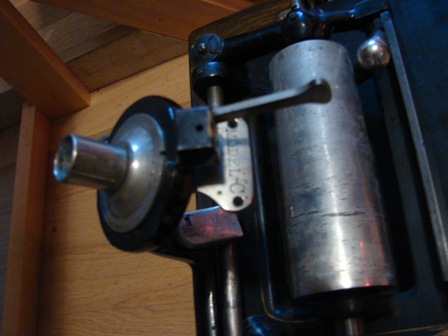
Thanks for your advice and links. I will look thru what you have sent and hopefully be able to utilize the info. As far as the model goes, it actually says Model C on it so I hope that is helpful.
No worries.
Just wondering- Where does it say Model C?
Just wondering- Where does it say Model C?
-
katschultz
Topic author - Junior Member
- Posts: 3
- Joined: Mon May 12, 2008 3:13 am
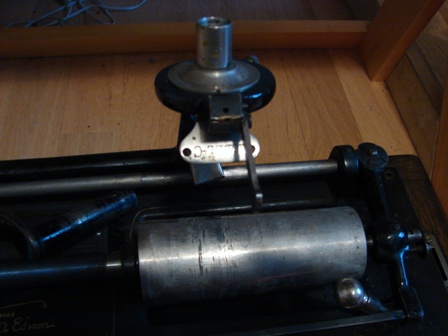
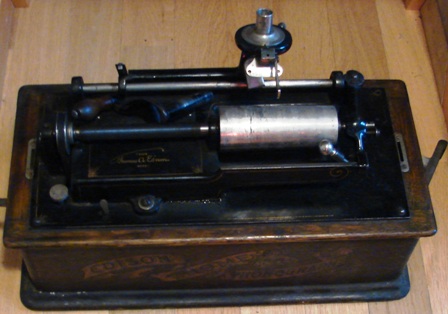
I am attaching some pictures of what I am talking about and hopefully you will be able to see it.
- Attachments
-
- phonograph 008.jpg (39.67 KiB) Viewed 2534 times
-
- phonograph 001.jpg (45.02 KiB) Viewed 2526 times
-
- phonograph 007.jpg (47.9 KiB) Viewed 2522 times
Ahh.. That's the Model C reproducer, used to play 2 minute wax cylinders.
Here's a picture of a couple of mine.
The first one is the same as yours, which has Model C printed on the "fish tail weight", and the two holes drilled in it. These holes later disappeared (I think during 1907?), and were originally meant to enable more small weights to be added, but I've never seen one with the extra weights.
The second one, without the F/T weight, is a recorder & not a reproducer. You could buy blank wax cylinders, and make your own recordings at home with one of these.
The third is a Model H reproducer. These came out in 1908 when Edison started making 4 minute wax cylinders. The grooves were half as wide as those on a 2 min cylinder, and required a stylus/needle half the size of the Model C's. Convertion kits were made available to convert 2 minute machines, to play both 2 & 4 minute records by altering the gearing, so the reproducer could move across the record at half the speed but still have the cylinder revolve at 160rpm. The Model H reproducer was included in this kit.

So, your machine is a Model A, with a model C reproducer.
It's definately a model A, because it has the speed control knob at the front left hand corner. This knob was no longer used on the Model B range, because the speed control was then only accessible from the underside of the bed plate with the motor (thats what the black painted part that the upper works & motor attach to is called)
I must admit I'm a little confused about the colour of the cabinet. The very last of the model A's did get finished in the "antique oak" colour which the Model B's had, which yours appears to be in the first photo.
I noticed though, that in a couple photo's of the upper works you posted, the wooden bedplate frame looks like it has a few spots where the "green oak" colour is showing through.
Now, whether those areas are just where the finish has worn off, or if the machine has been refinished over the top of the Green oak colour- either by Edison or somebody at a later time, it's hard to tell from a photo. It would be much easier to determine by actually looking at the machine in person. Then again, it could just be years of furniture wax & dirt.
Something I've noticed, is that your reproducer is in upside down. The fish tail weight should be at the top, rather than at the bottom as in your pictures. If you loosen off the little screw sticking out from the black ring the reproducer sits in (at the 1 o'clock position), you can lift it out carefully, and turn it around. If you look at the round "body" of the reproducer, just above the F/T weight, you'll see a little slot cut into the edge. There's a little pin in the black ring "reproducer carriage" that fits into this slot. Once the reproducer is sitting flat in this ring with the pin in the slot, you can then tighten up the little screw to hold the reproducer securely. This is so the stylus lines up with the groove correctly, and so it can support the weight of the small witches hat horn.
In the photo's, the finish looks quite good, and if it is the original finish, I would advise against having the cabinet restored. Most serious collectors don't want machines that have been refinished. They much prefer machines to have the original finish, even if it's not perfect. A few spots of wear or light scratches etc, are perfectly acceptable for an item that's over 100 yrs old, and was probably the families main scorce of entertainment for a generation or two.
Like I said earlier, I think if you give it a good clean & wax, you will probably be surprised at how good it looks, once 100 yrs of dirt, dust, furniture polish etc etc is removed. Although you might never want to sell your family heirloom, a machine with a good original finish will always hold it's value better than one that's been refinished too..
Is there any chance of posting a picture of the console phonograph you spoke of?
Is it a cylinder or disc phonograph?
Here's a picture of a couple of mine.
The first one is the same as yours, which has Model C printed on the "fish tail weight", and the two holes drilled in it. These holes later disappeared (I think during 1907?), and were originally meant to enable more small weights to be added, but I've never seen one with the extra weights.
The second one, without the F/T weight, is a recorder & not a reproducer. You could buy blank wax cylinders, and make your own recordings at home with one of these.
The third is a Model H reproducer. These came out in 1908 when Edison started making 4 minute wax cylinders. The grooves were half as wide as those on a 2 min cylinder, and required a stylus/needle half the size of the Model C's. Convertion kits were made available to convert 2 minute machines, to play both 2 & 4 minute records by altering the gearing, so the reproducer could move across the record at half the speed but still have the cylinder revolve at 160rpm. The Model H reproducer was included in this kit.
So, your machine is a Model A, with a model C reproducer.
It's definately a model A, because it has the speed control knob at the front left hand corner. This knob was no longer used on the Model B range, because the speed control was then only accessible from the underside of the bed plate with the motor (thats what the black painted part that the upper works & motor attach to is called)
I must admit I'm a little confused about the colour of the cabinet. The very last of the model A's did get finished in the "antique oak" colour which the Model B's had, which yours appears to be in the first photo.
I noticed though, that in a couple photo's of the upper works you posted, the wooden bedplate frame looks like it has a few spots where the "green oak" colour is showing through.
Now, whether those areas are just where the finish has worn off, or if the machine has been refinished over the top of the Green oak colour- either by Edison or somebody at a later time, it's hard to tell from a photo. It would be much easier to determine by actually looking at the machine in person. Then again, it could just be years of furniture wax & dirt.
Something I've noticed, is that your reproducer is in upside down. The fish tail weight should be at the top, rather than at the bottom as in your pictures. If you loosen off the little screw sticking out from the black ring the reproducer sits in (at the 1 o'clock position), you can lift it out carefully, and turn it around. If you look at the round "body" of the reproducer, just above the F/T weight, you'll see a little slot cut into the edge. There's a little pin in the black ring "reproducer carriage" that fits into this slot. Once the reproducer is sitting flat in this ring with the pin in the slot, you can then tighten up the little screw to hold the reproducer securely. This is so the stylus lines up with the groove correctly, and so it can support the weight of the small witches hat horn.
In the photo's, the finish looks quite good, and if it is the original finish, I would advise against having the cabinet restored. Most serious collectors don't want machines that have been refinished. They much prefer machines to have the original finish, even if it's not perfect. A few spots of wear or light scratches etc, are perfectly acceptable for an item that's over 100 yrs old, and was probably the families main scorce of entertainment for a generation or two.
Like I said earlier, I think if you give it a good clean & wax, you will probably be surprised at how good it looks, once 100 yrs of dirt, dust, furniture polish etc etc is removed. Although you might never want to sell your family heirloom, a machine with a good original finish will always hold it's value better than one that's been refinished too..
Is there any chance of posting a picture of the console phonograph you spoke of?
Is it a cylinder or disc phonograph?
-
schultz
OOOOHHH, ok this is all so confusing but I think I am getting it.
Regarding the "fish tail weight", I have done nothing more than take the lid off to look at it and I accidentally pushed a lever and it started spinning but that's about it. That's one of the reasons I was in need of a manual. As for the color, yes it is "green oak" throughout the entire piece including the handle. This also made me think that somehow it was a model C because I could not find model A with the "green oak". Do you think this could just be a really late production or something else? I know that pictures aren't as good as the real thing in your hand but so far you have been the only person interested in talking to me about it, too bad you are in Australia. I did search EBAY and a few other sites, and found out my treasure isn't as valuable as I had thought or hoped ($500-$600 US dollars) but restored with an original horn could be worth $1500; strange I think. As for the phonograph console, it is still in my grandmother's attic and I don't remember what kind it is, I will have to take a look and some pictures the next time I am there, I do know that it played discs and there are probably over 100 sitting next to it, 99% of them are in a book that was made to hold the records. The records aren't like the vinyl one's I remember, they are really thick and don't seem to be hardly scratched, except for the one's not in a book. Anyway, the console model is also a crank type but just like the Edison, there is no horn to be found. I will keep looking, hopefully one will turn up. Thanks again for all of you effort in helping me, I do appreciate that. I do not plan on selling my phonograph, I would like to have it displayed in my sitting room with a few other pieces from that era that I have aquired. It's funny, now that I am older, I find myself facinated with my granmother's old things; but to find something that was already 70 years old when I was born is amazing!! Not to mention that it still works!!! I really doubt that my XBOX still works when it's over 100 years old, haha!
Regarding the "fish tail weight", I have done nothing more than take the lid off to look at it and I accidentally pushed a lever and it started spinning but that's about it. That's one of the reasons I was in need of a manual. As for the color, yes it is "green oak" throughout the entire piece including the handle. This also made me think that somehow it was a model C because I could not find model A with the "green oak". Do you think this could just be a really late production or something else? I know that pictures aren't as good as the real thing in your hand but so far you have been the only person interested in talking to me about it, too bad you are in Australia. I did search EBAY and a few other sites, and found out my treasure isn't as valuable as I had thought or hoped ($500-$600 US dollars) but restored with an original horn could be worth $1500; strange I think. As for the phonograph console, it is still in my grandmother's attic and I don't remember what kind it is, I will have to take a look and some pictures the next time I am there, I do know that it played discs and there are probably over 100 sitting next to it, 99% of them are in a book that was made to hold the records. The records aren't like the vinyl one's I remember, they are really thick and don't seem to be hardly scratched, except for the one's not in a book. Anyway, the console model is also a crank type but just like the Edison, there is no horn to be found. I will keep looking, hopefully one will turn up. Thanks again for all of you effort in helping me, I do appreciate that. I do not plan on selling my phonograph, I would like to have it displayed in my sitting room with a few other pieces from that era that I have aquired. It's funny, now that I am older, I find myself facinated with my granmother's old things; but to find something that was already 70 years old when I was born is amazing!! Not to mention that it still works!!! I really doubt that my XBOX still works when it's over 100 years old, haha!
Who is online
Users browsing this forum: No registered users and 1 guest
It is currently Thu Oct 06, 2016 12:24 pm
