Hello. I am a new jukebox collector. I have a Wurlitzer 412 and a Seeburg 100G. I recently bought one of the 3W1 remote units (5cent model). When I place a nickel in it shows 1 credit (green light) but doesn't credit the 100g and after I make the selection the motor runs and selection wheel seems to operate properly, but doesn't trigger the stepper relay in the selector unit at the 100G. Is it possible that it is because the 3W1 I bought is the 5 cent model and my juke is a 10cent per play model? Do I need to purchase a 3W1-D? I am fairly certain it is wired properly.
Any help is greatly appreciated.
Thank you.
-Tony

Using a Seeburg 3W1 Select-O-Matic with
Q&A about all types of jukeboxes: Wurlitzer, Seeburg, Rock-Ola, AMI, and more.
-
Color jockey
Topic author - Regular Member
- Posts: 42
- Joined: Mon Nov 25, 2013 9:22 am
- Location: Los Angeles, California, USA
Tony, credit is done locally at the machine or wallbox. Credit on the wallbox will not show up on the mechine.
The pricing on the wallbox has nothing to do with the machine pricing and can be changed by moving the position or wiring of the credit coils in the wallbox.
Has the stepper been serviced?
Is there a 2050 tube in the socket?
I wrote this for the 200 boxes, but it is mostly applicable to the 100s as well:
The first step is to determine whether the wallbox or stepper is at-fault.
Testing the 200 select wallbox is easy. Disconnect it from the machine. Connect you ohmmeter from the chassis ground screw and the -blue- signal screw. Then, with no buttons pressed, turn the wiper by hand and note that you see a low-no resistance connection at each rivet on the wafer as the arm passes over it.
Ideally there should not be more than a few ohms measured at any rivet, but the system is reasonably forgiving and even several dozen ohms will be OK IF the stepper itself is working well.
Stepper: First order of business is to make sure you have a good 2050 tube. Look at the top inside of the tube, in the area around the cathode (orange glow) you should see a deep violet aura when you touch the signal wire to chassis ground. Pale, sky blue indicate a weak tube.
Check the 100 ohm resistor on the tube plate circuit. Be sure that the large 5mfd capacitor in the 2050 plate circuit has been replaced.
Take a small flat blade screwdriver and use it to move the stepper wheels. They should easily snap back to their "home" positions from any point when released. A drop of light oil on the bearing shaft of each stepper may loosen them up, if not, the contact wafers will have to be remove and tarnish removed from the contacts with a non-abrasive polish. The wafer must then be realigned with the contact wiper when reassembled.
Gently press down on the edge of each stepper "clapper" to the point where the toggle is not touching either the wheel teeth nor the top of the slot. While holding it there gently move the toggle from side-to-side and be sure it instantly snaps back. These steppers are rated to be accurate at a pulse width of 1/100th of a second. Seeburg operates them at 1/25th so there is ample headroom, however all parts must be free moving.
When diagnosing the stepper is is important to note if the miscount occurs only in one stepper wheel -or both. Does it sometimes play a higher letter-number? this indicates that the wheels are gummy and not homing. Or does it always err on the low side by selecting a lower letter or number.
Beyond these tests and measures requires a bit more skill and some common sense -it is easy to make a mess of a stepper by tinkering. You'll need to assess your abilities to deal with a somewhat delicate electro-mechanical device, or turn it over to someone else. The good news is that once properly serviced, steppers are quite reliable and likely wont need attention for many years. I have nine old Seeburgs with a total of 93 V3W wallboxes and another 21 Rowe AMI wallboxes in two other places. While I'm not wild about still using steppers in 2014, if properly serviced they are quite reliable -even in heavy service.
Rob/NYC
The pricing on the wallbox has nothing to do with the machine pricing and can be changed by moving the position or wiring of the credit coils in the wallbox.
Has the stepper been serviced?
Is there a 2050 tube in the socket?
I wrote this for the 200 boxes, but it is mostly applicable to the 100s as well:
The first step is to determine whether the wallbox or stepper is at-fault.
Testing the 200 select wallbox is easy. Disconnect it from the machine. Connect you ohmmeter from the chassis ground screw and the -blue- signal screw. Then, with no buttons pressed, turn the wiper by hand and note that you see a low-no resistance connection at each rivet on the wafer as the arm passes over it.
Ideally there should not be more than a few ohms measured at any rivet, but the system is reasonably forgiving and even several dozen ohms will be OK IF the stepper itself is working well.
Stepper: First order of business is to make sure you have a good 2050 tube. Look at the top inside of the tube, in the area around the cathode (orange glow) you should see a deep violet aura when you touch the signal wire to chassis ground. Pale, sky blue indicate a weak tube.
Check the 100 ohm resistor on the tube plate circuit. Be sure that the large 5mfd capacitor in the 2050 plate circuit has been replaced.
Take a small flat blade screwdriver and use it to move the stepper wheels. They should easily snap back to their "home" positions from any point when released. A drop of light oil on the bearing shaft of each stepper may loosen them up, if not, the contact wafers will have to be remove and tarnish removed from the contacts with a non-abrasive polish. The wafer must then be realigned with the contact wiper when reassembled.
Gently press down on the edge of each stepper "clapper" to the point where the toggle is not touching either the wheel teeth nor the top of the slot. While holding it there gently move the toggle from side-to-side and be sure it instantly snaps back. These steppers are rated to be accurate at a pulse width of 1/100th of a second. Seeburg operates them at 1/25th so there is ample headroom, however all parts must be free moving.
When diagnosing the stepper is is important to note if the miscount occurs only in one stepper wheel -or both. Does it sometimes play a higher letter-number? this indicates that the wheels are gummy and not homing. Or does it always err on the low side by selecting a lower letter or number.
Beyond these tests and measures requires a bit more skill and some common sense -it is easy to make a mess of a stepper by tinkering. You'll need to assess your abilities to deal with a somewhat delicate electro-mechanical device, or turn it over to someone else. The good news is that once properly serviced, steppers are quite reliable and likely wont need attention for many years. I have nine old Seeburgs with a total of 93 V3W wallboxes and another 21 Rowe AMI wallboxes in two other places. While I'm not wild about still using steppers in 2014, if properly serviced they are quite reliable -even in heavy service.
Rob/NYC
"If we believe absurdities, we shall commit atrocities" -- Voltaire
-
Color jockey
Topic author - Regular Member
- Posts: 42
- Joined: Mon Nov 25, 2013 9:22 am
- Location: Los Angeles, California, USA
Thank you! That is very helpful. Have you ever heard of using cat5E Ethernet cable to connect a 3W1 to the jukebox? The only way I have to connect the two units is to use the existing Ethernet cable run through my house. The cable has 8 24 gauge wires twisted in pairs. I figure I can untwist 1 pair and that leave me 3 24 gauge wires for the 25V power, 3 wires for the ground, and the last 2 twisted wires for the ground (trigger wire). Do you think is could be acceptable? I did a test and it powers up the 3W1 without a problem, although it does dim the lights when the motor runs and a nickel is inserted. Or is that normal for the lights to dim when a selection is made? (About 30% dim)
Thanks again!
-Tony
Thanks again!
-Tony
Hello Tony,
It is ok to run a multicore cable for signal cables but use a heavy duty cable for the power supply to the wall box, we used to use a minimum of 1.5 mm2 cable to supply our wallboxes.
Regards
Alan
It is ok to run a multicore cable for signal cables but use a heavy duty cable for the power supply to the wall box, we used to use a minimum of 1.5 mm2 cable to supply our wallboxes.
Regards
Alan
-
Ron Rich
- Forum Moderator
- Posts: 8193
- Joined: Sun May 06, 2007 11:31 pm
- Location: Millbrae (San Francisco area)CA, USA
Hi Tony,
Seeburg sold "wall-box wire" that was two, 16 gauge, stranded, for power/ground, and one 18 ga. for signal. This was deemed adequate for 100 feet, and up to six WOM's. Some "dimming" of the lamps is normal, mostly at coin drop, and then again at motor start, and end of run. I would consider 30 % excessive--however--do you have the correct lamps installed (If you purchased a used "Johnny Rockets" unit, all bets are off, as they "modified" the lamp [and coin} system) ?--have you correctly lubricated the WOM ? Both
can cause lamp dimming. Ron Rich
Seeburg sold "wall-box wire" that was two, 16 gauge, stranded, for power/ground, and one 18 ga. for signal. This was deemed adequate for 100 feet, and up to six WOM's. Some "dimming" of the lamps is normal, mostly at coin drop, and then again at motor start, and end of run. I would consider 30 % excessive--however--do you have the correct lamps installed (If you purchased a used "Johnny Rockets" unit, all bets are off, as they "modified" the lamp [and coin} system) ?--have you correctly lubricated the WOM ? Both
can cause lamp dimming. Ron Rich
-
cutter
- Regular Member
- Posts: 36
- Joined: Tue Sep 10, 2013 4:01 am
- Location: Winnipeg, Manitoba Canada
I bought 40 ft of 5 lead18 gauge to connect my 3W1 to a 100C. I got this at my local Home Depot here in Canada. I use the extra to leads to wire in a remote reject switch.
-
Color jockey
Topic author - Regular Member
- Posts: 42
- Joined: Mon Nov 25, 2013 9:22 am
- Location: Los Angeles, California, USA
More great info. I am not sure where it came from. But there is a small wire nut on the selector wires. It looks like 1 orange wire tied to 2 blue wires. Any idea what they are for? The credit function operates normally. After dropping a nickel in, 1 credit is applied (green light goes on). After 1 play another coin must be added…
-Tony
-Tony
-
Ron Rich
- Forum Moderator
- Posts: 8193
- Joined: Sun May 06, 2007 11:31 pm
- Location: Millbrae (San Francisco area)CA, USA
Cutter,
18 gauge is fine if you have only one, WOM, under 100 feet, away from the phonograph--Be sure that the screw in 3.2 amp "safety fuse" is 3.2 amps or lower--I suggest a 2 amp would be too large a size--
18 gauge is fine if you have only one, WOM, under 100 feet, away from the phonograph--Be sure that the screw in 3.2 amp "safety fuse" is 3.2 amps or lower--I suggest a 2 amp would be too large a size--
-
Ron Rich
- Forum Moderator
- Posts: 8193
- Joined: Sun May 06, 2007 11:31 pm
- Location: Millbrae (San Francisco area)CA, USA
Hi Tony,
Well, if it has been re-worked for "nickels only", I can guar-an-tee it was used in a JR or similar place !
Yep--those require that all selections be played after depositing a coin--should "say so" in large letters, below the title strips !
As for the wiring--Who knowz ?? Did you purchase the service manual for it ?? Ron Rich
Well, if it has been re-worked for "nickels only", I can guar-an-tee it was used in a JR or similar place !
Yep--those require that all selections be played after depositing a coin--should "say so" in large letters, below the title strips !
As for the wiring--Who knowz ?? Did you purchase the service manual for it ?? Ron Rich
-
Color jockey
Topic author - Regular Member
- Posts: 42
- Joined: Mon Nov 25, 2013 9:22 am
- Location: Los Angeles, California, USA
Ron,
It hasn't been changed to a nickel it always was. It's a 3W1 not 3W1-D
-Tony
It hasn't been changed to a nickel it always was. It's a 3W1 not 3W1-D
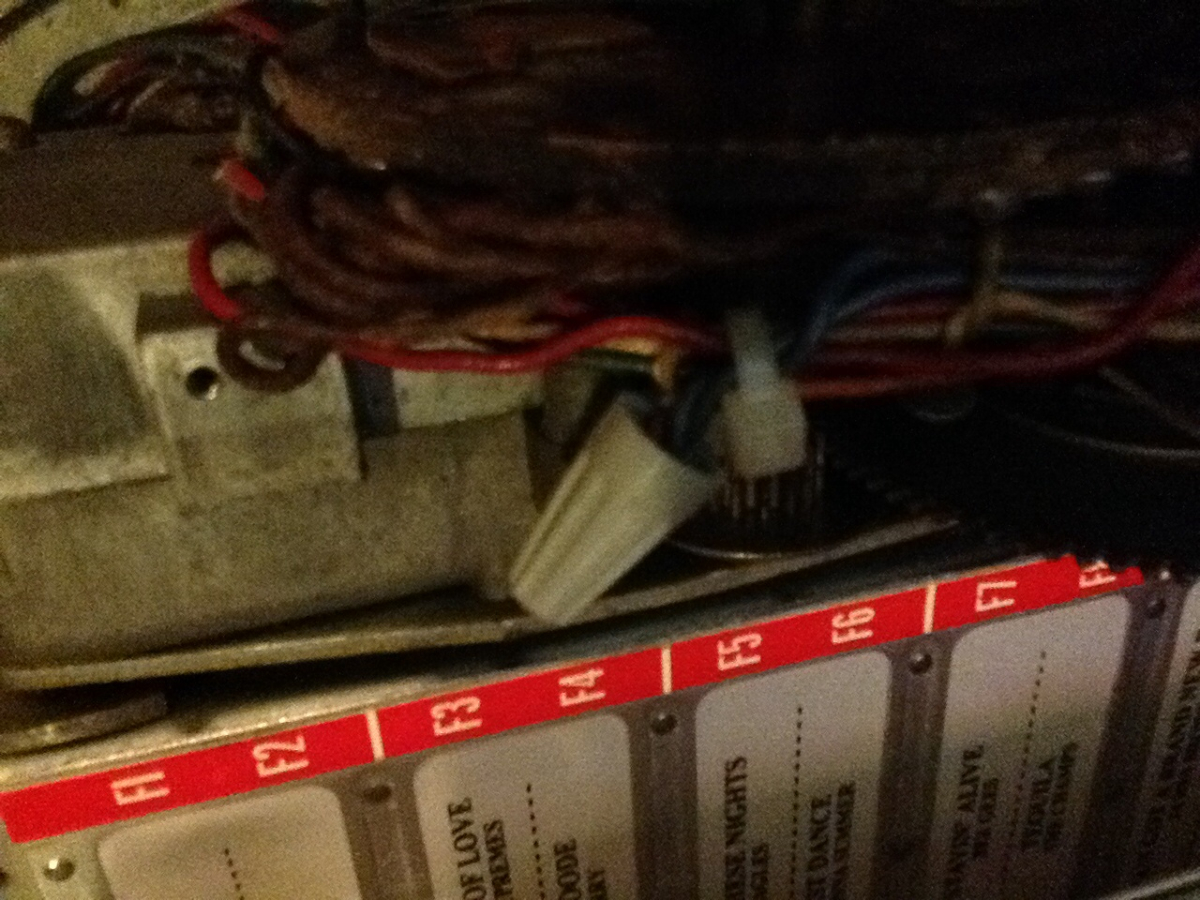
- image.jpg (835.98 KiB) Viewed 456 times
-Tony
-
Ron Rich
- Forum Moderator
- Posts: 8193
- Joined: Sun May 06, 2007 11:31 pm
- Location: Millbrae (San Francisco area)CA, USA
Hi Tony,
I understand that--however, do dimes/quarters work ?? If so, it's NOT a JR mod--
As for that wire--can't see it well enough to determine anything---
Ron Rich
I understand that--however, do dimes/quarters work ?? If so, it's NOT a JR mod--
As for that wire--can't see it well enough to determine anything---
Ron Rich
-
Color jockey
Topic author - Regular Member
- Posts: 42
- Joined: Mon Nov 25, 2013 9:22 am
- Location: Los Angeles, California, USA
Upon further inspection I noticed that the wires tied together are two blue wires that lead back to the letter/number key pad, they are tied to a third wire that is grounded behind the stepper selection wheel. Does anyone have a clue what this would be done for? It doesn't have free play, a nickel must be dropped into the coin slot to receive credits (make stepper motor/wheel rotate). To fill everyone in, my problem is that my new 3W1 doesn't trigger my Seeburg 100G juke box. The juke is in excellent condition and has been restored with the stepper/selector unit installed with a glowing 2050 tube. But when the 3W1 selections are made the 2050 tune doesn't seem to be triggered (no change/flicker).
Any help would be great!
Thanks again.
-Tony
Any help would be great!
Thanks again.
-Tony
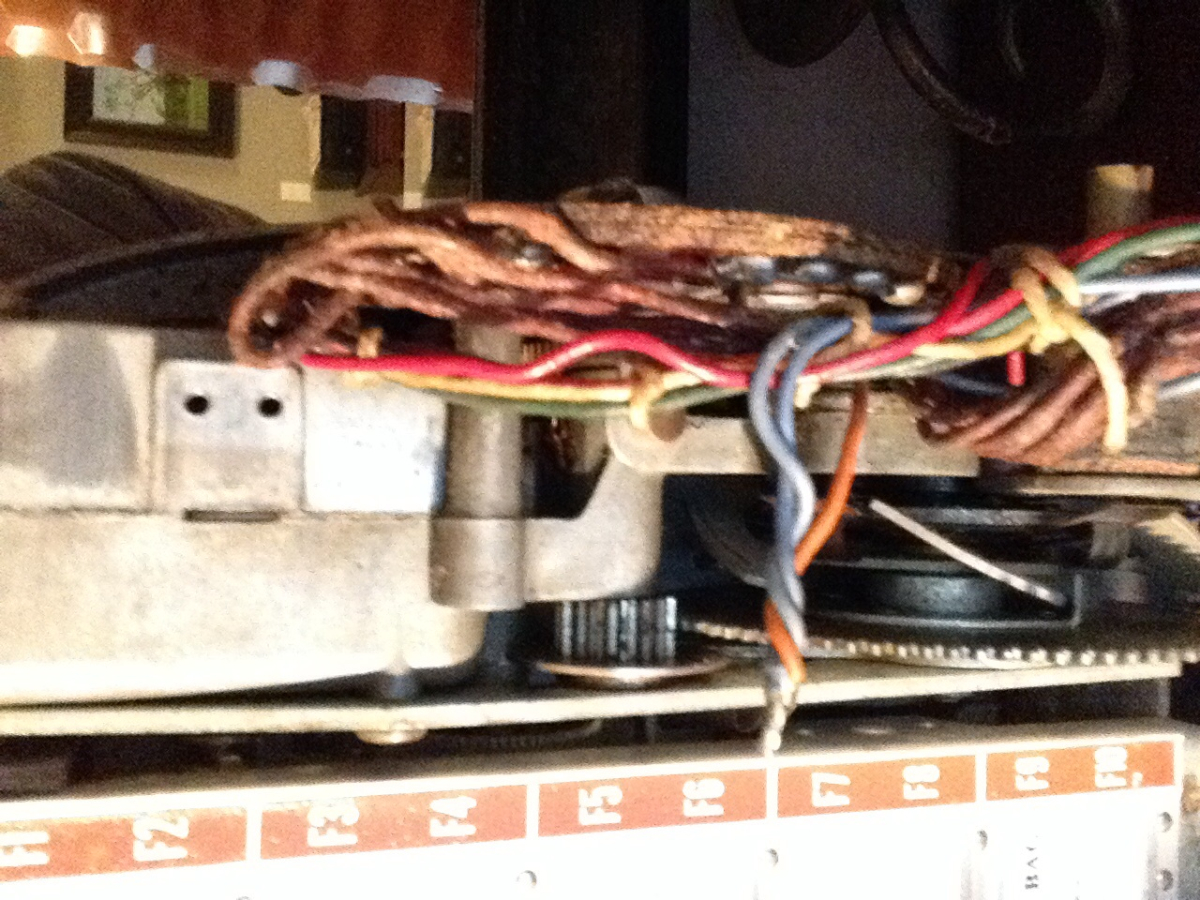
- image.jpg (956.27 KiB) Viewed 454 times
-
Ron Rich
- Forum Moderator
- Posts: 8193
- Joined: Sun May 06, 2007 11:31 pm
- Location: Millbrae (San Francisco area)CA, USA
Tony,
Go back to Rob NYC's earlier post here which tells you how to trouble shoot this problem--
Once again--Got the Service Manual ? It contains schematics, which if read, should tell you what those wires are connected to, and thus allow someone to figure out what someone else attempted there, as it is certainly does not appear to be a factory design ?
Again--do dimes and quarters function if dropped into the coin slot ?? Ron Rich
Go back to Rob NYC's earlier post here which tells you how to trouble shoot this problem--
Once again--Got the Service Manual ? It contains schematics, which if read, should tell you what those wires are connected to, and thus allow someone to figure out what someone else attempted there, as it is certainly does not appear to be a factory design ?
Again--do dimes and quarters function if dropped into the coin slot ?? Ron Rich
-
Color jockey
Topic author - Regular Member
- Posts: 42
- Joined: Mon Nov 25, 2013 9:22 am
- Location: Los Angeles, California, USA
I have ordered the manual. Still in the mail. Dimes and quarters get rejected. Seems to be a true 5c model 3W1.
Thanks.
-Tony
Thanks.
-Tony
-
Ron Rich
- Forum Moderator
- Posts: 8193
- Joined: Sun May 06, 2007 11:31 pm
- Location: Millbrae (San Francisco area)CA, USA
Nope--iffin it refuses dimes and quarters, it has been modified, as EVERY 3W-1 originally accepted them--The 3W-1 D, was set for "Dime play", as the lowest possible amount of money it need for 1 selection--They still accepted Nickels, but one needed to deposit two Nickels, rather then just one, in order to light the "select lamp". Original 3W-1 coin instruction glass showed "1 selection =Nickel, 2 selections =dime, 5 (or 6) selections -quarter 3W-1D glass showed 1 selection Dime, or 2 nickels, 3 selections-quarter Other pricing glass was available--Ron Rich
Who is online
Users browsing this forum: Yahoo [Bot] and 5 guests
It is currently Thu Oct 06, 2016 8:53 am