Page 1 of 1

Attn: Steve -- "Western Electric" horns

Posted: Wed Aug 16, 2006 4:13 pm
by Joe_DS
Hi Steve:

I spotted your question on the OTVMMB regarding Western Electric designed horns. In a nutshell, both the exponential "straight horn", and the folded horn were designed by Western Electric (under Bell Labs). Initially--late 1925--Victor offered only these two styles for their Orthophonic line; the straight horn being used in the smaller models -- the Consolette (4-3), the Colony (4-5), and the Granada (4-4); the large, six foot folded horn was used in the Credenza (8-1; later 8-30).


The folded horn that made it's way to the (production version of the) Credenza was based on the prototype designed by Bell Labs. It was slightly modified in that the cast-iron "elbow" was moved to the back of the cabinet, rather than running through the horn's chamber, as in this illustration:

Image
(Prototype Horn -- note, the old style tone arm and sound-box in the illustration.)
FROM -- http://history.sandiego.edu/gen/recording/ortho.html
ALSO SEE -- SOUND RECORDING AT BELL LABS -- http://history.sandiego.edu/gen/recordi ... -labs.html

In 1926, the line was expanded and more models were introduced incorporating folded horns of various sizes. As one example, the 8-4 was introduced that year and fitted with a horn 3/4 the size of the Credenza's, but following the same "fold" pattern.

HTH
Joe_DS

Posted: Thu Aug 17, 2006 5:12 pm
by STEVE
Hi Joe_DS

Many thanks for answering this!

I couldn't really get to the bottom of it on the other site with some people saying it was only the straight horns, others saying folded etc. So it was for both....

The one thing that has always confused me about the various Victor Ortho' models is that there didn't appear to be a lot of consistency in the horn designs. For instance HMV (Gramophone Co.) solely produced one horn design in terne-plate but made it in 3 different sizes for 163 (smallest), 193 (middle) and 202 (largest). Easy, simple to follow. But Victor has horns in gumwood AND metal. It has straight "Ortho'" horns, folded ones, horns of differing angles and configurations, tighter folded horns etc etc.

When I hear someone mention a particular model, I haven't a clue as to what to expect the internal horn to be like!

I've also noticed that the Japanese don't appear to want the Victor models as much as the HMV equivalents? Why is that?

I'll look at the links you've provided now.

Thanks again for your very clear, straightforward and unequivocal answer.

ATB

Steve :wink:

Orthophonic Horn Styles...

Posted: Sun Aug 20, 2006 8:46 pm
by Joe_DS
When I hear someone mention a particular model, I haven't a clue as to what to expect the internal horn to be like!


I agree about Victor's use of various horn sizes and styles in their Orthophonic line. I've have been told, but have yet to verify, that all were designed by the engineers at Bell Labs (Western Electric).

The "Credenza style horn," which was divided into four sections joining at the mouth, and employing a horizontal "heart-shaped" chamber, was used mostly in the larger and medium size cabinet models. For instance, the 10-50/10-51 models, equipped with an automatic changer, used a larger version of the horn, measuring about eight feet long. (The standard Credenza horn was six feet in length from sound box to horn mouth.) The 8-4 was fitted with a 3/4 size version (mouth size) and was about five feet in length; while the VV-4-40's horn was smaller still, with a mouth about 1/2 the size of the Credenza's, and about 4 3/4 feet in length.

The straight horn, originally used in the Consolette (4-3), the Colony (4-5) and the Granada (4-4), was eventually relegated only to the Consolette. The Granada was fitted with a small folded horn, while the Colony was dropped from the line.

Taking the Colony's place was the 4-7, which employed a new style horn divided into two sections. This same style horn was used in many Orthophonic Victrolas such as this VE-7-25X, which recently sold on eBay:

Image


For example, a slightly smaller version of the same horn design was used in the VV-1-90 table top Orthophonic Victrola. Even the VV-4-20, which eventually replaced the 4-7, used this style horn, but in this case, it was turned on its side!

(One Orthophonic Victrola with a unique horn design was the 8-12, which Paul Edie describes on his web site --- http://www.victor-victrola.com.)


As for the metal horns, they were introduced relatively late in the Orthophonic Victrola's production life. With the exception of the 2-35 and 2-55 portables, and the rather odd 7-11 -- which used the same style tone chamber as the 2-55 for the Victrola, but an electrically driven loudspeaker for the radio -- the metal horns were used in the large cabinet models such as the 8-35 (follow on to the Credenza), the 8-9, and the 10-35 (equipped with automatic changer).

According to recent information, two types of folded metal horns may have been used for the 8-35. One for sale at this time, on eBay, is purportedly fitted with a folded horn using a vertical split; however, in two examples I've seen personally, a horizontal chamber or "heart," nearly identical to that of the Credenza's horn, was employed. In this case, though, the heart was positioned closer to the bottom of the horn, probably to extend the length of the tone passage.

In terms of volume and sound quality, the 8-35 is absolutely stunning. Though less mellow than the Credenza, the volume is greater, and the bass is every bit as rich and deep.

Posted: Tue Aug 22, 2006 11:57 am
by STEVE
hi Joe_DS

Thank you again for your detailed enthusiastic descriptions of the various models - I have now at least got some idea which model contains which horn type etc!

I did see your earlier response to my "Japanese question" but I didn't have time to respond until I looked at it again another day when I had more time. It would appear between the two dates that you have modified your reply to eradicate the bit about the RCA take over of Victor in the early 30's?

I'm sure I read something about that in your description? Or am I going barmy and seeing stuff which isn't there?

I wondered if you'd discovered something in the meantime and deleted the comment pending further research?

Thanks again!

S

Re Japanese Victrolas

Posted: Tue Aug 22, 2006 5:27 pm
by Joe_DS
I did see your earlier response to my "Japanese question" but I didn't have time to respond until I looked at it again another day when I had more time. It would appear between the two dates that you have modified your reply to eradicate the bit about the RCA take over of Victor in the early 30's?

I'm sure I read something about that in your description? Or am I going barmy and seeing stuff which isn't there?


Hi Steve:

Yes. That was my fault. Because I am an atrocious speller/typist, I always use Outlook Express's New Message box, which comes with a spelling-checker, to compose my posts.

I wanted to embellish the section concerning the various size Orthophonic horns, but when I copied the text back to the post box on this site, I accidentally omitted the "top section" of my original reply. (I didn't notice this until after I clicked on the "submit" button.)

I remember that I speculated that Japanese collectors might be drawn more to the HMV Re-Entrant models because of their quality, durability, and the fact that they are equipped with larger horns than the Orthophonic Victrolas.

Unlike a pristine HMV model, which is normally "ready to play" -- save for motor adjustments/lubrication, and perhaps a sound box tune-up -- Orthophonic Victrolas often need far more maintenance in order to restore their sonic capabilities. For instance, cracked or swelled pot metal components such as the sound box, the tone arm support, and braces and couplings used to connect the cast iron elbow to the horn, often must be repaired or replaced. In addition, the wooden horns, which were assembled out of gumwood slats and sections glued together, may need extensive repair.

And, while this may have had no impact on the international market for high performance acoustic gramophones, I did point out that the Victor company always had a strong presence in Japan, and a number of discontinued Orthophonic models were produced there after RCA took over in the US.

(Interestingly, Paul Edie has re-done his web site, and the information about the Japanese Victors no longer appears--at least I can't find it. I DID manage to locate the data from the old site using Google's cache' feature, which I've pasted here):

-----------------------------------------------------------------------------

FROM: http://www.victor-victrola.com/J1.htm
Japanese Victrolas

Victrolas with a "J1" prefix were manufactured by The Victor Talking Machine Company of Japan, Limited, and were intended for distribution and sale in the Far East. The vast majority of "J1" machines were produced in the early 1930's after Victor had been bought by RCA in the United States. Many J1 Victrolas are very similar to earlier US models, making it quite possible that some of the tooling and parts left over from discontinued US Victrola production was sent to Japan so that similar machines could be made in that country. Prior to the early 1930's, Victrolas were exported to Japan from the USA. For example, a recently discovered J1-91 appears to be nearly identical to the US VV 1-90. The cabinet has slightly different trim and carving details, but the components appear virtually identical to the US version. Serial numbers appear on the dataplate similar to their US counterparts.

Selling prices and production quantities of J1 Victrolas are not currently known. Further research is being done on these machines.

Model Serial Number Range Feature Notes
J1-35 501-?? -- Some have 1935 date
J1-40 501-?? -- Some have 1936 date
J1-50 501-?? -- Some have 1935 date
J1-51 501-?? -- Some have 1936 date
J1-60 501-?? -- Some have 1932 date
J1-71 501-?? -- Some have 1934 date
J1-80 501-?? -- Similar to VV-80. Some have 1930 date.
J1-81 501->6400 -- Similar to VV 1-90. Some have 1932 date.
J1-91 501-?? -- Some have 1932 date
J1-92 501-?? -- Some have 1935 date
J1-95 501-?? -- Some have 1938 date

Perhaps the smallest Western Electric horn...

Posted: Thu Nov 30, 2006 7:44 am
by Joe_DS
Hi Steve:

Here's a few photos culled from a Japanese collector's site of the VV-1-90, Victor's only Orthophonic table top model.

Image

The VV-1-90 was fitted with the smallest folded horn in the series:

Image

As for sound quality, it has a very rich, mellow tone, and pumps out more than just a hint of bass. Based on what I've listened to, it is not as loud as the HMV table tops of the 1930s, which as you know, used non-folded metal horns, but still, it is quite room filling.

Posted: Thu Nov 30, 2006 12:02 pm
by Neophone
Gents,
You mind if a dummy pops in for a sec.
The horn on the 1-90 looks very much like the horn on one of my Granadas

Image

Which is all wood.

Now my Electric Granada has a straight horn with a metal elbow.

Image

Sorry I don't have a photo of the front, it's stored away from home right now. Is there any sort of heartpiece in the straight horn? It's my understanding that all Electric Granadas (VE 4-4) had the staight horn as opposed to the folded.
Are the smaller folded horns basically the same as the large one illustrated but turned sideways, and of course smaller :)

horns...

Posted: Thu Nov 30, 2006 8:28 pm
by Joe_DS
Hi Neophone:

>>"The horn on the 1-90 looks very much like the horn on one of my Granadas "<<


You are right, the two horns are very similar. For the 1-90, it looks like the designers simply flattened the bottom portion of the Granada's folded horn.


>>"It's my understanding that all Electric Granadas (VE 4-4) had the straight horn as opposed to the folded."

Interesting. I'd never heard that. I looked up the Granada/4-4 on Victor-Victrola.com -- http://victor-victrola.com/4-4.htm -- and all Paul Edie mentions is that the folded horn was introduced at s/n 39000, with the VV 4-4 designation (replacing the word "Granada" on the name plate) starting at s/n 61500.

He also states that no electric motor versions were produced in 1925, that all VE 4-4's have a grille cover, with the VE 4-4 designation starting at s/n 6200, and that a total of 19,860 electric motor versions were produced.

As for the "straight horn," it did not use a "heart" chamber. The exponentially correct taper--from sound box to horn mouth--accounts for it's fantastic performance compared to similar size (pre-Orthophonic era) Victor horns.

>>"Are the smaller folded horns basically the same as the large one illustrated but turned sideways, and of course smaller?"<<

It depends. The large and medium size horns split the tone chamber into four conduits or chambers that were reunited at the horn's mouth, as indicated in the shadow illustration of the Credenza-size horn above. Some of the small folded horns, such as the 1-90's--and perhaps the Granada's --split the tone chamber into two conduits. There used to be an animated GIF image of the 1-90's tone chamber on a Japanese site, but apparently, it no longer exists; in any event, I can't find it.

As I noted, the follow-on 4-40's horn--which is more medium in size-- is considerably different from that of the Granada's. Like the Credenza, it divides into four sections in the heart area. I believe that the odd-bird horn used in the 8-12, is also divided into four sections in the long, vertical heart, but have never seen a shadow-graph illustration of it.

Posted: Thu Nov 30, 2006 11:23 pm
by Neophone
Joe,

I'll have to go back to the site where I believe I got the info about straight horns in the electric Granadas, I may well be mistaken.

Regards,
J.

Re: Perhaps the smallest Western Electric horn...

Posted: Tue May 29, 2007 10:29 pm
by Hideki Watanabe
Joe_DS wrote:Hi Steve:I have a magzine called "Record Collector" in which Kei Ikeda talked about Japanese-made Victrola using orthophonic sound boxes. It has all the models' photoes. By the way the price of Credenza in Japan at that time(1926) was 1060 yen, for which you could buy a fair good size house in Japan.

Hideki Watanabe

Here's a few photos culled from a Japanese collector's site of the VV-1-90, Victor's only Orthophonic table top model.

Image

The VV-1-90 was fitted with the smallest folded horn in the series:

Image

As for sound quality, it has a very rich, mellow tone, and pumps out more than just a hint of bass. Based on what I've listened to, it is not as loud as the HMV table tops of the 1930s, which as you know, used non-folded metal horns, but still, it is quite room filling.

Posted: Mon Jun 04, 2007 5:22 pm
by STEVE
Hi Hideki

Thanks for that price information - do you happen to know if HMV's were ever originally sold in Japan or was there only Victor? That would explain the surge in interest in HMV models like 202 and 203 if they hadn't been available over there before.

Steve

Victor and HMV in Japan

Posted: Wed Jun 06, 2007 9:46 pm
by Hideki Watanabe
Hi, Steve

I heard from some Japanese collectors that HMV model like 157, 163, 193, 194, 202 and 203 were not available at that time. Nihon Victor was the original company who imported those orthophonic models from 1-90 to Credenza. If you were not rich at that time, it is almost impossible to buy even 1-90 model from US. It was 250yen in Japan and Nihon Victor started making their own 1-90 using US-made parts, which were easily imported. Some collectors think the Japanese-made cabinet is better than US make. 30 yen was the one month salary for elementary school teachers in Japan. So you can guess how expensive they were. I heard this one also from collectors that HMV202 or 203 cost twice or more as much as Orthophonic Credenza at that time. So this is my guess, Nihon Victor didn't have any connection with HMV in England or they were simply too expensive for the publlic. I hope this help.

Hideki

Posted: Thu Jun 07, 2007 12:05 am
by STEVE
Hi Hideki

Yes, you're right - i've since found out that the world was divided into two zones as far as the distribution of the Victor / G & T machines was concerned. Everywhere East of London was exclusively G & T with everywhere West Of New York being Victor. This resulted in Australia getting HMV, Japan geting Victor and China, HMV etc.

Re: Attn: Steve -- "Western Electric" horns

Posted: Sun Apr 11, 2010 7:37 pm
by Joe_DS
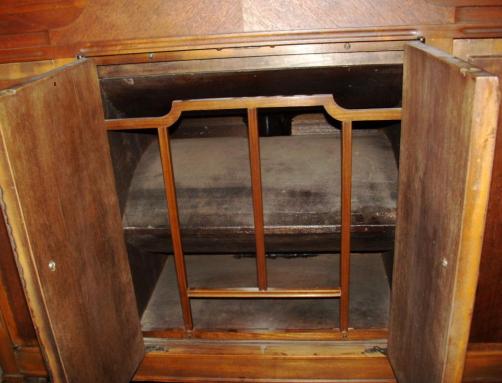
I thought I'd resurrect this old post string to add another photo. This one is the VV-4-40 horn--copied from a craigslist post--which followed the same fold pattern as the Credenza and its slightly smaller brother, the VV-8-4. While hard to tell in the photo, the bottom portion of the horn has a very gradual taper, and is not quite flat. The heart, which contains the conduit for the four sections, is quite large, talking over most of the space inside the chamber.

4-40 Horn--small.JPG
4-40 Horn--small.JPG (28.8 KiB) Viewed 7139 times


The mouth of the horn measures 16 1/2 inches high by 16 1/2 inches wide, while its overall length is about 4 3/4 feet, which means that it can reproduce the upper range of bass pretty well. Restored, and if the acoustic conditions are right, it provides a rich, room filling sound, slightly more mellow than the Credenza, but more powerful than the smaller (four-series) models such as the VV-4-3 or VV-4-7.