Hi Steve:
Hi Steve:
Is the horn on the Victor V an original Victor horn? It's quite amazing!
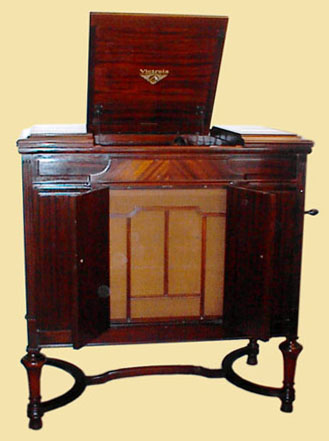
No, this is an after-market horn originally supplied by an outside vendor for use on a variety of talking machines produced at the time. At some point, probably in the 1950s, it was repainted with hand painted flowers. (When up close, you can see the brush strokes!) I was going to refinish it, but have received so many compliments that I decided to leave it as it was when I acquired it. The horn that came with my Victor V -- which was in pieces when I acquired it -- was actually a Columbia style nickel plated horn that had been soldered to a Victor V elbow. I opted for the replacement because the Columbia horn was suspended too low over the cabinet.
---------------------------------------------------------------------------------
Can I ask you how do you determine / measure the frequency response / output of a machine ie you mention 125 Hz, but how can you measure this or lower frequencies?
The comparison I made was between the 4-40's horn and a pair of Bose speakers I own, that are rated to a low of 125 Hz. Since it was based on what I could physically hear, of course, it's purely subjective, and unfortunately not very scientific. Basically, I test played some organ selections to see what the differences were. From what I could hear, the 4-40's horn is able to pump out about the same amount of bass as my Bose speakers.
I used to have a copy of a Victor frequency tester record--I forget what it was specifically labeled--which had samples of various (constant) tone frequencies between 5000-100 Hz. (I think these were used by radio stations?) There were about a dozen tracks--six on each side of the record--and each was devoted to a different frequency, and matched to the output of the Orthophonic Victrola. (This was a pre-1930 pressing with a VE inside an oval pressed into the shellac.) Unfortunately, I sat on that record about ten years ago, and have yet to find another.
------------------------------------------------------------------------------
I did join in the debate on the other board about sealing tone-arm pivots etc. but I left confused. What part is everybody taking apart to reseal with new gaskets and grease?
After work today, I'll look over the posts to see what they were talking about. I suspect that they meant the felt gasket that sits UNDER the base of the earlier style Orthophonic tone arm --
Here are some basic hints for making the tonearm as air tight as possible:

The ring coupling in the above illustration is "locked" in place with screws visible from the under side of the tone arm. These must be loosened before the ring is turned.
-----------------------------------------------------
I should add that the above tone arm is from an early production (probably circa 1926) Orthophonic Victrola. Later models used a different tone arm support, similar to the pre-Orthophonic models, with a top mount pivot.
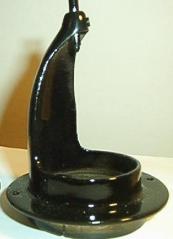
Whether there is a felt gasket under the bottom of the support, I don't know. Mine is stuck in place and cannot be removed. (To ensure air-tightness in this area, I squirted heavy grease between the edge of the tone arm, and the rim of the support.)