Hello everyone,
First, my story and the jukebox's history. Feel free to skip down to the nitty-gritty further down if you don't care. Also, yes, I know that the 1550 is a beast and quite a bear to work on. I have the service manuals and have been reading them cover to cover for the past week prior to doing anything. I'm not about to risk destroying anything on this that might be irreplaceable.
I grew up with a 1953 AMI in the house and loved it. Only thing it ever needed was oil and lightbulbs and my parents gave me those chores. So I really only have a basic knowledge of jukeboxes. Fast forward to this month when I was given the chance to buy a Wurlitzer 1550 from the widow of a dear, dear friend who passed away 3.5 years ago. The two of them had stayed up all night talking and listening to records. They went to bed that early that morning and he never woke up. The jukebox has been plugged in and left turned on, unplayed, ever since that night.
It 'mostly' works. Of course all the bulbs are burned out. The amp is non-functional from what looks to be blown tubes (2 are completely black on the inside) and the selector brings out 2 record trays every now and then. Other than 3 years of collected dust and the aforementioned problems, it is in near perfect condition, complete, and mostly original. It even has the wallbox stepper in the bottom of the cabinet. I have discovered some new caps and wiring inside the amp which tells me some work has been done, but there are still some original caps and the original rectifier that need replacing.
I'm not looking forward to moving it, though. I have read the sticky on moving jukeboxes in general and wanted to see if anyone had any knowledge of specifics for this model. I read the packing procedures in the service manuals but they mostly reference to put things 'like it was when you unpacked it' which is zero help. It does mention attaching cleats to the cabinet to make moving easier. Any idea what these looked like or where they attached? I have removed anything from the cabinet not fastened down to lighten the load. These things being the entire coin mech, slug rejecter, amp, the needles for safe keeping, and light bulbs. It looks like the entire play mechanism should just slide out the back but I haven't had any luck getting it to budge. I figure that'll take at least 100lbs off easy if I can get it out. Any tricks or hidden screws that I'm missing? The service manuals have been no help in this regards.
And I have an embarrassing admission. I can't, for the life of me, figure out how to get the two lower light bulbs out that are behind the colored plastic pilasters. I'm too afraid of breaking the pilasters to be rough with anything down there and I tried putting my hand down in from the top. I can get the fluorescent tube unfastened but there's not enough clearance to pull it out the top. I can't imagine that you'd have to start unscrewing things to replace these. Again, the service manual sheds no light. I guess they figure if you're working on the jukebox, you should be able to figure out how to take a darned light bulb out.
I hope I've provided enough relevant info. I know I have a lot to learn, but I plan on keeping this juke until I can pass it along to our kids (we're expecting our first in March). Let me know if any other info is needed and I appreciate any help that can be given.
Thanks in advance,
Matt

Wurlitzer 1550 moving and other newbie questions
Q&A about all types of jukeboxes: Wurlitzer, Seeburg, Rock-Ola, AMI, and more.
9 posts
• Page 1 of 1
-
gilpo
Topic author - Junior Member
- Posts: 4
- Joined: Thu Oct 15, 2015 5:44 am
- Location: Muncie, IN, USA
Wurlitzer 1550 moving and other newbie questions
by gilpo » Mon Oct 19, 2015 5:39 am
Re: Wurlitzer 1550 moving and other newbie questions
by mb9513 » Wed Oct 28, 2015 5:23 am
Matt: the 1500 series is the most complicated of any Wurlitzer. They took a good mechanism up to the 1100 and made it play both sides by using a double decker motor and an upside down(bad idea) tone arm, then doubled the trays on 2 sides and used a 2 speed mechanism. getting it going right is not a 1st timer job. the 1953 AMI you grew up with is a much simpler mechanism. That being said. the mechanism should have bolts underneath it to draw it down against the spring suspension. Tape or tie all the trays, you absolutely don't want them to flop around. they can get bent and then would have to be replaced. if it is similar to the other Wurlis I have worked on the lights in the pilasters are removed by looking at the top from inside behind the title board. there may be a cover where the supply wire goes down in. remove the cove and then you will see the light fixture held on by (2) screws. remove the entire light assembly, from the top. only then can you change the bulbs. The tubes that have black on the inside are normal. in the manufacturing process to get the last oxygen out of the tube a "getter" is activated and it makes what you see. if it is white for any reason, that is a bad tube. you will need to test them anyway. and have the amp recapped totally. be careful not to spend yourself into a hole, as that Wurlitzer does not hold as much value as other ones of the era, because it is hard to work on. Eventually I would like to tackle one as a challenge. Hope this helps. Mark
-
gilpo
Topic author - Junior Member
- Posts: 4
- Joined: Thu Oct 15, 2015 5:44 am
- Location: Muncie, IN, USA
Re: Wurlitzer 1550 moving and other newbie questions
by gilpo » Fri Nov 06, 2015 8:03 am
Thanks for your help, Mark.
We got it moved in one piece and I've had a blast working on it these last couple weeks. Here's some of what I've figured out to help anyone who might see this post in the future and need help:
1. The two chrome trim pieces on either side of the title strip holders come off. There are 3 thumb screws holding each of them on but I needed a flathead screwdriver to loosen them. Two of the thumbscrews on each side are really hard to find. You almost need to stick your head inside where the titlestrip bulbs are to see them. Once these trim pieces are off, the plastic pilasters just pull forward at the top and then lift out allowing easy bulb replacement.
2. Regarding fluorescent bulb starters, my service manual is wrong. On the top 33" bulb, I had to use a 20-25-30 watt starter as opposed to the 20 watt specified in the manual. A 20 just couldn't get the bulb going.
3. I replaced all the tubes, caps C-20 and C-30, sprayed De-Ox It in all the tube and plug sockets (including the dummy plug with the jumper wire) and the volume and tone control pots. I replaced all the wires going to the volume pot from the terminal strip as some were in the process of disintegrating. Now I have sound! The volume pot does show some damage and is very touchy and cuts out if you touch it wrong so I have a replacement on the way.
4. A couple little adjustments to the tray take-out mech and it no longer pulls out 2 trays. Haven't had an 'oh crap' moment in over a week now.
New questions:
1. For the first week, it played everything slow. I could press on one of the drive wheels and it would speed up to the proper speed. I oiled everything that related to the TT that was supposed to be oiled. Now it plays too fast. I'm guessing this is due to my house volts reading at 126 and the service manual says it expects 117. Is this the reason? Any advice on how to slow it down now?
2. Any experience replacing the cobra shielded tonearm cable? I read posts elsewhere on some suggestions as to what 'should' work as a replacement, but nothing authoritative. I know the length is important to the way the cobra pickup operates, but I want to replace with something that's as close to original as possible to preserve the original sound but just eliminate the crackle I keep getting during playback.
3. Is the schematic in the service manual for the 516 amp correct or are there errors contained within? I'm finding several differences that look original to the amp. I can obviously see some later repairs that appear to be wrong, but these original looking difference have me scratching my head. Should I leave alone or correct to match my schematic? For example, I have an extra wire coming off Pin 8 of the bottom (schematic wise) 6L6-G tube that connects to capacitor C-12 (in a can) on the other side of the amp. There shouldn't be such a connection, but the solder looks old and this wire is identical to the other original wiring in the amp and doesn't look like a later addition.
4. Do the resistors really go bad? Should I check every one as I work on re-capping this? Can I test them in-circuit or does one leg need to be lifted as on modern amps?
5. I need a source for a wire-wound 5200 ohm, 25 watt resistor. Can't find one anywhere. Someone replaced the one in the speaker plug adapter with a 4700 ohm and I'd like to get one closer to spec. The replacement also gets stupid hot and is too big to mount inside the adapter where it would be more protected and less likely to start a fire.
6. The slug rejector won't take any nickels. The service manual says there isn't an adjustment for nickels, only dimes and quarters. And the mod to switch to 1 play for a dime hasn't been done so I have no idea why it won't take nickels.
I'm really not concerned about the money or time spent on this thing. It has a tremendous amount of sentimental value and I don't plan on ever parting with it. Some guys fix up an old car. This jukebox is my new hobby. Any help would be greatly appreciated.
Thanks,
Matt
We got it moved in one piece and I've had a blast working on it these last couple weeks. Here's some of what I've figured out to help anyone who might see this post in the future and need help:
1. The two chrome trim pieces on either side of the title strip holders come off. There are 3 thumb screws holding each of them on but I needed a flathead screwdriver to loosen them. Two of the thumbscrews on each side are really hard to find. You almost need to stick your head inside where the titlestrip bulbs are to see them. Once these trim pieces are off, the plastic pilasters just pull forward at the top and then lift out allowing easy bulb replacement.
2. Regarding fluorescent bulb starters, my service manual is wrong. On the top 33" bulb, I had to use a 20-25-30 watt starter as opposed to the 20 watt specified in the manual. A 20 just couldn't get the bulb going.
3. I replaced all the tubes, caps C-20 and C-30, sprayed De-Ox It in all the tube and plug sockets (including the dummy plug with the jumper wire) and the volume and tone control pots. I replaced all the wires going to the volume pot from the terminal strip as some were in the process of disintegrating. Now I have sound! The volume pot does show some damage and is very touchy and cuts out if you touch it wrong so I have a replacement on the way.
4. A couple little adjustments to the tray take-out mech and it no longer pulls out 2 trays. Haven't had an 'oh crap' moment in over a week now.
New questions:
1. For the first week, it played everything slow. I could press on one of the drive wheels and it would speed up to the proper speed. I oiled everything that related to the TT that was supposed to be oiled. Now it plays too fast. I'm guessing this is due to my house volts reading at 126 and the service manual says it expects 117. Is this the reason? Any advice on how to slow it down now?
2. Any experience replacing the cobra shielded tonearm cable? I read posts elsewhere on some suggestions as to what 'should' work as a replacement, but nothing authoritative. I know the length is important to the way the cobra pickup operates, but I want to replace with something that's as close to original as possible to preserve the original sound but just eliminate the crackle I keep getting during playback.
3. Is the schematic in the service manual for the 516 amp correct or are there errors contained within? I'm finding several differences that look original to the amp. I can obviously see some later repairs that appear to be wrong, but these original looking difference have me scratching my head. Should I leave alone or correct to match my schematic? For example, I have an extra wire coming off Pin 8 of the bottom (schematic wise) 6L6-G tube that connects to capacitor C-12 (in a can) on the other side of the amp. There shouldn't be such a connection, but the solder looks old and this wire is identical to the other original wiring in the amp and doesn't look like a later addition.
4. Do the resistors really go bad? Should I check every one as I work on re-capping this? Can I test them in-circuit or does one leg need to be lifted as on modern amps?
5. I need a source for a wire-wound 5200 ohm, 25 watt resistor. Can't find one anywhere. Someone replaced the one in the speaker plug adapter with a 4700 ohm and I'd like to get one closer to spec. The replacement also gets stupid hot and is too big to mount inside the adapter where it would be more protected and less likely to start a fire.
6. The slug rejector won't take any nickels. The service manual says there isn't an adjustment for nickels, only dimes and quarters. And the mod to switch to 1 play for a dime hasn't been done so I have no idea why it won't take nickels.
I'm really not concerned about the money or time spent on this thing. It has a tremendous amount of sentimental value and I don't plan on ever parting with it. Some guys fix up an old car. This jukebox is my new hobby. Any help would be greatly appreciated.
Thanks,
Matt
Re: Wurlitzer 1550 moving and other newbie questions
by Rob-NYC » Fri Nov 06, 2015 9:27 am
Matt, I have no direct experience with that model, other than considering buying one in 1993.
However I can help with the basic questions.
Question #1: Too fast. Wurlitzer's do run a bit fast and depending on your sense of pitch, it may, or may not matter. One thing to check is for any build-up of rubber on the motor pulley itself. These deposits from the idler puck effectively increase the pulley size and cause the T-T to speed up.
2,: Cobra cable. Since this affect the RF circuit it should be low loss at approx 250Khz. Most short lengths of audio wire will work here. The cable does not directly affect the sound quality, but too much capacitance will kill oscillation. It is easy enough to experiment by soldering a short length of cable on and either clipping or carefully soldering to the connections on an old Cobra. I believe that model also has a microswitch that transfers the RF from A to B side. that can be a trouble maker as well.
3, 516 Amp and 6l6. this schematic: http://www.verntisdale.com/schem/516.jpg clearly shows the typical cathode bypass capacitor from pin 8 on a 6L6.
4. Do the resistors really go bad? Yep. Especially carbon resistors in voltage-current circuits such as plate or cathode. Wirewound though are either good or open.
5. I need a source for a wire-wound 5200 ohm, 25 watt resistor. Try here: http://www.mouser.com/Passive-Component ... /_/N-7fx9f Anything right up through 6.6 K ohm is OK as a dummy load. Personally, i would just increase the value of R13 to slightly lower the voltages to the G2's on the 6L6's and forget the wasteful dummy load.
6. The slug rejector won't take any nickels. I'm not sure about rejectors that old but, if you remove the slanted metal piece on the lower front of the rejector you may find a screw in a hole there that is used to divert the nickels. That is how I have all of mine on location set up.
I do have an old original service manual for the 1550 somewhere here, I'll look for it.
Rob/NYC
However I can help with the basic questions.
Question #1: Too fast. Wurlitzer's do run a bit fast and depending on your sense of pitch, it may, or may not matter. One thing to check is for any build-up of rubber on the motor pulley itself. These deposits from the idler puck effectively increase the pulley size and cause the T-T to speed up.
2,: Cobra cable. Since this affect the RF circuit it should be low loss at approx 250Khz. Most short lengths of audio wire will work here. The cable does not directly affect the sound quality, but too much capacitance will kill oscillation. It is easy enough to experiment by soldering a short length of cable on and either clipping or carefully soldering to the connections on an old Cobra. I believe that model also has a microswitch that transfers the RF from A to B side. that can be a trouble maker as well.
3, 516 Amp and 6l6. this schematic: http://www.verntisdale.com/schem/516.jpg clearly shows the typical cathode bypass capacitor from pin 8 on a 6L6.
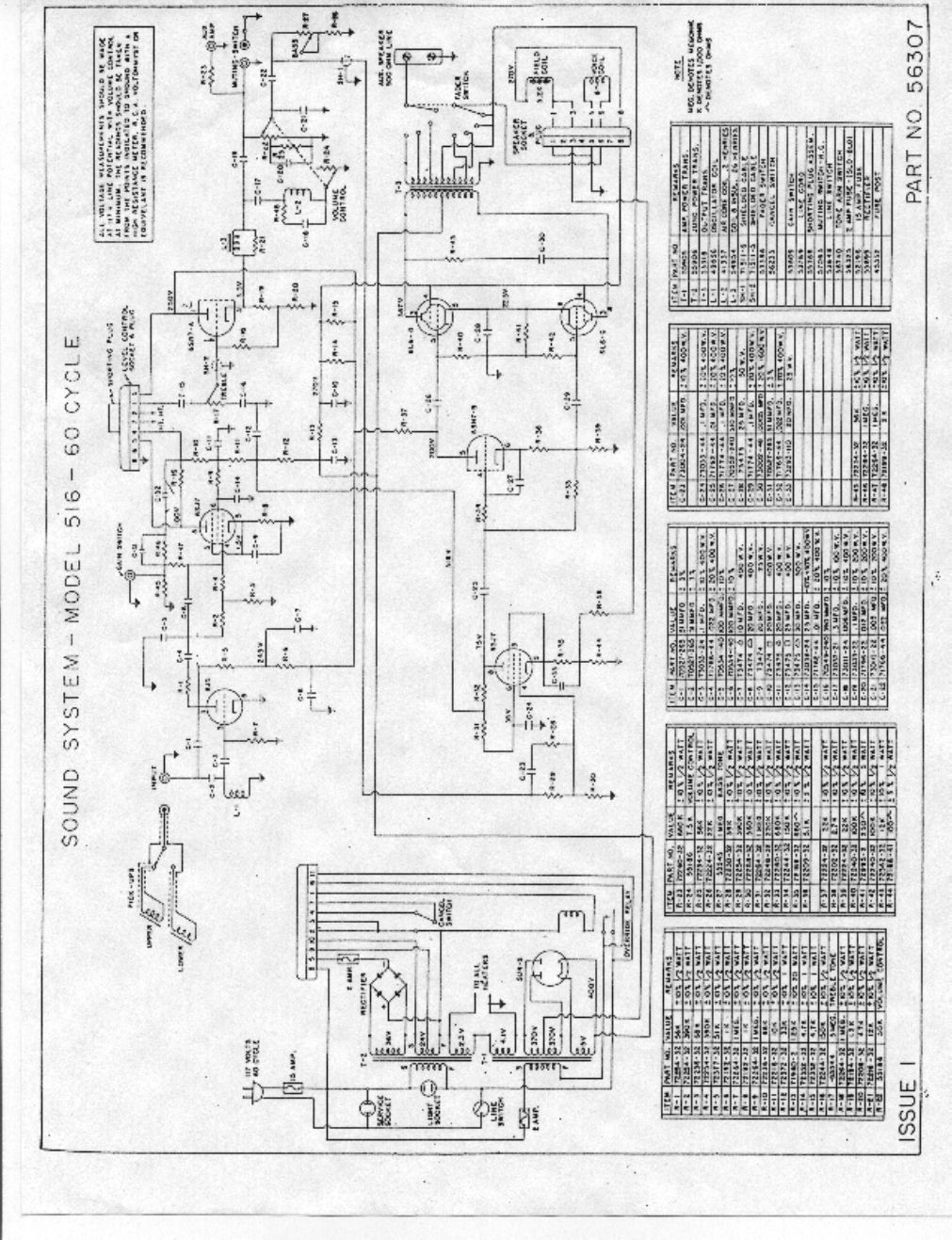
4. Do the resistors really go bad? Yep. Especially carbon resistors in voltage-current circuits such as plate or cathode. Wirewound though are either good or open.
5. I need a source for a wire-wound 5200 ohm, 25 watt resistor. Try here: http://www.mouser.com/Passive-Component ... /_/N-7fx9f Anything right up through 6.6 K ohm is OK as a dummy load. Personally, i would just increase the value of R13 to slightly lower the voltages to the G2's on the 6L6's and forget the wasteful dummy load.
6. The slug rejector won't take any nickels. I'm not sure about rejectors that old but, if you remove the slanted metal piece on the lower front of the rejector you may find a screw in a hole there that is used to divert the nickels. That is how I have all of mine on location set up.
I do have an old original service manual for the 1550 somewhere here, I'll look for it.
Rob/NYC
"If we believe absurdities, we shall commit atrocities" -- Voltaire
-
Ron Rich
- Forum Moderator
- Posts: 8194
- Joined: Sun May 06, 2007 11:31 pm
- Location: Millbrae (San Francisco area)CA, USA
Re: Wurlitzer 1550 moving and other newbie questions
by Ron Rich » Fri Nov 06, 2015 5:05 pm
Hi Matt,
On the slug rejector--do as Rob said--but if you find no screw--look at the diverter -I have seen them wired so they can't move, and believe it or not, there was an operator in this area ( no doubt, one of Rob's "Geppetto friends"), who "blocked nickels" with a piece of chewing gum,on many rejectors (YUCK !!) Ron Rich
On the slug rejector--do as Rob said--but if you find no screw--look at the diverter -I have seen them wired so they can't move, and believe it or not, there was an operator in this area ( no doubt, one of Rob's "Geppetto friends"), who "blocked nickels" with a piece of chewing gum,on many rejectors (YUCK !!) Ron Rich
Re: Wurlitzer 1550 moving and other newbie questions
by Rob-NYC » Sat Nov 07, 2015 1:32 pm
Ron Rich wrote:Hi Matt,
On the slug rejector--do as Rob said--but if you find no screw--look at the diverter -I have seen them wired so they can't move, and believe it or not, there was an operator in this area ( no doubt, one of Rob's "Geppetto friends"), who "blocked nickels" with a piece of chewing gum,on many rejectors (YUCK !!) Ron Rich
Funny that you mention that...Last Monday eve I collected a location which has 3Wa's. Three were stopped up with foreign coins (this place gets a lot of tourists). One box was backed up to the inlet so the rejector had to be removed. I also had to remove that chute on the nickle side and found that i had secured the diverter with masking tape. These boxes have been in three locations and in service since Nov 1987 and on location here from Aug 1993.. Since I own them...it musta been me. The tape has survived multiple washings so I left it in place.
Rob
"If we believe absurdities, we shall commit atrocities" -- Voltaire
-
gilpo
Topic author - Junior Member
- Posts: 4
- Joined: Thu Oct 15, 2015 5:44 am
- Location: Muncie, IN, USA
Re: Wurlitzer 1550 moving and other newbie questions
by gilpo » Mon Nov 09, 2015 7:11 am
Thanks Rob and Ron for your help!
1. I'm a musician so it actually bothers me more than the constant crackle and static from the failing tonearm cable. For perspective, I had to have my piano tuner come out a second time because his first tuning wasn't good enough. There was no build-up on any of the wheels. In this model, the motor rotation is transferred 4 times to get to the turntable. Don't shoot me, but the best solution I've found so far is to wrap high-grade electrical tape around the metal drive wheel. This large metal wheel transfers the rotation from the very small rubber idler wheel to the turntable. So, in this case, the larger diameter makes the turntable run slower. Three wraps took care of it and it's now within a couple RPM and I can live with it. I know this is a hack job but if there's a better way (that's as reversible) I'm all ears.
2. Would this work for the tonearm cable: http://www.amazon.com/Eightwood-Coax-Co ... rds=RG-174
3. The bypass cap you speak of on the schematic...are you referring to C-28? That's the one directly below the top 6L6 and is attached to ground and is shown between R-40 and R-41. If so, I have located this cap and it is also connected to pin 8 in addition to the wire going from pin 8 to C-12. So I have 2 caps connected to pin 8. Doesn't this double the capacitance? What effect does this have? Can I just disconnect the extra wire to C-12 or will bad things happen?
I have to confess, this is only the second electrical schematic I've ever read (the other being for my Pioneer SX-1250) and I have to say, it's easier for me to figure out what's going on in my Pioneer. I understand all the symbols and how each component works on its own, but I really have no clue what purpose each component serves in the overall circuit. I've read up on how tube amps work but I'm just not getting it. It makes no sense to me what's going on in here. If someone has the time and interest to explain this amp's schematic to me and the function of each 'stage', I would love to learn. Right now, I'm just trying to swap old caps and resistors out for new to (hopefully) improve the tone a bit and prevent future catastrophic failure. The (apparent) differences between the schematic and the actual amp aren't helping things and are giving me quite the headache. I've done well so far neither electrocuting myself on the B+ nor frying anything and I'd like to keep it that way. I have a nice Fluke DMM and it's helped out a lot but I'm definitely an amateur in using it. It took me a week to get up the nerve and confidence to take readings off live circuits in this amp. I just want this thing to sound as close to what it did back in 1952.
4 and 5. Thanks! I'll replace these as I go.
6. No screw and no gum, thankfully! Sitting on my table, the rejector would take nickels about 75% of the time (which is a huge improvement over the installed rate of 0%). Even successive drops of the same nickel produced seemingly random results. It seems that nickel acceptance is slightly speed based, so I cleaned, degreased, and sprayed de-ox it over everything and have the nickel acceptance rate up to 90% or so. I think cabinet leveling might have an effect as well, but that'll have to wait until I'm done digging in its innards.
Rob, if you have a service manual with any technician notes, I'd love to see them. I'm finding slight differences here and there. Also, there are several pages of diagrams showing the varying states of the selection mech circuits that reference circuits in colored lines. The manual from Victory Glass is all B&W and so it's hard for me to follow along. I have a letter/number combos that fail to select so scans of these pages would be hugely helpful in troubleshooting. Or if you're willing to part with your manual I'd be interested in buying.
New question:
What's recommended to polish the various metal surfaces? My record trays are quite dull and have zero shine to them. I've seen other 1550s where the trays were mirror-like. Also, the top and front grill trim are nickel plate, I think, and are quite tarnished. What can I use on that without worrying about polishing the plating right off?
Thanks again for all your help!
-Matt
1. I'm a musician so it actually bothers me more than the constant crackle and static from the failing tonearm cable. For perspective, I had to have my piano tuner come out a second time because his first tuning wasn't good enough. There was no build-up on any of the wheels. In this model, the motor rotation is transferred 4 times to get to the turntable. Don't shoot me, but the best solution I've found so far is to wrap high-grade electrical tape around the metal drive wheel. This large metal wheel transfers the rotation from the very small rubber idler wheel to the turntable. So, in this case, the larger diameter makes the turntable run slower. Three wraps took care of it and it's now within a couple RPM and I can live with it. I know this is a hack job but if there's a better way (that's as reversible) I'm all ears.
2. Would this work for the tonearm cable: http://www.amazon.com/Eightwood-Coax-Co ... rds=RG-174
3. The bypass cap you speak of on the schematic...are you referring to C-28? That's the one directly below the top 6L6 and is attached to ground and is shown between R-40 and R-41. If so, I have located this cap and it is also connected to pin 8 in addition to the wire going from pin 8 to C-12. So I have 2 caps connected to pin 8. Doesn't this double the capacitance? What effect does this have? Can I just disconnect the extra wire to C-12 or will bad things happen?
I have to confess, this is only the second electrical schematic I've ever read (the other being for my Pioneer SX-1250) and I have to say, it's easier for me to figure out what's going on in my Pioneer. I understand all the symbols and how each component works on its own, but I really have no clue what purpose each component serves in the overall circuit. I've read up on how tube amps work but I'm just not getting it. It makes no sense to me what's going on in here. If someone has the time and interest to explain this amp's schematic to me and the function of each 'stage', I would love to learn. Right now, I'm just trying to swap old caps and resistors out for new to (hopefully) improve the tone a bit and prevent future catastrophic failure. The (apparent) differences between the schematic and the actual amp aren't helping things and are giving me quite the headache. I've done well so far neither electrocuting myself on the B+ nor frying anything and I'd like to keep it that way. I have a nice Fluke DMM and it's helped out a lot but I'm definitely an amateur in using it. It took me a week to get up the nerve and confidence to take readings off live circuits in this amp. I just want this thing to sound as close to what it did back in 1952.
4 and 5. Thanks! I'll replace these as I go.
6. No screw and no gum, thankfully! Sitting on my table, the rejector would take nickels about 75% of the time (which is a huge improvement over the installed rate of 0%). Even successive drops of the same nickel produced seemingly random results. It seems that nickel acceptance is slightly speed based, so I cleaned, degreased, and sprayed de-ox it over everything and have the nickel acceptance rate up to 90% or so. I think cabinet leveling might have an effect as well, but that'll have to wait until I'm done digging in its innards.
Rob, if you have a service manual with any technician notes, I'd love to see them. I'm finding slight differences here and there. Also, there are several pages of diagrams showing the varying states of the selection mech circuits that reference circuits in colored lines. The manual from Victory Glass is all B&W and so it's hard for me to follow along. I have a letter/number combos that fail to select so scans of these pages would be hugely helpful in troubleshooting. Or if you're willing to part with your manual I'd be interested in buying.
New question:
What's recommended to polish the various metal surfaces? My record trays are quite dull and have zero shine to them. I've seen other 1550s where the trays were mirror-like. Also, the top and front grill trim are nickel plate, I think, and are quite tarnished. What can I use on that without worrying about polishing the plating right off?
Thanks again for all your help!
-Matt
-
Ron Rich
- Forum Moderator
- Posts: 8194
- Joined: Sun May 06, 2007 11:31 pm
- Location: Millbrae (San Francisco area)CA, USA
Re: Wurlitzer 1550 moving and other newbie questions
by Ron Rich » Mon Nov 09, 2015 4:43 pm
Matt,
Use ONLY hot-soapy water to clean the slug rejector--dry totally and no lube of any kind should be used, except for "sliding surfaces" outside of the coin path may be lubed with graphite based lube, VERY lightly !
Ron Rich
Use ONLY hot-soapy water to clean the slug rejector--dry totally and no lube of any kind should be used, except for "sliding surfaces" outside of the coin path may be lubed with graphite based lube, VERY lightly !
Ron Rich
Re: Wurlitzer 1550 moving and other newbie questions
by svtforme » Thu Nov 26, 2015 5:32 pm
Great post! I will be keeping an eye on this as I recently acquired a 1550a myself and just joined this site. I am also in a similar position and going through the entire machine. Mine works pretty well - just needs to be cleaned up.
Post some pictures if you can. I would also be interested to see what stepper yours has (252 or 253?) and where it is located in the machine and whether it works or not. I have been looking for one - but they are scarce.
Post some pictures if you can. I would also be interested to see what stepper yours has (252 or 253?) and where it is located in the machine and whether it works or not. I have been looking for one - but they are scarce.
9 posts
• Page 1 of 1
Who is online
Users browsing this forum: Google Adsense [Bot], highriverguy, HorrorBiz 72, Juke-rocks, Ron Rich and 11 guests
It is currently Thu Oct 06, 2016 6:19 pm
- Delete all board cookies
- All times are UTC+02:00