I forgot to mention a couple of things in my above post. For instance, the diaphragm's gaskets, when new, were extremely soft. They not only held the diaphragm in place, isolating it from the shell, but provided an air tight "compression" chamber so that the air would be pumped out to the horn's mouth. In addition, they absorbed extraneous vibrations which would cause peaks or other shrill noises. It's best to replace them with gaskets made for phonograph repair, and to not use conventional ring gaskets--normally too hard--from local hardware stores, etc.
Also, the adjustment of the needle bar pivot should be done before inserting the screw securing the diaphragm to the needle bar. The needle bar's "foot" should just touch the diaphragm, but exert no pressure on it; nor should it pull the diaphragm forward, once the screw is inserted.
Listening to your YouTube video, again, I was wondering if you have a volume adjustment knob on the side of your cabinet. If so, you can make the volume louder or softer by either turning the knob, or pulling it outward and pushing it in.
Lastly, just in case you don't know this, ideally, a steel needle should only be used to play one side of one record, then discarded. It probably does no damage to play two sides, but that's about it. NEVER remove a used steel needle and reinsert it to play another record. The reason for this is that the point wears slightly every time a side of a record is played, creating a flattened area at the tip of the needle. If reinserted, this flattened (and sharp) surface will literally cut into the groove of the record, causing damage. Steel needles are still being produced and are available from many suppliers.
Good luck with your sound box rebuild.
JDS

Sonora help!
Q&A about Talking Machines from the pre-electronic era (approx. 1885-1928).
-
TripleSpring
- Regular Member
- Posts: 55
- Joined: Fri Jan 16, 2009 11:23 am
You wont get this motor running properly because the fibre gear has been stripped. You'll either have to have a new gear made, or find a good used replacement. These motors were made by Paillard of Switzerland & are fairly common, so a used replacement shouldn't be too hard to find.
Below is a picture of a good (left), and worn (right) fibre gear. The fibre is sandwiched between the the two brass washers, and the outer circumference of the fibre should be the same as that of the two brass discs/washers.
Paillard supplied motors to hundreds of off-brand gramophone manufacturers around the world, and the size of gears & bearings vary, so you may need to send your spindle to George Vollema for a perfect match.
You can get new fibre gears made, so if you'd rather go that route, you'll need to take the spindle (on which the fibre gear is pressed) into a few machine shops to see who can do it & for what price.
Just be careful because at the bottom of the spindle there is a tiny ball bearing, and if that falls out & is is lost, the motor wont work properly once reassembled.

Below is a picture of a good (left), and worn (right) fibre gear. The fibre is sandwiched between the the two brass washers, and the outer circumference of the fibre should be the same as that of the two brass discs/washers.
Paillard supplied motors to hundreds of off-brand gramophone manufacturers around the world, and the size of gears & bearings vary, so you may need to send your spindle to George Vollema for a perfect match.
You can get new fibre gears made, so if you'd rather go that route, you'll need to take the spindle (on which the fibre gear is pressed) into a few machine shops to see who can do it & for what price.
Just be careful because at the bottom of the spindle there is a tiny ball bearing, and if that falls out & is is lost, the motor wont work properly once reassembled.
-
Sonoradude
Topic author - Junior Member
- Posts: 23
- Joined: Mon Aug 27, 2012 6:43 am
Thanks! Joe, I have a question regarding the diaphragm and arm. I am currently uploading a video to Youtube. Can you check it out? https://www.youtube.com/watch?v=bGXiFze ... e=youtu.be
Thanks!
Thanks!
-
Sonoradude
Topic author - Junior Member
- Posts: 23
- Joined: Mon Aug 27, 2012 6:43 am
-
Joe_DS
- Forum Moderator
- Posts: 1056
- Joined: Thu Jun 08, 2006 4:23 pm
- Location: San Francisco, California, USA
Sonoradude wrote:Thanks! Joe, I have a question regarding the diaphragm and arm. I am currently uploading a video to Youtube. Can you check it out? https://www.youtube.com/watch?v=bGXiFze ... e=youtu.be
Thanks!
By "one piece" I meant that the reproducer's (AKA "sound box's") shell does not have a removable back--such as a Victor Exhibition sound box , or Victor #2 sound box--or others--that lets you easily remove the gaskets and change diaphragms.
For comparison's sake, watch this video showing the repair of a Victor #2 sound box:
https://www.youtube.com/watch?v=2rhh5_7UYGY
You'll notice that the entire back plate is removed for servicing. Many of the steps shown in this video apply to servicing the reproducer you have, such as detaching the needle bar from the center of the diaphragm, carefully situating the diaphragm between the front and back gasket, etc.
Since the one you have does not have a removable back plate, you'll have to work from the front, as described in my earlier post. Prior to working on it, you'll have to remove the sound box from the tonearm. I'm not sure if it just twists off or not. For that, I'll defer to TripleSpring, who probably knows far more about Sonora Phonographs than I do.
Properly restored, it should look like this, with the mica diaphragm firmly suspended between the back and front gaskets --
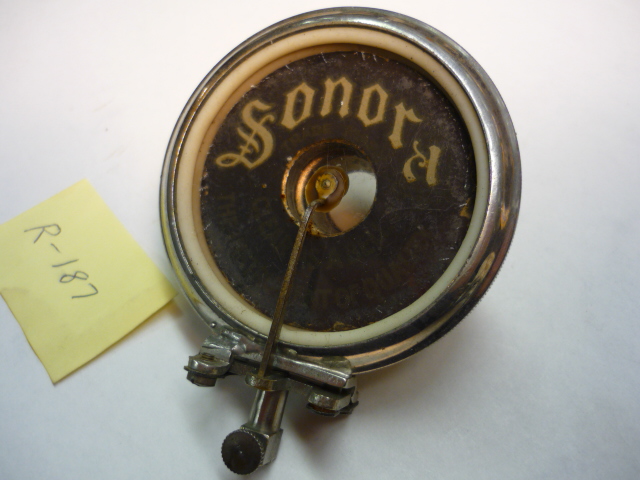
(Note: While it's hard to tell, the front, visible gasket is partly tucked under the rim to hold it, and the diaphragm, in place.)
Joe_DS
-
Sonoradude
Topic author - Junior Member
- Posts: 23
- Joined: Mon Aug 27, 2012 6:43 am
Thanks Joe! Where would I order new gaskets/rings? Any place online you can recommend?
-
Joe_DS
- Forum Moderator
- Posts: 1056
- Joined: Thu Jun 08, 2006 4:23 pm
- Location: San Francisco, California, USA
Sonoradude wrote:Thanks Joe! Where would I order new gaskets/rings? Any place online you can recommend?
Here are a few shops I've dealt with in the past. All provide good service, and most, if not all, stock reproducer parts --
Great Lakes Antique Phonograph -- http://www.victroladoctor.com/
Antique Phonograph Supply Company -- http://www.antiquephono.com/
Victrola Repair Service -- http://www.victrolarepairservice.com/
Hawthorn's Antique Audio -- http://www.thoseoldrecords.com/phonorep.html
Here are some others that have been recommended by fellow collectors --
http://www.shenandoahrestoration.com/
http://www.wyattsmusical.com/
HTH,
Joe_DS
-
Sonoradude
Topic author - Junior Member
- Posts: 23
- Joined: Mon Aug 27, 2012 6:43 am
Triplespring: Thanks for the info on the governor. That will be my next big purchase (or I will have to send it in).
Who is online
Users browsing this forum: No registered users and 1 guest
It is currently Thu Oct 06, 2016 12:16 pm