Can someone identify this item for me? I think it is a capacitor and was told by my kit maker that a small cap was the replacement. However, there are three connectors on the bottom and not two. So, something does not make sense.
Thanks, James

M100A Mallory Type WP ???
Q&A about all types of jukeboxes: Wurlitzer, Seeburg, Rock-Ola, AMI, and more.
-
James_Douglas
Topic author - Regular Member
- Posts: 77
- Joined: Wed May 29, 2013 1:36 am
- Location: San Francisco, CA USA
- Attachments
-
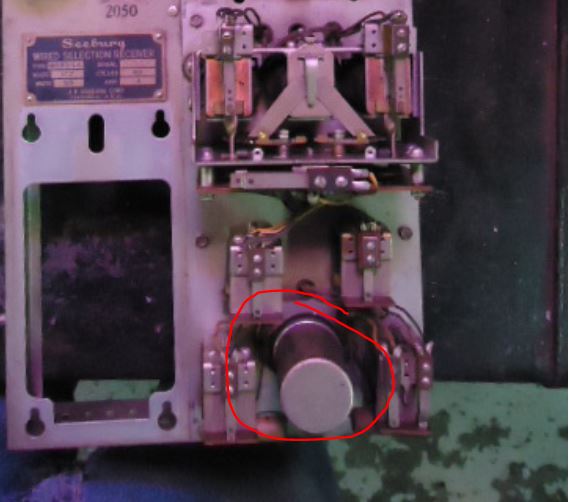
- mallory_type_wp_2.JPG (42.64 KiB) Viewed 1122 times
That is what they call an electrolytic capacitor. The values??? and the values that you havve to replace it with I don't know either.
recore
recore
-
James_Douglas
Topic author - Regular Member
- Posts: 77
- Joined: Wed May 29, 2013 1:36 am
- Location: San Francisco, CA USA
OK, I think I have a handle on the "Big Caps". I found this write up on the net and it helped a lot.
Also, I got a WSR5-L6 schematic online and it shows that .005 MF-1000V capacitor in my WSR3 that is not on the WSR3 schematic.
My only question now is on the Mallory cap, since it has three posts with wires on it, what are the values?
Thanks all, James
*****************
Examining Wired Selection Receivers in my collection,
here's what I found:
WSR-3 (used in the M100A ONLY) Has a large capacitor
next to the 2050 tube, outside the stepper cover. This
is the motor capacitor, and was only installed on the
WSR-3 receiver for the M100A. It also has the
cylindrical cap under the stepper cover [Mallory type WS on my M100A -James Douglas], and the
square rectangular one mounted on the inside wall of
the receiver.
WSR-5 (used in the B, BL, C, G, W) Motor cap has been
moved to the Mechanism starting with the M100B. WSR 5
still has the cylindrical cap inside the stepper
cover. It also has the cylindrical cap under the
stepper cover, and the square rectangular one mounted
on the inside wall of the receiver.
WSR-7 (used in the R, J, JL) No cylindrical cap in
stepper area. It retains the square rectangular one
mounted on the inside wall of the receiver however.
None of the receivers in my present collection have
phenolic stepper plates. Although I've seen them
often, it never occured to me that some WSR-3's and
WSR-5's may have them, while others dont.
I'm puzzled that you have a WSR-5 receiver with no
square rectangular cap underneath. What is the serial
number? I can't say I've ever seen a WSR-5, or ANY WSR
without it. But as I am beginning to understand,
nothing was consistent.
Here are other things that don't seem consistent to
me...
Stepper Mounting Plates: Some are metal, some are
phenolic. Common sense would say that early machines
should have metal, later should have phenolic. But
this doesn't seem to be the case. Ron has suggested
that the phenolic was a wartime thing (along with the
cardboard stepper and CCU covers mentioned next). My
M100A's WSR-3 has a metal one, and while I have worked
on WSR-5's with phenolic ones, I have several WSR-5's
with metal stepper plates here in my collection.
Stepper and CCU Covers: Same issue.. My M100A has
original metal ones, but I've seen later machines
(even up as late as G's)with cardboard ones that I
feel were original. I cannot say I have ever seen a
WSR-7 (R, J, JL) with anything but metal covers.
My assumption with the above two puzzles is that the
metal parts must have come first, then Seeburg must
have switched to phenolic stepper plates, and
cardboard stepper and CCU covers at some point because
they were cheaper, but soon realized they were not
holding up, and went back to steel plates and covers
again.
Which brings me to the lower back doors covers. All
M100A's had a metal back cover plate, and my M100B has
what I feel as best I can tell an original metal back
plate as well. I have never seen a C, G, W, or R with
anything but a Masonite back cover. So I am assuming
that all A's and probably most if not all B and BL
models had metal back plates, then Seeburg switched to
masonite with the C, G, W, and R. Perhaps they
switched to Masonite panels at some point around the
BL or a the onset of C production, and then realized
that they kept getting damaged, and went back to metal
back panels with the 100-J. All 100-J machines had
steel lower back covers.
Remember a glaring case of this changing design and
materials issue was when Seeburg went to printed
circuit boards with the K, KD, and L models of 1957.
After experiencing technical issues, quickly they went
back to wired chassis and Amphenol plugs in the 1958
models 201, 161, and 101.
Another thing Seeburg never explains well is the
amplifier type MRA-2 of 1949. This amplifier's
schematic appears in the service manual for the M100A,
and is referred to as a directly compatible with the
MRA-1. The only difference appears to be that it uses
military numerical tubes in place of the 6V6's. A
label pasted on the chassis of an MRA-2 in my
collection reads: "The Hum Balancing Control located
near the 5U4 tube should be adjusted for minimum hum
if tubes are changed. This amplifier is
interchangeable with the MRA-1"
So what amplifier came stock with the M100A? an MRA-1
or an MRA-2? I am guessing all M100A's left Chicago
with an MRA-1. My MRA-2 came out of a M100B, I do not
know if it was original to it. All MRA-2 amplifiers
had the same blue nameplate on it printed MRA-1,
however the "1" is overstamped with a larger "1". Mine
is also using standard 6V6's, with the military tubes
long gone. So the existence of the MRA-2 amplifier
remains another mystery to me.
*****Here is a sidebar about 100-J machines I always
found interesting. How come some 100-J machines have
green tonearms, green record strippers, with green
plastic stripper plates; while some have red tone
arms, red record strippers with clear plastic stripper
plates? The second mystery to me is the often
publicized artists' conception of a 100-J with an
incorrect woven cane veneer pattern on the side. in
this rendering is some type of prototype reverse
screened/single strip Record Now Playing indicator
that was not produced until 1963 with the LPC-1.
Additionally some of the 100-J glamour shots have
german writing on different parts of the machine
instead of english. I always considered the HF-100-R &
100-J machines to be the height of Seeburg development
and design, never again equalled. After 1955,
everything seemed like a design compromise, and things
got too complicated. *****
John D. Rutoskey
Automatic Music Machines
Baltimore, Maryland
Also, I got a WSR5-L6 schematic online and it shows that .005 MF-1000V capacitor in my WSR3 that is not on the WSR3 schematic.
My only question now is on the Mallory cap, since it has three posts with wires on it, what are the values?
Thanks all, James
*****************
Examining Wired Selection Receivers in my collection,
here's what I found:
WSR-3 (used in the M100A ONLY) Has a large capacitor
next to the 2050 tube, outside the stepper cover. This
is the motor capacitor, and was only installed on the
WSR-3 receiver for the M100A. It also has the
cylindrical cap under the stepper cover [Mallory type WS on my M100A -James Douglas], and the
square rectangular one mounted on the inside wall of
the receiver.
WSR-5 (used in the B, BL, C, G, W) Motor cap has been
moved to the Mechanism starting with the M100B. WSR 5
still has the cylindrical cap inside the stepper
cover. It also has the cylindrical cap under the
stepper cover, and the square rectangular one mounted
on the inside wall of the receiver.
WSR-7 (used in the R, J, JL) No cylindrical cap in
stepper area. It retains the square rectangular one
mounted on the inside wall of the receiver however.
None of the receivers in my present collection have
phenolic stepper plates. Although I've seen them
often, it never occured to me that some WSR-3's and
WSR-5's may have them, while others dont.
I'm puzzled that you have a WSR-5 receiver with no
square rectangular cap underneath. What is the serial
number? I can't say I've ever seen a WSR-5, or ANY WSR
without it. But as I am beginning to understand,
nothing was consistent.
Here are other things that don't seem consistent to
me...
Stepper Mounting Plates: Some are metal, some are
phenolic. Common sense would say that early machines
should have metal, later should have phenolic. But
this doesn't seem to be the case. Ron has suggested
that the phenolic was a wartime thing (along with the
cardboard stepper and CCU covers mentioned next). My
M100A's WSR-3 has a metal one, and while I have worked
on WSR-5's with phenolic ones, I have several WSR-5's
with metal stepper plates here in my collection.
Stepper and CCU Covers: Same issue.. My M100A has
original metal ones, but I've seen later machines
(even up as late as G's)with cardboard ones that I
feel were original. I cannot say I have ever seen a
WSR-7 (R, J, JL) with anything but metal covers.
My assumption with the above two puzzles is that the
metal parts must have come first, then Seeburg must
have switched to phenolic stepper plates, and
cardboard stepper and CCU covers at some point because
they were cheaper, but soon realized they were not
holding up, and went back to steel plates and covers
again.
Which brings me to the lower back doors covers. All
M100A's had a metal back cover plate, and my M100B has
what I feel as best I can tell an original metal back
plate as well. I have never seen a C, G, W, or R with
anything but a Masonite back cover. So I am assuming
that all A's and probably most if not all B and BL
models had metal back plates, then Seeburg switched to
masonite with the C, G, W, and R. Perhaps they
switched to Masonite panels at some point around the
BL or a the onset of C production, and then realized
that they kept getting damaged, and went back to metal
back panels with the 100-J. All 100-J machines had
steel lower back covers.
Remember a glaring case of this changing design and
materials issue was when Seeburg went to printed
circuit boards with the K, KD, and L models of 1957.
After experiencing technical issues, quickly they went
back to wired chassis and Amphenol plugs in the 1958
models 201, 161, and 101.
Another thing Seeburg never explains well is the
amplifier type MRA-2 of 1949. This amplifier's
schematic appears in the service manual for the M100A,
and is referred to as a directly compatible with the
MRA-1. The only difference appears to be that it uses
military numerical tubes in place of the 6V6's. A
label pasted on the chassis of an MRA-2 in my
collection reads: "The Hum Balancing Control located
near the 5U4 tube should be adjusted for minimum hum
if tubes are changed. This amplifier is
interchangeable with the MRA-1"
So what amplifier came stock with the M100A? an MRA-1
or an MRA-2? I am guessing all M100A's left Chicago
with an MRA-1. My MRA-2 came out of a M100B, I do not
know if it was original to it. All MRA-2 amplifiers
had the same blue nameplate on it printed MRA-1,
however the "1" is overstamped with a larger "1". Mine
is also using standard 6V6's, with the military tubes
long gone. So the existence of the MRA-2 amplifier
remains another mystery to me.
*****Here is a sidebar about 100-J machines I always
found interesting. How come some 100-J machines have
green tonearms, green record strippers, with green
plastic stripper plates; while some have red tone
arms, red record strippers with clear plastic stripper
plates? The second mystery to me is the often
publicized artists' conception of a 100-J with an
incorrect woven cane veneer pattern on the side. in
this rendering is some type of prototype reverse
screened/single strip Record Now Playing indicator
that was not produced until 1963 with the LPC-1.
Additionally some of the 100-J glamour shots have
german writing on different parts of the machine
instead of english. I always considered the HF-100-R &
100-J machines to be the height of Seeburg development
and design, never again equalled. After 1955,
everything seemed like a design compromise, and things
got too complicated. *****
John D. Rutoskey
Automatic Music Machines
Baltimore, Maryland
-
Ken Layton
- Senior Member
- Posts: 292
- Joined: Sun Jun 07, 2009 8:06 pm
- Location: Olympia, Washington USA
Those tall cans are called "twist prong" electrolytics. They were invented by Mallory back in 1937 and several manufacturers copied them over the years. Brand new ones are now made by Antique Electronics of Tempe, Arizona using the original 1937 Mallory machinery (Antique Electronics bought the equipment from Mallory).
Mallory called their line of twist prong can capacitors their "FP" line.
Mallory called their line of twist prong can capacitors their "FP" line.
"I always considered the HF-100-R &
100-J machines to be the height of Seeburg development
and design, never again equalled. After 1955,
everything seemed like a design compromise, and things
got too complicated."
I had several arguments over these beliefs with Op's on Tenth avenue.
From what I recall, Seeburg sold his company in 1956 ostensibly to avoid his having to deal with it's coming unionization. Nice guy.
The outright hatred of the Tormat system was asinine and a product of people with poor education in electronics.
Even Wurlitzer and Rock-Ola finally realized that those ancient pin-and-coil schemes were ridiculous once things progressed to 200 selections.
I have 9 old Seeburg 200's in retro locations and while I also have vintage (MM1 hideaways) Rowe/AMI systems in use, the Seeburg Tormat is far superior and infinitely repairable as compared to both the E-M and newer microprocessor based systems.
Rob/NYC
100-J machines to be the height of Seeburg development
and design, never again equalled. After 1955,
everything seemed like a design compromise, and things
got too complicated."
I had several arguments over these beliefs with Op's on Tenth avenue.
From what I recall, Seeburg sold his company in 1956 ostensibly to avoid his having to deal with it's coming unionization. Nice guy.
The outright hatred of the Tormat system was asinine and a product of people with poor education in electronics.
Even Wurlitzer and Rock-Ola finally realized that those ancient pin-and-coil schemes were ridiculous once things progressed to 200 selections.
I have 9 old Seeburg 200's in retro locations and while I also have vintage (MM1 hideaways) Rowe/AMI systems in use, the Seeburg Tormat is far superior and infinitely repairable as compared to both the E-M and newer microprocessor based systems.
Rob/NYC
"If we believe absurdities, we shall commit atrocities" -- Voltaire
-
James_Douglas
Topic author - Regular Member
- Posts: 77
- Joined: Wed May 29, 2013 1:36 am
- Location: San Francisco, CA USA
Ken Layton wrote:Those tall cans are called "twist prong" electrolytics. They were invented by Mallory back in 1937 and several manufacturers copied them over the years. Brand new ones are now made by Antique Electronics of Tempe, Arizona using the original 1937 Mallory machinery (Antique Electronics bought the equipment from Mallory).
Mallory called their line of twist prong can capacitors their "FP" line.
Ken,
Thank you very much on the lead to Antique Electronics. Why these kit makers do not just source the "correct" items is beyond me. They substitute stuff with different mounting requirements and sizes when original size and function parts are available. Silly.
I will pull the Mallory and see what exact capacitance it is and order a replacement. I sanded off the rivets off of the rectangular capacitor on the inside-side of the case and will solder the replacement into the wiring. I think I will silicon it to the inside of the case, after drilling two small holes, and put a zip tie on it to make sure it does not go anyplace.
Thanks again, James
-
Ken Layton
- Senior Member
- Posts: 292
- Joined: Sun Jun 07, 2009 8:06 pm
- Location: Olympia, Washington USA
I have scanned the Mallory 1970's twist prong capacitor catalog pages, but the forum does not allow pdf files.
-
Ron Rich
- Forum Moderator
- Posts: 8196
- Joined: Sun May 06, 2007 11:31 pm
- Location: Millbrae (San Francisco area)CA, USA
James,
There are really two reasons that the "kit guy's" do not include the original "cans"--(one Verntisdale.com, does offer some of them at an added price).
1. For years, they were just plain "unavailable", and,
2. The cost of them, today, since the demand is low, will drive up the price substantially.
Ron Rich
There are really two reasons that the "kit guy's" do not include the original "cans"--(one Verntisdale.com, does offer some of them at an added price).
1. For years, they were just plain "unavailable", and,
2. The cost of them, today, since the demand is low, will drive up the price substantially.
Ron Rich
-
James_Douglas
Topic author - Regular Member
- Posts: 77
- Joined: Wed May 29, 2013 1:36 am
- Location: San Francisco, CA USA
Hi Guys, Been soldering away all morning.
The Mallory is a Type WP. I think the Mallory # is 235016 as the other number 87583 is the Seeburg number. It has 300 then a space then 50 printed on it. Would this be 300uf and 50V or 50uf and 300V?
Attached is the cap that came with the kit. Is there any reason to run down one of the cans from Antique Electric or just use what was supplied in the kit? I attached a photo of the replacement. Since I have not taken it out yet what is the procedure for wiring it in?
The kit has the small cap and as you can see there are several leads going to THREE posts on the Mallory.
Slogging through it...
James
The Mallory is a Type WP. I think the Mallory # is 235016 as the other number 87583 is the Seeburg number. It has 300 then a space then 50 printed on it. Would this be 300uf and 50V or 50uf and 300V?
Attached is the cap that came with the kit. Is there any reason to run down one of the cans from Antique Electric or just use what was supplied in the kit? I attached a photo of the replacement. Since I have not taken it out yet what is the procedure for wiring it in?
The kit has the small cap and as you can see there are several leads going to THREE posts on the Mallory.
Slogging through it...
James
- Attachments
-
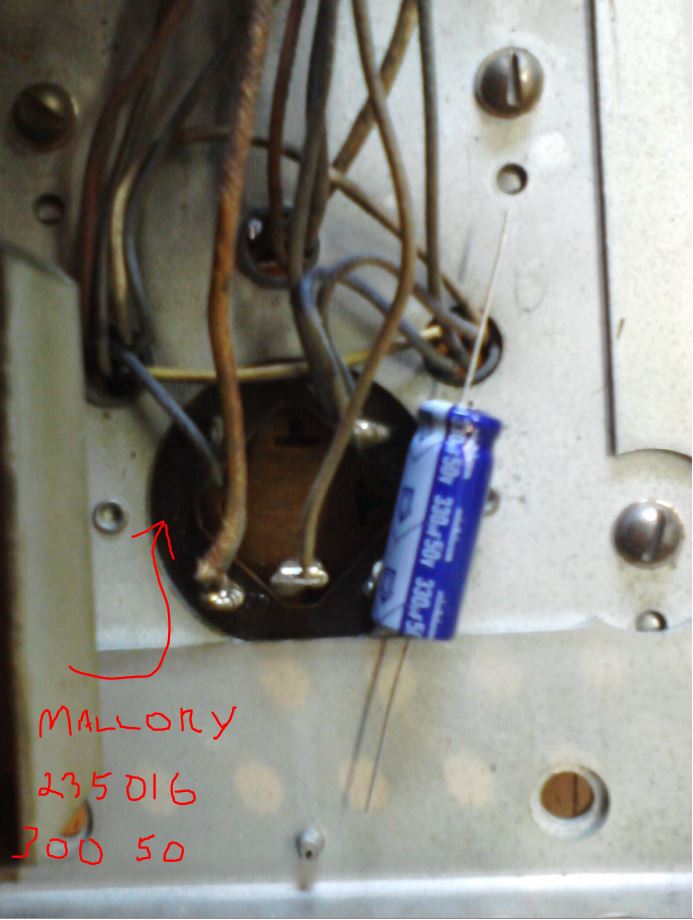
- mallory_type_wp_235016.JPG (73.88 KiB) Viewed 1078 times
-
Ron Rich
- Forum Moderator
- Posts: 8196
- Joined: Sun May 06, 2007 11:31 pm
- Location: Millbrae (San Francisco area)CA, USA
James,
There are only TWO, ELECTRICAL connections there. The "can" connections are all common. The center is the positive one. 300ufx50volts-- Ron Rich
There are only TWO, ELECTRICAL connections there. The "can" connections are all common. The center is the positive one. 300ufx50volts-- Ron Rich
-
James_Douglas
Topic author - Regular Member
- Posts: 77
- Joined: Wed May 29, 2013 1:36 am
- Location: San Francisco, CA USA
Thanks Ron!
Any performance reason to hunt down an original large Mallory type can? If not, then I will pull it and stick in the replacement and figure out a way to isolate the leads so nothing shorts.
Thanks again, James
PS. Now that I have sipped some coffee and am waking up...I can leave the Bakelite board in place when I take the Mallory out and jump the 2 common wires and then add the new capacitor between the center wire and the jumper. Correct?
Any performance reason to hunt down an original large Mallory type can? If not, then I will pull it and stick in the replacement and figure out a way to isolate the leads so nothing shorts.
Thanks again, James
PS. Now that I have sipped some coffee and am waking up...I can leave the Bakelite board in place when I take the Mallory out and jump the 2 common wires and then add the new capacitor between the center wire and the jumper. Correct?
Last edited by James_Douglas on Mon Oct 14, 2013 6:11 pm, edited 2 times in total.
-
Ron Rich
- Forum Moderator
- Posts: 8196
- Joined: Sun May 06, 2007 11:31 pm
- Location: Millbrae (San Francisco area)CA, USA
James,
You probably won't find a can like that--but there is no reason to hunt one down--
Ron Rich
You probably won't find a can like that--but there is no reason to hunt one down--
Ron Rich
James, (and anyone else dealing with these machines) Seeburg used a negative voltage with respect to chassis so it is important to keep the can of the new cap insulated. For these low voltages a little tape around the can is enough.
Rob.
Rob.
"If we believe absurdities, we shall commit atrocities" -- Voltaire
-
James_Douglas
Topic author - Regular Member
- Posts: 77
- Joined: Wed May 29, 2013 1:36 am
- Location: San Francisco, CA USA
Rob-NYC wrote:James, (and anyone else dealing with these machines) Seeburg used a negative voltage with respect to chassis so it is important to keep the can of the new cap insulated. For these low voltages a little tape around the can is enough.
Rob.
Rob, Thanks for the heads up on that. I did not know that. I will go back and wrap all the capacitor cans with some tape. Thanks again, James
-
Ron Rich
- Forum Moderator
- Posts: 8196
- Joined: Sun May 06, 2007 11:31 pm
- Location: Millbrae (San Francisco area)CA, USA
Guy's,
That cap is grounded to the can--no tape needed--the one that is not grounded is the 300uf (330) in the stepper section. Ron Rich
That cap is grounded to the can--no tape needed--the one that is not grounded is the 300uf (330) in the stepper section. Ron Rich
Who is online
Users browsing this forum: No registered users and 5 guests
It is currently Fri Oct 07, 2016 12:33 am