I summarized its functionality above, although I didn't make clear that, as well as providing speaker protection, it delays speaker connection by 5 seconds, thus eliminating on-thump. (I have the associated magazine article.)
It can be powered from 20 to 70 volts DC, configured by 2 resistors.

Rowe AMI CD100 -- speaker thump at power on
Q&A about all types of jukeboxes: Wurlitzer, Seeburg, Rock-Ola, AMI, and more.
-
Ron Rich
- Forum Moderator
- Posts: 8193
- Joined: Sun May 06, 2007 11:31 pm
- Location: Millbrae (San Francisco area)CA, USA
What's the main purpose of it--just to prevent the "Thrump", or do they claim some sort of "protection", for something ( which I doubt ?) ?
Ron Rich
Ron Rich
-
 MattTech
- Senior Member
- Posts: 1461
- Joined: Tue Apr 29, 2008 7:38 am
- Location: Philadelphia Pa USA - Home Electronics - Service Technician
Ron Rich wrote:What's the main purpose of it--just to prevent the "Thrump", or do they claim some sort of "protection", for something ( which I doubt ?) ?
Ron Rich
Ron, these contraptions sold online are meant to provide various benefits, depending on their design.
One benefit is to fatten the seller's wallet by "scare-ing" people into buying them.

But seriously, some do offer "protection" of speakers by sensing any unusual "DC" voltage potential along the speaker lines, and opening the connection via the relay.
And as you are well aware of, this can happen if the amplifier suffers a fault of some component, causing the DC "offset" to climb past a null situation.
Jukeboxes were originally meant for commercial use, and such things as a momentary "thump" were not an issue, but personally, attaching these contraptions must be done with extreme care and with considerable knowledge of the circuit in mind - because they "can" compromise reliability in some cases (thus the disclaimer we've all heard of "modifications are not covered under warranty, etc")
Some transistor output stages are sensitive to having speakers connected after powering up - the load/surge can compromise things.
The Internet is a marvelous thing, however it's not a good substitute for actually being there.
-
Ron Rich
- Forum Moderator
- Posts: 8193
- Joined: Sun May 06, 2007 11:31 pm
- Location: Millbrae (San Francisco area)CA, USA
Hi Matt,
Yep--kinda whut I had ASSUMED--but since my Momma,and Pappy attempted to teach me never to assume nothin', I attempt not to be assumptive==
 Ron Rich
Yep--kinda whut I had ASSUMED--but since my Momma,and Pappy attempted to teach me never to assume nothin', I attempt not to be assumptive==
Ron RichMattTech wrote:But seriously, some do offer "protection" of speakers by sensing any unusual "DC" voltage potential along the speaker lines, and opening the connection via the relay.
And as you are well aware of, this can happen if the amplifier suffers a fault of some component, causing the DC "offset" to climb past a null situation.
This one is the real deal in that regard. Silicon Chip magazine is a reliable publisher.
However, that board provides a lot more functionality than I'm looking for or need to eliminate the on-thump.
Will go ahead with the simple time delay relay and, for good measure, provide the amp with a dummy load until the speakers are switched in.
-
MattTech
- Senior Member
- Posts: 1461
- Joined: Tue Apr 29, 2008 7:38 am
- Location: Philadelphia Pa USA - Home Electronics - Service Technician
gtc wrote:MattTech wrote:But seriously, some do offer "protection" of speakers by sensing any unusual "DC" voltage potential along the speaker lines, and opening the connection via the relay.
And as you are well aware of, this can happen if the amplifier suffers a fault of some component, causing the DC "offset" to climb past a null situation.
This one is the real deal in that regard. Silicon Chip magazine is a reliable publisher.
However, that board provides a lot more functionality than I'm looking for or need to eliminate the on-thump.
Will go ahead with the simple time delay relay and, for good measure, provide the amp with a dummy load until the speakers are switched in.
If in doubt, a 200 ohm 10 watt load can be connected permanently across the output - before the relay - to slightly load and absorb any sudden loading issues - it will not affect speaker loading, power, or sound.
The Internet is a marvelous thing, however it's not a good substitute for actually being there.
MattTech wrote:If in doubt, a 200 ohm 10 watt load can be connected permanently across the output - before the relay - to slightly load and absorb any sudden loading issues - it will not affect speaker loading, power, or sound.
Thanks for the tip.
-
Ron Rich
- Forum Moderator
- Posts: 8193
- Joined: Sun May 06, 2007 11:31 pm
- Location: Millbrae (San Francisco area)CA, USA
Guys,
There was some questioning of "dummy loads" in the early days of transistor outputs. Thinking was that they should NEVER be power up, without a load. This changed ( as far as I know), with the invention of silicon transistors. Both Seeburg and Rowe stated it was not necessary, and both specified that the out put bias must be set, with NO, in, nor out-put of any kind, connected . I have set up many "switching systems", where the amp ran with no load for a period of time, and added no dummy load, without having any problem. Ron Rich
There was some questioning of "dummy loads" in the early days of transistor outputs. Thinking was that they should NEVER be power up, without a load. This changed ( as far as I know), with the invention of silicon transistors. Both Seeburg and Rowe stated it was not necessary, and both specified that the out put bias must be set, with NO, in, nor out-put of any kind, connected . I have set up many "switching systems", where the amp ran with no load for a period of time, and added no dummy load, without having any problem. Ron Rich
-
MattTech
- Senior Member
- Posts: 1461
- Joined: Tue Apr 29, 2008 7:38 am
- Location: Philadelphia Pa USA - Home Electronics - Service Technician
Ron Rich wrote:Guys,
There was some questioning of "dummy loads" in the early days of transistor outputs. Thinking was that they should NEVER be power up, without a load. This changed ( as far as I know), with the invention of silicon transistors. Both Seeburg and Rowe stated it was not necessary, and both specified that the out put bias must be set, with NO, in, nor out-put of any kind, connected . I have set up many "switching systems", where the amp ran with no load for a period of time, and added no dummy load, without having any problem. Ron Rich
Also, Ron, you should mention that even some vacuum tube amplifiers needed a load before powering up.
Nevertheless, without deeply scoping out the specifics of this Rowe amp, along with owner-installed modifications, it's not gonna do any harm to pop in a pre-loading stabilizer, to be on the safe side of things.
The Internet is a marvelous thing, however it's not a good substitute for actually being there.
-
Ron Rich
- Forum Moderator
- Posts: 8193
- Joined: Sun May 06, 2007 11:31 pm
- Location: Millbrae (San Francisco area)CA, USA
Hi Matt,
It is my understanding that ALL tube amps, MUST have a load-- I ASSUME that's where the idea for the early flower powered type transistor, originated ?? Ron Rich
It is my understanding that ALL tube amps, MUST have a load-- I ASSUME that's where the idea for the early flower powered type transistor, originated ?? Ron Rich
-
MattTech
- Senior Member
- Posts: 1461
- Joined: Tue Apr 29, 2008 7:38 am
- Location: Philadelphia Pa USA - Home Electronics - Service Technician
Ron Rich wrote:Hi Matt,
It is my understanding that ALL tube amps, MUST have a load-- I ASSUME that's where the idea for the early flower powered type transistor, originated ?? Ron Rich
No Ron, not "all" tube amps needed a speaker load - some were designed with "internal" safeguards to allow them to be "safe" with no loading.
For instance, amplifiers used with multiple speaker switching circuits (zone controls) and others, that could be "silenced" for headphone only use.
Console stereos that had connections for "external speaker" options where the owner would plug/unplug the external speakers, etc.
It all depends on the design, and intended use.
The Internet is a marvelous thing, however it's not a good substitute for actually being there.
-
Ron Rich
- Forum Moderator
- Posts: 8193
- Joined: Sun May 06, 2007 11:31 pm
- Location: Millbrae (San Francisco area)CA, USA
Hi Matt,
Thanks for clearing that up--I like to learn something "new", everyday--maybe some day I'll know it all ??
Ron Rich
Thanks for clearing that up--I like to learn something "new", everyday--maybe some day I'll know it all ??
Ron Rich
Well, this topic certainly took a turn.
This gets close to the genesis of the whole load vs no load.
In tube circuits where an output tran was a given, running without a load -can- result in a large inductive kickback that can cause flashover in the tube or arcover in the transformer's primary windings.
The reason is that a transformer with an unloaded secondary develops sharp "Q" -tuned resonance point. If this is excited by a transient it can generate a kickback of several times the plate B+ this causes the damage. In early transistor circuits where transformer were used this could easily exceed the Vc (collector voltage max) and punch right through the transistor.
In transistor circuits w/out any kind of inductor in the output there really isn't any need for a load.
P.A. amps (similar to jukebox) are one of the oddball circumstances in that they all have output transformers and really should not be driven without at least a nominal load. Setting quiescent bias is OK if the bias pot is itself quiet and doesn't cause spikes.
In the mid&late 80's my friend Bill had me help him in setting up three bars with vintage Seeburgs (2-201 and a modded K) all were equipped for full stereo (pointless IMO) using SHP amps. The locations also had a house PA. The owner insisted on having manual switching between juke and PA feed to the speakers. Each amp blew up at least once per year and the results were burnt driver boards and soot all over the chassis.
Bill eventually got sick of dealing with these meltdowns and reenlisted me to work on those amps. I did a little detective work and asked the various bartenders (and other mooks) when the machine had failed and finally I found what I had suspected. The juke was playing (always full-on) and some dope switched to the house PA. That caused the spike which killed the amps.
I argued with the owner about installing relays that would transfer the loads when the juke started. He agreed when I finally told him that it was either this, or Bill and I walk away (location owned the machines) and when they next fail he'd be left with three large floor lamps.
The relays eliminated the hot switching and the amps held up after that.
Rob
Guys,
There was some questioning of "dummy loads" in the early days of transistor outputs. Thinking was that they should NEVER be power up, without a load. This changed ( as far as I know), with the invention of silicon transistors. Both Seeburg and Rowe stated it was not necessary, and both specified that the out put bias must be set, with NO, in, nor out-put of any kind, connected . I have set up many "switching systems", where the amp ran with no load for a period of time, and added no dummy load, without having any problem. Ron Rich
This gets close to the genesis of the whole load vs no load.
In tube circuits where an output tran was a given, running without a load -can- result in a large inductive kickback that can cause flashover in the tube or arcover in the transformer's primary windings.
The reason is that a transformer with an unloaded secondary develops sharp "Q" -tuned resonance point. If this is excited by a transient it can generate a kickback of several times the plate B+ this causes the damage. In early transistor circuits where transformer were used this could easily exceed the Vc (collector voltage max) and punch right through the transistor.
In transistor circuits w/out any kind of inductor in the output there really isn't any need for a load.
P.A. amps (similar to jukebox) are one of the oddball circumstances in that they all have output transformers and really should not be driven without at least a nominal load. Setting quiescent bias is OK if the bias pot is itself quiet and doesn't cause spikes.
In the mid&late 80's my friend Bill had me help him in setting up three bars with vintage Seeburgs (2-201 and a modded K) all were equipped for full stereo (pointless IMO) using SHP amps. The locations also had a house PA. The owner insisted on having manual switching between juke and PA feed to the speakers. Each amp blew up at least once per year and the results were burnt driver boards and soot all over the chassis.
Bill eventually got sick of dealing with these meltdowns and reenlisted me to work on those amps. I did a little detective work and asked the various bartenders (and other mooks) when the machine had failed and finally I found what I had suspected. The juke was playing (always full-on) and some dope switched to the house PA. That caused the spike which killed the amps.
I argued with the owner about installing relays that would transfer the loads when the juke started. He agreed when I finally told him that it was either this, or Bill and I walk away (location owned the machines) and when they next fail he'd be left with three large floor lamps.
The relays eliminated the hot switching and the amps held up after that.
Rob
"If we believe absurdities, we shall commit atrocities" -- Voltaire
After a 3 week shipping wait, the timer relay arrived from Hong Kong but ... not the voltage I ordered! Sent me 220V instead of 110V. 
Sender was most apologetic and has sent me the right one. Another 3 week wait I guess.
Nice little unit though. Can make use of the 220V version elsewhere.
Sender was most apologetic and has sent me the right one. Another 3 week wait I guess.
Nice little unit though. Can make use of the 220V version elsewhere.
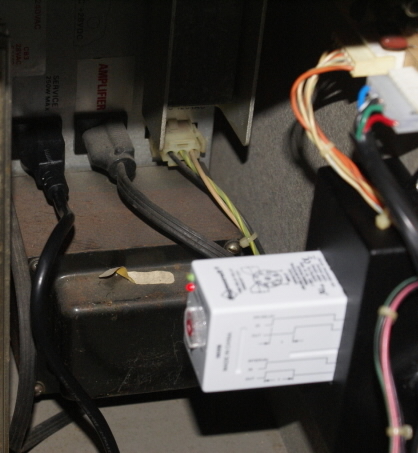
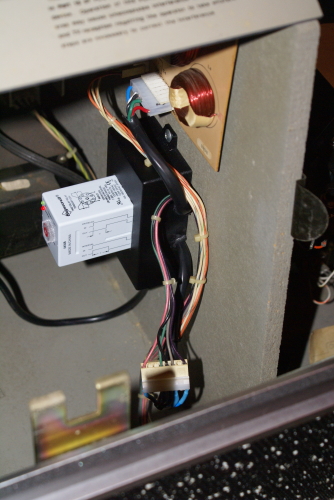
Just occurred to me to round this thread off with a few photos of how I solved the power-on thump.
The solution, which is powered via the service outlet, is non-intrusive and easily bypassed, if necessary. It puts a dummy load across the amp until the 5 second delay timer switches in the speakers.
Now all I hear at power-on is the click of the on switch.
The solution, which is powered via the service outlet, is non-intrusive and easily bypassed, if necessary. It puts a dummy load across the amp until the 5 second delay timer switches in the speakers.
Now all I hear at power-on is the click of the on switch.
- Attachments
-
- CD-100 de-thumper 2.jpg (112.65 KiB) Viewed 374 times
-
- CD-100 de-thumper 1.jpg (166.61 KiB) Viewed 374 times
Who is online
Users browsing this forum: Bing [Bot] and 6 guests
It is currently Thu Oct 06, 2016 3:34 pm