Page 1 of 2
HMV 103 from 1927
Posted: Tue Jun 22, 2010 5:19 am
by imfast101
so i recently purchased a hmv 103 from an old lady. she purchased it from a guy who came from london and gave me a bunch of 78s to go with it. Its in very nice shape...looks almost brand new! i had one question....can electronically recorded 78s be played on this machine? all the records she gave me are still in the sleeves they were purchased in and look brand new...never played, but i can tell they are electronically recorded for lack of the starting groove or whatever its called. Also how many revolutions of the crank is normally necessary to play a record? i noticed that i turn it about 18-20 times...no more than 20..will play a whole record no problem. To go more than 20 turns its really stiff on the crank. Also i paid 250 bucks for it...was it worth it? It looks like it has been totally rebuit (like the motor and reproducer). the reproducer gasket even looks like its new and so do the bearing in the tone arm. Im a total newb so i may be totally wrong LOL

any help would be AMAZING! thanks in advance!
Re: HMV 103 from 1927
Posted: Tue Jun 22, 2010 6:34 am
by Joe_DS
I can answer your first question. The HMV 103 was, indeed, designed to play the recently (1925) introduced electrically recorded records. If all original, it should be equipped with a #4 sound box (reproducer), a thin swan-neck style tonearm, and a long, tapering horn inside the cabinet.
Here's a nice photo of an HMV 103 --
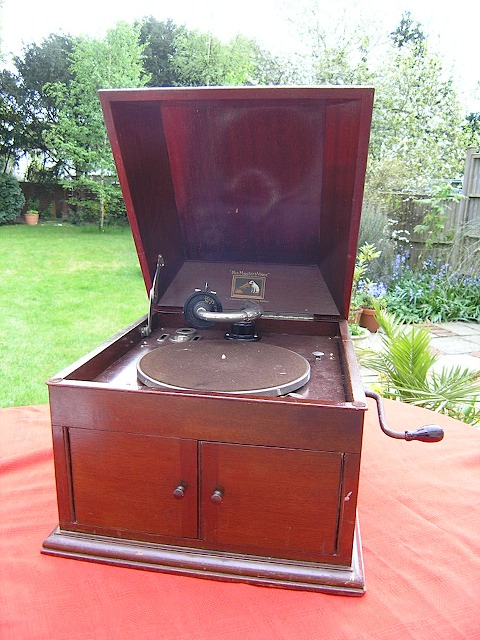
Here's one playing a circa-late 1930s/early 1940s record --
http://www.youtube.com/watch?v=pTXGXQHQAcw------------------------------------------------------------------------
If in good condition, the sound box should play most records recorded prior to about 1934 very well. You probably already know to use a steel needle only once to play one side of a record before changing, but it bears repeating.
If the motor/reproducer have been rebuilt, and the case is in good condition, I'd say you did very well for $250.
Re: HMV 103 from 1927
Posted: Tue Jun 22, 2010 6:35 pm
by imfast101
wow thanks for the info! i just didnt wanna ruin my soundbox or the records...yea the soundbox looks like its just been rebuilt and the whole machine just seems pristine. I was very surprised at the condition when i went and got it. Ill post pics when i get a chance. The only thing thats diff is that the needle cups are on the right side and the knob or the door to the motor is lower left. I emailed ian calderbank and he said it did in fact come from england and its a genuine 103. Im really pumped! I was just hoping i got my moneys worth cause i know its not one of the big 3. I also have a 1914 columbia i got from an aunt but somwhere along the line someone replaced the motor board and put a swedish motor in it

. it was free so im not complaining!
Re: HMV 103 from 1927
Posted: Tue Jun 22, 2010 6:36 pm
by imfast101
another question....how can you determine if a record was electronically recorded or not? i heard you can tell by the label but i cant find the site i found it on. i have so many records id like to separate them by age.
Re: HMV 103 from 1927
Posted: Tue Jun 22, 2010 7:50 pm
by Joe_DS
imfast101 wrote:another question....how can you determine if a record was electronically recorded or not? i heard you can tell by the label but i cant find the site i found it on. i have so many records id like to separate them by age.
You can't always tell by the label. In the US, electrically recorded Victor records were stamped with a small VE (for Victor Electric) in an oval (later the VE appeared inside a diamond) in the shellac run-off area of the groove. Columbia records used a similar marking, a "W" (for "Western Electric") in a circle. I'm not sure if HMV or UK Columbia records were stamped in a similar fashion, since I don't have any of these discs.
Other brands did put "Electrically Recorded" or a similar notice on the label itself. In the US, some of the Brunswick records were marked with "Light Ray," which described their unique electrical recording process.
In terms of sound quality, you can normally hear the difference. The acoustically recorded records often have a hollow sound quality, with very little or no bass, compared to electrically recorded discs. Electrically recorded records, especially the early ones, are bass heavy. Some also sound quite shrill or strident.
One source I turn to, when I want to get an idea when a specific record was recorded, is the Online Discographical Project --
http://www.78discography.com/ -- which lists thousands of records, along with their recording dates. Keep in mind, though, while the major companies began issuing electrically recorded records in mid-late 1925, many smaller ones continued to issue acoustically recorded discs well into the late 1920s.
Re: HMV 103 from 1927
Posted: Tue Jun 22, 2010 9:02 pm
by imfast101
wow thanks! it was def a good decision to join this forum! i didnt know they had so many helpful people out there!
thanks for all the information! it seems ive found another question lol .....What can i use to polish the tonearm and handle needle cups etc? Id like to clean them up some but i dont want to harm them. I thought about something like "never dull". idk if anyone has used it before but its like a cotton with a chemical that smells like petrol. Thanks!
Re: HMV 103 from 1927
Posted: Wed Jun 23, 2010 4:18 am
by imfast101
heres some pics of the hmv 103 i got!!
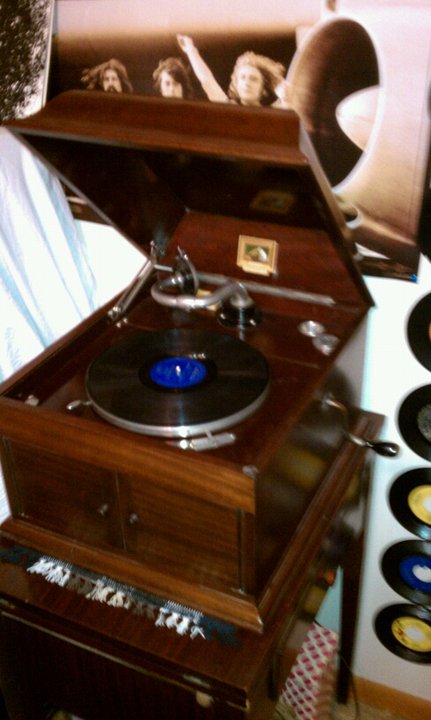
- myhmv.jpg (56.9 KiB) Viewed 3306 times
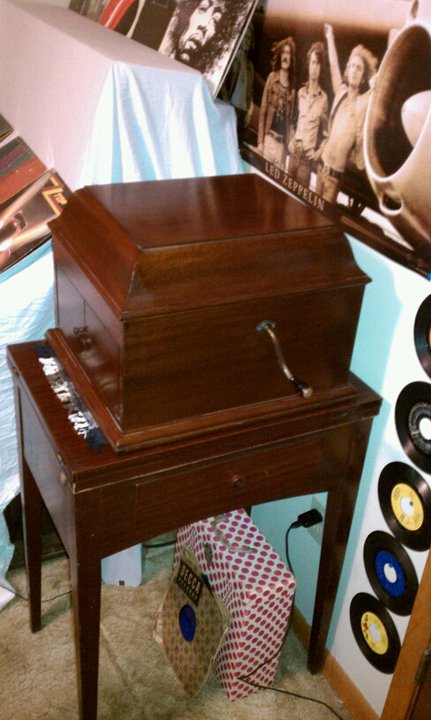
- my hmv2.jpg (69.82 KiB) Viewed 3306 times
Re: HMV 103 from 1927
Posted: Wed Jun 23, 2010 6:01 am
by Joe_DS
Nice looking gramophone! If the plating is dull, but otherwise without signs of corrosion, I think I'd leave it as-is, at least for the time being. I believe that they used nickel plating on the metal parts, but whether a protective lacquer coat was applied over the plating, I don't know. Hopefully, we'll hear from some of the UK based gramophone experts.
JDS
Re: HMV 103 from 1927
Posted: Wed Jun 23, 2010 6:34 am
by imfast101
thanks! yea there's no corrosion or nething yet....hopefully never..id love to hear from some experts haha. the only thing remotely wrong is the leather or cloth pad thing on the brake for the turntable is a little worn...doesnt keep it stopped while cranking. Thats it! lol any ideas? btw i will post a pic of my columbia when i get a chance just for the hell of it!
Re: HMV 103 from 1927
Posted: Wed Jun 23, 2010 8:04 am
by TripleSpring
UK & AU Columbias, Regals & Parlophone records all use the Western Electric "W" in a circle to indicate an elecrtic recording, and HMV will have a shape or symbol- such as a square or triangle, after the matrix number in the run-out area if it's an electrical recording. This practise seems to have stopped in the late 30s/early 40s though, but these later records will have a run-in groove anyway which will indicate an electric recording too.
Personally, I would polish all the nickel plating with a good quality metal polish. HMV never used lacquer on nickel plated parts, and leaving them dull & tarnished will only encourage corrosion in the future. The only metal finishes HMV lacquered were those such as gold or silver oxide, so these should not be polished.
As for the brake pad, I cut a small piece from a leather treadle sewing machine belt to make replacements. I have heard of people glueing a small flat piece of leather to the existing pad though. If you do replace it, just be very careful opening the prongs that hold the leather, as they can easily break off.
Re: HMV 103 from 1927
Posted: Wed Jun 23, 2010 9:09 am
by imfast101
wow ok thanks! ill def just glue cause my luck sucks..and ill def break it prolly lol. ill look for something useful and small enough around the house or ill go to the local cloth place. Whats a good metal polish? i dont want to get something to strong or anything...as i said my luck sucks and id get something thatll take plating off
Im realy eager to learn everything i can about these machines so i can properly maintain it and collect them. I get on this forum about 5 times a day just to look at all the info! keep the advice coming i appreciate it so much!
Re: HMV 103 from 1927
Posted: Wed Jun 23, 2010 9:11 am
by imfast101
btw if you see the handle in the pic thatsthe only piece thats silver and just tarnished i guess you can say....by the handle u can see the silverand away from it it turns a brown but it comes off rubbin on it. I just want to do preventive maintenance..

Re: HMV 103 from 1927
Posted: Thu Jun 24, 2010 1:04 am
by Ron Rich
Just a guess for the brake pad--How about one side, or the other of "Velcroe"---I keep finding more and more uses for that "stuff"-- Ron Rich
Re: HMV 103 from 1927
Posted: Thu Jun 24, 2010 3:26 am
by imfast101
I never thought of that...ima try it ill let u know how it works when I can. prolly the side that's not so abrasive. Anything on a good polish yet?
Re: HMV 103 from 1927
Posted: Thu Jun 24, 2010 5:39 am
by Joe_DS
imfast101 wrote:I never thought of that...ima try it ill let u know how it works when I can. prolly the side that's not so abrasive. Anything on a good polish yet?
I actually posted this, today, on another site, but it applies here, as well:
I've seen several online references to a product called "Flitz metal polish." --
http://www.flitzit.com/shopping.html -- Apparently, it's very popular with gun collectors who want to shine up the nickel plated surfaces on their antique firearms.
Paul Edie also recommends it on his site --
http://www.victor-victrola.com/RESTORAT ... ain%29.htm(Main Page --
http://www.victor-victrola.com )
For the turntable brakes, I've used a small, very thin piece of leather culled from an old belt, cut to fit, and Krazy-glued onto the blunt end of the original piece. I installed one on my present Victrola's brake about ten years ago, when I first got it, and it still works fine.