Nope-Matt--"In my day", there were no chisels----
Ron Rich

Crosley Record Player Reviews
Electrically amplified phonographs or radio/phonographs and related components (approx. 1928-1990).
-
Bobby Basham
- Senior Member
- Posts: 498
- Joined: Sat Aug 26, 2006 2:50 pm
- Location: Tucson, Arizona, USA
Ron may have graduated from Moses High like I did...I think we were using clay tablets...lot less laborious and easier on the pocket book during the school year. --BB
-
Ron Rich
- Forum Moderator
- Posts: 8193
- Joined: Sun May 06, 2007 11:31 pm
- Location: Millbrae (San Francisco area)CA, USA
Bobby,
You got it wrong, my friend ! I pre-date that by about 100k years !! Ron Rich
You got it wrong, my friend ! I pre-date that by about 100k years !!
Ron RichMy kids were always fond of asking me "Dad? Were you sad when the dinosaurs died?"
Vinyl is disease which attacks that area of the brain desiring digital recordings. Once you catch it, you are cured.
-
Ron Rich
- Forum Moderator
- Posts: 8193
- Joined: Sun May 06, 2007 11:31 pm
- Location: Millbrae (San Francisco area)CA, USA
Thom,
Then I guess your kids are old now too ??? Ron Rich
Then I guess your kids are old now too ??? Ron Rich
-
 MattTech
- Senior Member
- Posts: 1461
- Joined: Tue Apr 29, 2008 7:38 am
- Location: Philadelphia Pa USA - Home Electronics - Service Technician
Why am I now inclined to think this soon will erupt into a.....
"I'm so old that......???" thread.
"I'm so old that......???" thread.
The Internet is a marvelous thing, however it's not a good substitute for actually being there.
-
Ron Rich
- Forum Moderator
- Posts: 8193
- Joined: Sun May 06, 2007 11:31 pm
- Location: Millbrae (San Francisco area)CA, USA
Cause you are "so old", that you recall this happening before ??
Ron Rich
Ron Rich
Pilot made some very high Quality suitcase record players. Garrard 121 turntable, Magnetic Cart. transformer tube amp. HEAVY but good sound. Restore properly one of these and you are good for 20 years or more.
-
Radiotvnut
- Junior Member
- Posts: 22
- Joined: Tue Feb 01, 2011 8:18 pm
- Location: Meridian, MS
I'm the one who made the youtube video on how junky the "crosley" and other current phonographs are.
Concerning Califone record players, I like their older products; but, their later stuff does not impress me much (this is especially true of their current phonograph offering that looks like a rebadged Crosley).
When I was in elementary school during the '80's, we had some older Califone model 1410 and 1440 tube type record players, in addition to the blue and brown cased 1430K solid state models with the light on the tonearm. By the time I made it to jr. high school, there were some newer grey cased 1430K's and 1430C's. In the music room of my middle school, there was a Califone stereo model.
Over the years, I've worked on a good many idler driven Califone school record players and I generally like the older ones better. Sometime in the late '80's-early '90's, they stopped using the standard shaded pole AC motor in favor of a cheap DC motor. I've worked on a couple of mid-to-late '90's Califone model 1010AV record players that used this motor and on both of them, the cheap little motor was on it's way out. Had it not been for the cheap motor, they might have been decent machines. Of course, Califone does not offer parts support for older models and a new motor was NLA. On one of these units, I yanked out the newer drive mechanism and replaced it with an older AC motor driven mechanism.
The current Califone phonograph offering, the 1005, looks like a pile of crap. From what I've read about it, this model contains no headphone jack, uses a single needle for all speeds, and does not even have corner protectors on the cabinet.
I guess my favorite school phonographs are the tube Newcomb models from the '60's and '70's. These are built like tanks and generally sound very good. I also like the older Audiotronics models, except for the later ones with plastic tonearms. I'm not too crazy about the early solid state school record players because many of them use germanium transistors that have their own built-in "waterfall effect". In today's world, those old germanium transistors are getting unstable and new ones are often difficult to find or expensive.
Concerning Califone record players, I like their older products; but, their later stuff does not impress me much (this is especially true of their current phonograph offering that looks like a rebadged Crosley).
When I was in elementary school during the '80's, we had some older Califone model 1410 and 1440 tube type record players, in addition to the blue and brown cased 1430K solid state models with the light on the tonearm. By the time I made it to jr. high school, there were some newer grey cased 1430K's and 1430C's. In the music room of my middle school, there was a Califone stereo model.
Over the years, I've worked on a good many idler driven Califone school record players and I generally like the older ones better. Sometime in the late '80's-early '90's, they stopped using the standard shaded pole AC motor in favor of a cheap DC motor. I've worked on a couple of mid-to-late '90's Califone model 1010AV record players that used this motor and on both of them, the cheap little motor was on it's way out. Had it not been for the cheap motor, they might have been decent machines. Of course, Califone does not offer parts support for older models and a new motor was NLA. On one of these units, I yanked out the newer drive mechanism and replaced it with an older AC motor driven mechanism.
The current Califone phonograph offering, the 1005, looks like a pile of crap. From what I've read about it, this model contains no headphone jack, uses a single needle for all speeds, and does not even have corner protectors on the cabinet.
I guess my favorite school phonographs are the tube Newcomb models from the '60's and '70's. These are built like tanks and generally sound very good. I also like the older Audiotronics models, except for the later ones with plastic tonearms. I'm not too crazy about the early solid state school record players because many of them use germanium transistors that have their own built-in "waterfall effect". In today's world, those old germanium transistors are getting unstable and new ones are often difficult to find or expensive.
-
Bobby Basham
- Senior Member
- Posts: 498
- Joined: Sat Aug 26, 2006 2:50 pm
- Location: Tucson, Arizona, USA
I also like the older Newcomb, Audiotronics, VM stuff. I have one of those older classroom tube record players with the single 12A7(?) tube. Small oval speaker in the front, but when you put your ear up close to it, the "fidelity" was amazing. And it seems like that headphone jack was tapped right off the speaker...no padding down of the output so it could probably be used for an extension speaker.
Some of these thrift stores have back rooms and "bone yards" where stuff is just piled up and doesn't sell well. Ask to take a look-see back there and you may be surpised at what you find. --BB
Bobby Basham
Tucson, Arizona
Some of these thrift stores have back rooms and "bone yards" where stuff is just piled up and doesn't sell well. Ask to take a look-see back there and you may be surpised at what you find. --BB
Bobby Basham
Tucson, Arizona
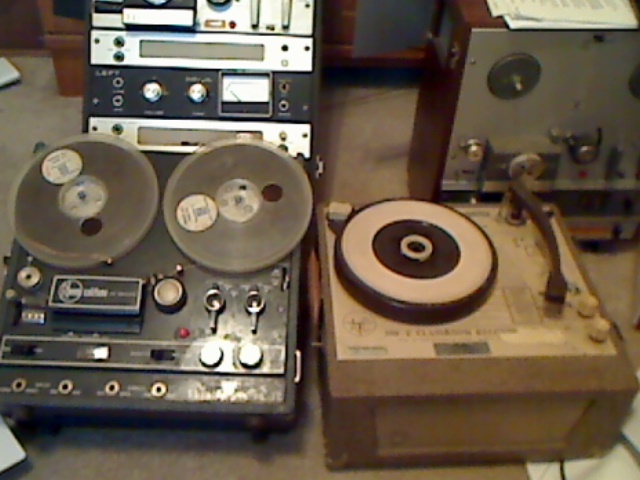
- Classroom tape recorder and phono - FREE!
- Rheem-Califone and Audiotronics.jpg (89.18 KiB) Viewed 1013 times
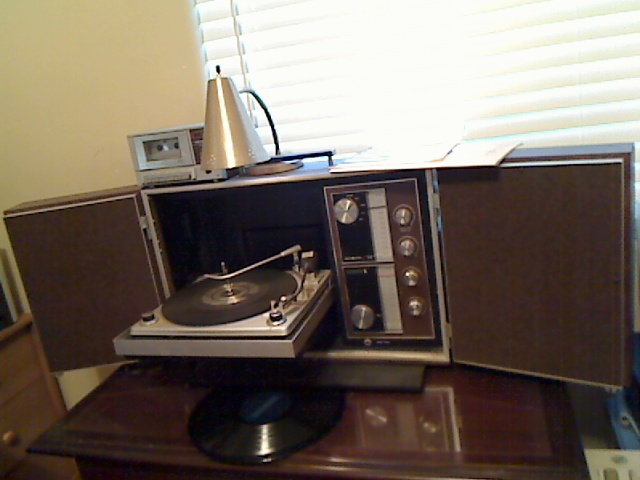
- Stereo Portable w/ detachable speakers $20.00
- Zenith-01A.jpg (81.44 KiB) Viewed 1013 times
- SELF-CONTAINED TUBE MODEL - ONLY $3.98
- Webcor Stereo Recorder.jpg (3.1 KiB) Viewed 1013 times
-
Radiotvnut
- Junior Member
- Posts: 22
- Joined: Tue Feb 01, 2011 8:18 pm
- Location: Meridian, MS
Most of the classroom record players had the headphone jack wired across the speaker with no padding. That was so that an external speaker or listening station with individual volume controls could be used. I'd like to find one of those Audiotronics models with the single 6T9 tube, as well as a Rheem-Califone record player (1410, 1430, 1440) from the late '60's-early '70's.
-
 Record-changer
- Senior Member
- Posts: 1139
- Joined: Fri Apr 21, 2006 8:11 pm
- Location: Bloomington IN USA
If it really ran way too fast, you might have gotten one intended for use in Europe, where the line frequency is 50 Hz. Running that on 60 Hz would make it 20% fast.
Who is online
Users browsing this forum: No registered users and 4 guests
It is currently Thu Oct 06, 2016 10:06 am
