
last year to play on an acoustic machine
Messages about vintage 78rpm records and cylinder records.
-
likes2listen
Topic author - Junior Member
- Posts: 6
- Joined: Thu Jun 28, 2007 12:05 am
- Location: Washington DC
I've seen 3 different dates, pre-WWII (1940 I guess the 1st four mos didnt count?), 1935, and glancing here 1932. So is there a definitive date, or is it kind of open. If its the later, is there any timeline for specific labels. I've stuck to 1930 (being conservative), but would certainly like to expand that, if I could without unintentionally wrecking a record by playing it on an old talking machine. I guess other question is why the switch, less costly to produce? Better sound? Thnks.
-
 Neophone
- Senior Member
- Posts: 174
- Joined: Thu Nov 02, 2006 4:18 am
- Location: South Boston, Mass., U.S.A.
L2L,
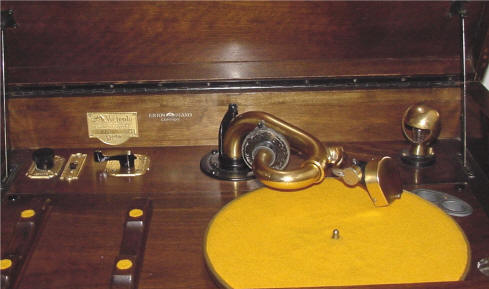
You will find many different "definitive" answers. I understand it has to do with the recipies/hardness of the shellac and/or the abrasives in the shellac. I stick, for the most part with mid-thirties. What type phonograph are you talking about here? Mica or aluminum diaphragmed? I play all but the earliest electrics on my Victor Granada. I have some new-ish stuff from the fifties I don't play on an acoustic machine ever, but I give forties stuff at least one spin on the Granada. Of course I use soft tone or fibre needles. I have also heard it said that European releases used harder shellac longer than in the U.S.
Check the needle after playing the record. if it's clean, no "fluff" it's probably fine to play with a mechanical reproducer. Of course it goes without saying if you're hearing blasting on the loud passages you're are exceeding the range of the reproducer.
Why the change over to electric pick-up? "Better" sound, the ability to control volume better, lighter pick-ups hence less record wear (at least after the first few years of elecrtic pickups! ) Probably a bit of "Keeping up with the Jones" and I'm sure economics eventually led to the change. My best guess on that LOL!
Regards,
J.
You will find many different "definitive" answers.
I understand it has to do with the recipies/hardness of the shellac and/or the abrasives in the shellac. I stick, for the most part with mid-thirties. What type phonograph are you talking about here? Mica or aluminum diaphragmed? I play all but the earliest electrics on my Victor Granada. I have some new-ish stuff from the fifties I don't play on an acoustic machine ever, but I give forties stuff at least one spin on the Granada. Of course I use soft tone or fibre needles. I have also heard it said that European releases used harder shellac longer than in the U.S.
Check the needle after playing the record. if it's clean, no "fluff" it's probably fine to play with a mechanical reproducer. Of course it goes without saying if you're hearing blasting on the loud passages you're are exceeding the range of the reproducer.
Why the change over to electric pick-up? "Better" sound, the ability to control volume better, lighter pick-ups hence less record wear (at least after the first few years of elecrtic pickups!
) Probably a bit of "Keeping up with the Jones" and I'm sure economics eventually led to the change. My best guess on that LOL!
Regards,
J.
Listening to the Victrola fifteen minutes a day will brighten and alter your whole life...
-
likes2listen
Topic author - Junior Member
- Posts: 6
- Joined: Thu Jun 28, 2007 12:05 am
- Location: Washington DC
J,
Thanks for the tip. How clueless of me NOT to think of checking the needle after a play. I guess the only hang up with that is spending big bucks on a disk only to find you shouldn't play. Sorry for my poor choice of words, but I was thinking in terms of the record material rather than the player. It's kind of interesting in the sense, were they cheaper to make, less fragile, yet wore more than the older disks?
Thanks for the tip. How clueless of me NOT to think of checking the needle after a play. I guess the only hang up with that is spending big bucks on a disk only to find you shouldn't play. Sorry for my poor choice of words, but I was thinking in terms of the record material rather than the player. It's kind of interesting in the sense, were they cheaper to make, less fragile, yet wore more than the older disks?
-
Neophone
- Senior Member
- Posts: 174
- Joined: Thu Nov 02, 2006 4:18 am
- Location: South Boston, Mass., U.S.A.
L2L,
DUH! Don't mind me! The records! Yeah, cheaper I'll bet and cheaper to ship and handle due to decreased weight. And of course as newer machines with lighter electronic pick-ups became more the norm those heavy, sturdy discs were no longer necessary. Then vinyl replaced shellac due to it's resistance to breakage and probably cost-and on from there. At least that's what I'd assume.
Regards,
J.
P.S. As far as the checking the needle thingy-I meant to say (My poor choice of words this time! ) If you do that for various records after a while you'll get an idea of the various labels and eras and what will safely play.-unfortunately you may damage a record or two, but in the long run you'll be able to guesstimate in advance.
DUH! Don't mind me!
The records! Yeah, cheaper I'll bet and cheaper to ship and handle due to decreased weight. And of course as newer machines with lighter electronic pick-ups became more the norm those heavy, sturdy discs were no longer necessary. Then vinyl replaced shellac due to it's resistance to breakage and probably cost-and on from there. At least that's what I'd assume.
Regards,
J.
P.S. As far as the checking the needle thingy-I meant to say (My poor choice of words this time!
) If you do that for various records after a while you'll get an idea of the various labels and eras and what will safely play.-unfortunately you may damage a record or two, but in the long run you'll be able to guesstimate in advance.Listening to the Victrola fifteen minutes a day will brighten and alter your whole life...
-
likes2listen
Topic author - Junior Member
- Posts: 6
- Joined: Thu Jun 28, 2007 12:05 am
- Location: Washington DC
-
Neophone
- Senior Member
- Posts: 174
- Joined: Thu Nov 02, 2006 4:18 am
- Location: South Boston, Mass., U.S.A.
-
likes2listen
Topic author - Junior Member
- Posts: 6
- Joined: Thu Jun 28, 2007 12:05 am
- Location: Washington DC
-
Neophone
- Senior Member
- Posts: 174
- Joined: Thu Nov 02, 2006 4:18 am
- Location: South Boston, Mass., U.S.A.
-
likes2listen
Topic author - Junior Member
- Posts: 6
- Joined: Thu Jun 28, 2007 12:05 am
- Location: Washington DC
I'll keep the fingers crossed for you. I initially purchased mine purely as a conversation piece (I live in a really old home) and had to have a victor as I once worked for RCA in Camden NJ and in the building where I was told that Caruso recorded. I also worked next to the building where they produced the old cathedral radios (have one of those too!). Anyway, with the Victor, there were a couple of 78s I decided to play one on a whim and well the rest is pretty obvious!
-
Neophone
- Senior Member
- Posts: 174
- Joined: Thu Nov 02, 2006 4:18 am
- Location: South Boston, Mass., U.S.A.
L2L,
Thanks for the well wishes. That's a fantastic story. It is so easy to get hooked! There's so much wonderful music on these old 78's. I've been hooked now for about three years. I just keep finding more and more great stuff!
Regards,
J.
Thanks for the well wishes. That's a fantastic story. It is so easy to get hooked!
There's so much wonderful music on these old 78's. I've been hooked now for about three years. I just keep finding more and more great stuff!
Regards,
J.
Listening to the Victrola fifteen minutes a day will brighten and alter your whole life...
-
 Record-changer
- Senior Member
- Posts: 1139
- Joined: Fri Apr 21, 2006 8:11 pm
- Location: Bloomington IN USA
What I would do is play most 78s on electronic phonos. I would then get second copies of records without much monetary value to play on the acoustic machine. All acoustic phonos wear out records rapidly, but the ones made after 1932 wear out quicker on them. 1932 is the year Victor started using the softer shellac for better quality, because it no longer sold acoustic players after being bought by RCA. Other companies started changing over later, because they still had acoustic players.
The electronic record player was invented in 1926. The corresponding use of electric motors and the invention of the record changer in 1927 led to the standardization of record speeds as 78.26 rpm in 1928. But, with the exception of Brunswick and a few small companies, most phonograph companies stayed with acoustic players until they started making combination radio-phonos. Victor made some acoustic phonos with RCA radios in them before being bought by RCA. The stock-market crash put Victor into near-bankruptcy, and RCA bought it in 1931.
The electronic record player was invented in 1926. The corresponding use of electric motors and the invention of the record changer in 1927 led to the standardization of record speeds as 78.26 rpm in 1928. But, with the exception of Brunswick and a few small companies, most phonograph companies stayed with acoustic players until they started making combination radio-phonos. Victor made some acoustic phonos with RCA radios in them before being bought by RCA. The stock-market crash put Victor into near-bankruptcy, and RCA bought it in 1931.
-
Joe_DS
- Forum Moderator
- Posts: 1056
- Joined: Thu Jun 08, 2006 4:23 pm
- Location: San Francisco, California, USA
Victor made some acoustic phonos with RCA radios in them before being bought by RCA. The stock-market crash put Victor into near-bankruptcy, and RCA bought it in 1931.
I hate to nit-pick, but neither "near-bankruptcy" nor the stock market crash had anything to do with the sale of the Victor Talking Machine Co to RCA, and it wasn't sold to RCA in 1931.
On January 6, 1927, Eldridge Johnson ( http://en.wikipedia.org/wiki/Eldridge_R._Johnson ) sold his controlling interest in Victor to the banking firm of Siegelman & Spyer, which in 1929 sold the company to the Radio Corporation of America, ( http://en.wikipedia.org/wiki/Radio_Corp ... of_America ). The company then became known as the "Radio-Victor Division of the Radio Corporation of America," and later, RCA Victor.
At the time of Johnson's sale to Siegelman & Spyer, The Victor Talking Machine Company was a profitable business. It remained profitable at the time it was sold to RCA by the banking firm.
REFERENCES --
http://www.davidsarnoff.org/vtm-appendix01.html
http://victor-victrola.com/
MORE CAN BE FOUND BY DOING A GOOGLE SEARCH FOR THE FOLLOWING TERMS:
Victor talking machine company "Siegelman & Spyer"
Victor made some acoustic phonos with RCA radios in them before being bought by RCA.
True! During the 1926-1929 period, there were a number of acoustic Orthophonic models equipped with built-in radiolas. Even before that, starting around 1922/1923, Victor began offering "radio-ready" Victrolas equipped with special panels designed for the installation of small radio sets, as noted on the Victor-Victrola page -- http://victor-victrola.com/ and in "Look for the Dog."
But, with the exception of Brunswick and a few small companies, most phonograph companies stayed with acoustic players until they started making combination radio-phonos.
Of course, Victor also sold a number of all-electric Victrolas (using loudspeakers in place of horns), dubbed "Electrolas," as well as Electrola/Radiola combinations, starting in early 1926. They were given fancy names, in addition to numeric designations, such as:
The Cromwell (12-1); produced between 1926-1928
The Tuscany (12-2); produced 1926
The 12-15; produced 1928
The 12-25; produced 1927-1928
The Hyperion (15-1); produced 1926-1928
Sources:
Look for the Dog; Robert Baumbach
Victor-Victrola Page -- http://victor-victrola.com/
In addition to the Electrolas, during the 1926-1928 period, Victor also offered a number of electric/acoustic models using an electronic (tube amplified) pick-up and a driver (voice coil) coupled to an exponential horn. One interesting model, the VE-8-60 -- http://victor-victrola.com/8-60.htm -- offered BOTH electrically amplified as well as all-acoustic reproduction!
VE-8-60
BTW, during this same period--circa 1926-1928--Columbia also offered a line of all electric models--known as "Electric Viva-Tonal Phonographs;" the 900, 901, 920 and 930. They also produced phonograph/radio combinations, as well as radios sans phonographs.
-
Neophone
- Senior Member
- Posts: 174
- Joined: Thu Nov 02, 2006 4:18 am
- Location: South Boston, Mass., U.S.A.
All acoustic phonos wear out records rapidly,....
I would have to disagree with that. With a good rebuilt reproducer, well lubricated tone-arm and a fresh steel needle or a fibre needle. wear will be negligible. I am not debating the fact that for the most part modern lightweight pick-ups are better for any record, however these records were designed with heavy reproducers in mind. I do believe the early electric pick-ups sold in the mid thirties were nearly as heavy as an acoustic reproducer. (Does anyone have any info on the weight of early electric pick-ups?)
Regards,
J.
Listening to the Victrola fifteen minutes a day will brighten and alter your whole life...
-
Record-changer
- Senior Member
- Posts: 1139
- Joined: Fri Apr 21, 2006 8:11 pm
- Location: Bloomington IN USA
Always nice to have more accurate data. My source was a magazine article which I have also found to be inaccurate elsewhere (It's photo of a "1931 Garrard RC-1" is actually a 1937 Collaro RC-1). I probably had that info somewhere, but I didn't know where to look.
A shellac record on an acoustic reproducer is usually not good for more than 50 plays. With a modern electronic system, wear is not detectable on a shellac record, although it is on a vinyl record.
I have measured a tracking force of over 5 pounds on some acoustic reproducers, and about half a pound on the early RCA Duo system.
That's two KILOgrams equivalent force for the acoustic, and 257 grams equivalent force for the early electronic. By 1946, they had cartridges able to track at half an ounce (14 grams equivalent force), and the first LP and 45 pickups tracked at around 10 grams equivalent force.
A shellac record on an acoustic reproducer is usually not good for more than 50 plays. With a modern electronic system, wear is not detectable on a shellac record, although it is on a vinyl record.
I have measured a tracking force of over 5 pounds on some acoustic reproducers, and about half a pound on the early RCA Duo system.
That's two KILOgrams equivalent force for the acoustic, and 257 grams equivalent force for the early electronic. By 1946, they had cartridges able to track at half an ounce (14 grams equivalent force), and the first LP and 45 pickups tracked at around 10 grams equivalent force.
-
likes2listen
Topic author - Junior Member
- Posts: 6
- Joined: Thu Jun 28, 2007 12:05 am
- Location: Washington DC
Who is online
Users browsing this forum: No registered users and 1 guest
It is currently Thu Oct 06, 2016 8:05 am