Page 1 of 1
Things to look out for when a grammophone starts to resonate
Posted: Thu Mar 20, 2008 8:34 pm
by xpro
Hi!
I got a Columbia No. 56 grammophone and it worked like a charm when I got it. Real nice loud sound. This morning however after playing a record, the second record didn't really want to get to speed, so I cranked it on a bit. It then started to have a loud noise coming from somewhere in the mechanics. It only starts when it gets up to speed. When I keep the device on its side, then it spins without any mechanical sound at all.
I was wondering where to look for a cause. I've had the turn table out of the box to inspect it but saw nothing odd, nothing that seems out of place. Perhaps it needs to be lubricated? Everything is functioning as it should, just that sound. It has an effect on the speed too, and it is shaking a bit, so you can hear it has an effect on the music as well. Is something resonating?
I realise it is difficult to judge what it is based on this description, but could someone perhaps indicate what kind of things I should be looking for and also if a device like this needs to be lubricated at special places? Thanks a lot!
Ron
Re: Things to look out for when a grammophone starts to resonate
Posted: Fri Mar 21, 2008 12:47 am
by Joe_DS
Oftentimes the noise/vibration you describe can be eliminated by putting a few drops of lightweight oil onto the small leather "foot" or "friction leather pad" that interacts with the governor's wheel (governor flange). Here's a few photos of a Victor Victrola governor, but the overall principle is the same for all gramophones:
TYPICAL 3-SPRING GOVERNOR -- 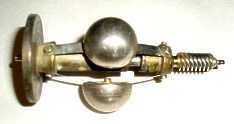 GOVERNOR PARTS --
If this does not solve the problem, make sure that the end screws holding the governor's three "flat springs" in place have not come loose. If so, try gently tightening them with an appropriate sized screwdriver.
If the speed slows down and speeds up while the turntable is spinning, then also check to make sure that the governor, itself, does not move sideways on its mounting. This can be adjusted by loosening the outer governor bushing's set screw and moving the governor bushing inward slightly. (The Governor shouldn't be held in place too tightly, or the governor will not be able to spin freely.) It would also probably help to put a drop of oil into the bushing, itself.
Re: Things to look out for when a grammophone starts to resonate
Posted: Fri Mar 21, 2008 1:06 am
by xpro
Oh this is great information, Joe. Thank you! When I took the mechanism out of the box I did locate the governor, and wondered if it was to blame for all this. I will attempt to get some light oil, and try that first. From your pictures I now also understand how it is supposed to work, as that was difficult to see in my Columbia. So that's great too!
Re: Things to look out for when a grammophone starts to resonate
Posted: Fri Mar 21, 2008 3:07 am
by Joe_DS
Hi Ron:
You probably already know this, but just in case... make sure you let the motor wind down completely before doing any work on the governor, or any part, for that matter. When I tackled my first motor, I accidentally overlooked this, and ended up with a torn thumb and a broken mainspring.
Also, if you are a do-it-yourself type person, try to locate a copy of "The Compleat Talking Machine" by Eric Reiss. (That's the way "complete" is spelled in the book's title.) It's available at Amazon.com and from most well-stocked book sellers. The book is packed with illustrations and step by step instructions for most repairs.
Joe_DS
Re: Things to look out for when a grammophone starts to resonate
Posted: Fri Mar 21, 2008 1:19 pm
by xpro
It's good you say that. I have seen that it doesn't take much for the turntable to be released and set in motion when the spring is not unwound. Probably would have forgotten about it.
Thanks for the tips, likely to try today or tomorrow.
Re: Things to look out for when a grammophone starts to resonate
Posted: Fri Mar 21, 2008 10:34 pm
by xpro
When I had oiled the regulator a bit it became noticeably better. Now the grammophone was useable again. It still has a bit of rumbling noise when slowing down, but not at the operating speed with the needle on the record. I guess this really shows it is the governor. I oiled the flange a bit, but that didn't do so much. But when I look at it closely then I think the rubber pad has just worn out. It seems some kind of spungy material, and I can just imagine that I am hearing some of the metal rubbing on the flange.
So the question is if one usually has to replace the rubber pad after years of use? I guess so, but is it possible to buy such replacements or can I use some ordinary materials? And also: would I have to adjust a lot? I could imagine that this rubber pad needs to be sitting correctly to end up at the correct speed?
Otherwise I am really happy with the advice here. I got my grammophone back to work and I learned a lot about how it works on the inside.
Re: Things to look out for when a grammophone starts to resonate
Posted: Sat Mar 22, 2008 3:13 pm
by Neophone
Xpro,
That governor pad is probably leather or felt, not rubber. You can replace it with a small bit of belt leather or a small bit of felt from a fabric store, which ever is appropriate. The length isn't critical, that's what the speed regulator screw/lever is for.
Be very very careful opening up the small prongs holding the pad and be sure to support the assembly. It would be best to remove the part in question if you can easily figure out how it comes out. Watch out for any springs.
Once you get it squared away you can down-load a great stroboscope
HERE or photocopy the one out of the back of
The Compleat Talking MachineThe rest of the motor probably needs at least a bit of a wipe down and re-greasing and oiling. If your machine doesn't have an oiling chart give a shout. I'm sure one of us here has a decent image of one or knows where one is on-line. Good Luck!
Regards,
J.
Re: Things to look out for when a grammophone starts to resonate
Posted: Sat Mar 22, 2008 8:38 pm
by xpro
I took a good look at it again. Could indeed be felt. It seems a bit difficult to remove. I didn't see any obvious screws there, but maybe it could get clearer when I would take the horn off, as it obscures the view a lot. But I could see that there should be some material left, so it was maybe not that bad at all.
I printed a stroboscope from the Jean Vernet programme, as I needed one for 50Hz being in Europe. What a smart idea to use the light bulb as source. It was exactly the reason why I asked, being affraid I would have to get some kind of expensive strobe for the adjustment. But I can see that the speed is quite ok (not surprisingly as the sound was right), so when things get bad, I am prepared to replace the governor pad. For now I oiled the flange a bit more, and I think it is quite ok.
Thanks for all your help guys! I am happy to be able to use my grammophone again, and maybe with all this enthusiasm here, I buy another one in the future too. What a great machine!