I was reading with interest a prior thread from last week regarding the tone arm pressure in the 1950's and 60's vintage RCA record changers. I was wondering the same thing about the correct weight of the stylus on the records. When I played a new condition recently produced 45 record on my 1954 RCA 3-HES-5 with ceramic Sonotone pickup and stylus (with RCA record changer-- not the V-M model), the stylus created a new groove into the disc that I could see in certain light. The stylus is new, so I know that's not the problem, and I checked it under a microscope also.
There seems to be no adjustment for the pressure of the tone arm, only a spring acting as a counterbalance. The RCA shop manuals with their exploded views make no mention of a tone arm pressure adjustment for this record changer.
So my questions are: Is the only way of adjusting the pressure by bending the spring plate or using a different, stronger spring? What should the pressure be with this pickup? What are the causes of the stylus "grooving" the record-- and what is the correct term for this occurence? It has happened so much to me that I'm afraid to ever play a nice record on my machines. If you hold a light at the correct angle as the record plays, you can see the track it makes. Am I only supposed to be playing records recorded before a certain period because of the hardness of the material? I certainly don't want to damage my records.
I restore early jukeboxes and I never have any problems at all with this issue, so I can only assume it's a pressure related problem, or the pivots both up and down and lateral need lubricating. Thanks for any help.

1954 RCA 3-HES-5 Tone Arm Pressure
Electrically amplified phonographs or radio/phonographs and related components (approx. 1928-1990).
-
Seeburg Music
Topic author - Junior Member
- Posts: 7
- Joined: Wed Apr 15, 2009 10:04 pm
- Location: Baltimore, Maryland USA
-
 Record-changer
- Senior Member
- Posts: 1139
- Joined: Fri Apr 21, 2006 8:11 pm
- Location: Bloomington IN USA
The correct force (not pressure) is about 8 grams equivalent force on the older ones and 5 on the newer ones, with original pickup. I don't know what pickup you have, so you should find out its range.
Changing the cartridge on a spring counterbalanced arm changes the stylus force, because the new cartridge weighs more or less than the old one.
Causes for the stylus carving its own groove:
- Stereo record used with mono pickup
- Too much horizontal friction, combined with too much stylus force
- Damaged or missing stylus point
- Used recording stylus by mistake (cartridge with needle chuck and screw)
- Used 78 stylus by mistake
- Used a styrene record with the older pickup
- Something is blocking the motion of the tonearm
- Stylus force too low for the stylus to track
- Arm height misadjusted, lifting the stylus from the record
- The cartridge or a mounting screw is also striking the record
- The position trip parts are binding
Another method of changing stylus force adds weight to the back of the arm.
Never guess at stylus force.
Changing the cartridge on a spring counterbalanced arm changes the stylus force, because the new cartridge weighs more or less than the old one.
Causes for the stylus carving its own groove:
- Stereo record used with mono pickup
- Too much horizontal friction, combined with too much stylus force
- Damaged or missing stylus point
- Used recording stylus by mistake (cartridge with needle chuck and screw)
- Used 78 stylus by mistake
- Used a styrene record with the older pickup
- Something is blocking the motion of the tonearm
- Stylus force too low for the stylus to track
- Arm height misadjusted, lifting the stylus from the record
- The cartridge or a mounting screw is also striking the record
- The position trip parts are binding
Another method of changing stylus force adds weight to the back of the arm.
Never guess at stylus force.
-
TripleSpring
- Regular Member
- Posts: 55
- Joined: Fri Jan 16, 2009 11:23 am
I always thought 2 grams was the recommended pressure for vinyl records?
-
Seeburg Music
Topic author - Junior Member
- Posts: 7
- Joined: Wed Apr 15, 2009 10:04 pm
- Location: Baltimore, Maryland USA
The RCA 3-HES-5 discussed here in my original posting is still using the original Sonotone 2T with the correct stylus in good condition. I didn't realize that you couldn't use styrene records on this? I figured the reason it was carving the groove was because the tracking was too heavy, not because of the cartridge/stylus itself. Perhaps the Sonotone 2T stylus cannot track with the more modern groove. This is interesting because I have never had this issue with any of the Wurlitzer or Rock-Ola jukeboxes we restore.
I was originally thinking of perhaps changing the cartridge to the one that the classroom Newcomb and Califone phonographs used in the 50's-70's. I think the stylus is an Astatic 81-T. However, I don't think you can get this stylus with the 78 tip on them anymore.
Is there a better ceramic replacement for this that can still give me both stylus tips?
I was originally thinking of perhaps changing the cartridge to the one that the classroom Newcomb and Califone phonographs used in the 50's-70's. I think the stylus is an Astatic 81-T. However, I don't think you can get this stylus with the 78 tip on them anymore.
Is there a better ceramic replacement for this that can still give me both stylus tips?
-
Record-changer
- Senior Member
- Posts: 1139
- Joined: Fri Apr 21, 2006 8:11 pm
- Location: Bloomington IN USA
I somehow thought you had a 45 player. Some of the info was confined to that (e.g. position trip).
Can you describe in more detail what the stylus is doing?
1954 pickups must NOT be used with stereo records. They will destroy the vertical modulation in the groove.
Ditto on jukebox pickups. The record will sound OK with the mono pickup, but it will sound awful when played on stereo players.
For TripleSpring:
2 grams-equivalent is the preferred tracking force with a precision arm and a modern cartridge. But such equipment was not available until the late 1960s.
- When the LP was first designed, it was designed for 12 grams-equivalent or less.
- By the mid 1950s, the average record player tracked at 8 grams-equivalent.
- By the early 1960s, 5 grams-equivalent was the norm, and 3 grams-equivalent was the best available.
- The Collaro changers used in most Magnavox stereos in the early 1960s were set at 3 to 4 grams-equivalent.
- To get tracking forces lower than 3 grams-equivalent, arms had to be redesigned. Ball bearings replaced the sleeve bearings used earlier, and antiskating devices were added. SME made the first arm that tracked below 3 grams-equivalent, and Dual made the first record changer able to track at under 3 grams-equivalent (1019, and 1009 mkII).
- I am running the 1961 Collaro changer in my avatar at 2 grams-equivalent, because I replaced the sleeve bearings with ball bearings and added antiskate. I did not have to modify the trip mechanism to achieve this.
- For some unknown reason, RCA always set the tracking force at the upper limit of the pickup it used.
- Garrard had an arm that could track below 3 grams-equivalent on the A-70 and Lab-80, but the trip mechanism had too much drag to work at forces under 3 grams-equivalent. And BSR had only a few units that could track reliably below 3 grams-equivalent (Notably 810 and 710).
- The Collaro units in the 1970s with magnetic cartridges tracked at 2 grams.
- Arms and pickups were made that tracked under 1 gram, but the effects of warped records and static electricity made them too unstable for reliable use.
- Most DJ pickups track at 3 to 5 grams, because immunity to skipping is more important than minimizing wear.
Note that the tracking force must match the range the cartridge is designed for. Otherwise the stylus will either rattle in the groove or weigh too heavily on the groove. The rattling is actually more destructive than the heavy force. So it is more dangerous to track a bit too light than to track too heavy.
Styrene records wear excessively with tracking forces over 4 grams.
Note that I use "grams-equivalent" in my text. That's because the gram is not a unit of force. It is a unit of mass. The newton is the correct unit for force, but 9.8 N is the weight of a kilogram at sea level. The gram-equivalent force used as a "gram" on pickup arms is actually 9.8 millinewtons. 2 grams-equivalent would be 19.6 mN.
Part of the problem comes from the use of the German unit "pond." It is a gram-equivalent unit of force (the weight of a gram of mass at sea level) that is NOT part of the metric system. It was incorrectly translated as "gram" when the manuals of Dual and Miracord changers were translated into other languages. This started the use of the wrong unit of measure for tracking force.
Should we change to ponds, change to millinewtons, or say "gram-equivalent" for tracking force?
Can you describe in more detail what the stylus is doing?
1954 pickups must NOT be used with stereo records. They will destroy the vertical modulation in the groove.
Ditto on jukebox pickups. The record will sound OK with the mono pickup, but it will sound awful when played on stereo players.
For TripleSpring:
2 grams-equivalent is the preferred tracking force with a precision arm and a modern cartridge. But such equipment was not available until the late 1960s.
- When the LP was first designed, it was designed for 12 grams-equivalent or less.
- By the mid 1950s, the average record player tracked at 8 grams-equivalent.
- By the early 1960s, 5 grams-equivalent was the norm, and 3 grams-equivalent was the best available.
- The Collaro changers used in most Magnavox stereos in the early 1960s were set at 3 to 4 grams-equivalent.
- To get tracking forces lower than 3 grams-equivalent, arms had to be redesigned. Ball bearings replaced the sleeve bearings used earlier, and antiskating devices were added. SME made the first arm that tracked below 3 grams-equivalent, and Dual made the first record changer able to track at under 3 grams-equivalent (1019, and 1009 mkII).
- I am running the 1961 Collaro changer in my avatar at 2 grams-equivalent, because I replaced the sleeve bearings with ball bearings and added antiskate. I did not have to modify the trip mechanism to achieve this.
- For some unknown reason, RCA always set the tracking force at the upper limit of the pickup it used.
- Garrard had an arm that could track below 3 grams-equivalent on the A-70 and Lab-80, but the trip mechanism had too much drag to work at forces under 3 grams-equivalent. And BSR had only a few units that could track reliably below 3 grams-equivalent (Notably 810 and 710).
- The Collaro units in the 1970s with magnetic cartridges tracked at 2 grams.
- Arms and pickups were made that tracked under 1 gram, but the effects of warped records and static electricity made them too unstable for reliable use.
- Most DJ pickups track at 3 to 5 grams, because immunity to skipping is more important than minimizing wear.
Note that the tracking force must match the range the cartridge is designed for. Otherwise the stylus will either rattle in the groove or weigh too heavily on the groove. The rattling is actually more destructive than the heavy force. So it is more dangerous to track a bit too light than to track too heavy.
Styrene records wear excessively with tracking forces over 4 grams.
Note that I use "grams-equivalent" in my text. That's because the gram is not a unit of force. It is a unit of mass. The newton is the correct unit for force, but 9.8 N is the weight of a kilogram at sea level. The gram-equivalent force used as a "gram" on pickup arms is actually 9.8 millinewtons. 2 grams-equivalent would be 19.6 mN.
Part of the problem comes from the use of the German unit "pond." It is a gram-equivalent unit of force (the weight of a gram of mass at sea level) that is NOT part of the metric system. It was incorrectly translated as "gram" when the manuals of Dual and Miracord changers were translated into other languages. This started the use of the wrong unit of measure for tracking force.
Should we change to ponds, change to millinewtons, or say "gram-equivalent" for tracking force?
-
orthophonic
- Regular Member
- Posts: 36
- Joined: Thu Sep 20, 2007 2:57 am
Weathers had a tonearm and cartridge that tracked at one gram in 1955.
Zenith introduced the Micro-Touch tonearm that came set at two grams
in 1962 (and tracked better than many others that were set at four or five grams), it used ball bearing races.
Shure introduced the N21 stylus and cart that could track at 1.5 gram
in about 1961 when used with the Matching/Integrated Shure Stereo
Dynetic tonearm.
The sonotone 2T in your RCA requires 6-8 grams and is suitable for only mono records from the 50's. The Astatic 89T is almost as bad on modern records but would be a Slight upgrade.
I restored an RCA using that changer a few years ago and modified it to use a DJ Stanton 500AL wired for mono. You have to add a small inexpensive preamp to do this but it improved the sound quality by
leaps & bounds and allows you to play styrene 45's and stereo records without damaging them.
Zenith introduced the Micro-Touch tonearm that came set at two grams
in 1962 (and tracked better than many others that were set at four or five grams), it used ball bearing races.
Shure introduced the N21 stylus and cart that could track at 1.5 gram
in about 1961 when used with the Matching/Integrated Shure Stereo
Dynetic tonearm.
The sonotone 2T in your RCA requires 6-8 grams and is suitable for only mono records from the 50's. The Astatic 89T is almost as bad on modern records but would be a Slight upgrade.
I restored an RCA using that changer a few years ago and modified it to use a DJ Stanton 500AL wired for mono. You have to add a small inexpensive preamp to do this but it improved the sound quality by
leaps & bounds and allows you to play styrene 45's and stereo records without damaging them.
-
Record-changer
- Senior Member
- Posts: 1139
- Joined: Fri Apr 21, 2006 8:11 pm
- Location: Bloomington IN USA
I was referring to products that worked right. The claims were exaggerated.
I have one of those Weathers arms. It's useless without the cartridge (which I do not have), because nothing else fits it. It is also not adjustable for tracking force. There were some problems with that Weathers pickup:
1. The pickup skipped on warped records, because the arm stayed up when the record surface lowered. The arm had too much inertia for 1 gram-equivalent tracking. The table the turntable was on also had to be stable. Many owners added a small weight to the arm to get it to behave.
2. Because the pickup modulated a small FM transmitter, you couldn't have one if your neighbor had one, or they interfered with each other.
3. The FM transmitters used exceed the current allowed power for such units, and they transmit in the wrong band. The FCC changed the rules on such devices in the mid 1970s.
I also worked on the Zenith Micro-Touch arms. Only the ones using the Zenith-made changers tracked at 2 grams-equivalent. They were (and are) hard to find, and had trouble with warped records due to arm mass. The ones using V-M changers tracked at 3 grams-equivalent.
The M21 Shure pickup is the one I was referring to.
I have one of those Weathers arms. It's useless without the cartridge (which I do not have), because nothing else fits it. It is also not adjustable for tracking force. There were some problems with that Weathers pickup:
1. The pickup skipped on warped records, because the arm stayed up when the record surface lowered. The arm had too much inertia for 1 gram-equivalent tracking. The table the turntable was on also had to be stable. Many owners added a small weight to the arm to get it to behave.
2. Because the pickup modulated a small FM transmitter, you couldn't have one if your neighbor had one, or they interfered with each other.
3. The FM transmitters used exceed the current allowed power for such units, and they transmit in the wrong band. The FCC changed the rules on such devices in the mid 1970s.
I also worked on the Zenith Micro-Touch arms. Only the ones using the Zenith-made changers tracked at 2 grams-equivalent. They were (and are) hard to find, and had trouble with warped records due to arm mass. The ones using V-M changers tracked at 3 grams-equivalent.
The M21 Shure pickup is the one I was referring to.
-
orthophonic
- Regular Member
- Posts: 36
- Joined: Thu Sep 20, 2007 2:57 am
True, the Weathers was a brilliant failure. I have one and when it works
it sounds amazing. the oscillator trimmer has to be adjusted cosntantly.
Mine has no problem with inertia, you have to adjust it. The Weathers arm was made for the FM cartridge only. Even with all of its problems, pretty amazing for 1955.
True,Just about every Zenith Microtouch in a VM I have come across was set to 2.5 grams, thep Zenith made belt drive with Microtouch were always set at 2 grams. Only the early Micro touch arms were massive,
the later,about 1966 onward are low mass and remarkably stable with warps.
Also interesting about the Zenith belt drive Micro-Touch is that it can
be updated to a modern magnetic and track at one gram. I did this with my top-of-the line 1967 Y960 console. I removed the ceramic cartridge
from its hinged holder and was able to install an Ortofon OM30.
You have to cut the mounting flange off the Ortofon and just use the body and mount it into the original floating hinged bracket.
The Ortofon is about the only modern magnetic that is small enough and light enough to fit and by mounting in the original bracket, it keeps the
original appearance and performance that keeps the tracking pressure
constant with a stack of records.
One thing I have noticed regarding replacement ceramic cartridges such as the EV used in Magnavoxes and the better Sears Silvertones and the
Zenith Microtouch ceramics (such as the 166) is that some of the aftermaket replacement brands (Arista is one that comes to mind)
are of very poor quality and are not even close to the specs and performance of originals. They sound much worse and require much higher tracking forces than originals.
I compared a good original 1968 Magnavox EV with an Arista replacement, they look identical, the original sounds fine for a ceramic
and tracks at 2-3 grams, the new replacement required over 5 grams
to avoid mistracking and sounded thin and harsh.
I had similar results comparing original Zenith ceramics and aftermarket
replacements.
it sounds amazing. the oscillator trimmer has to be adjusted cosntantly.
Mine has no problem with inertia, you have to adjust it. The Weathers arm was made for the FM cartridge only. Even with all of its problems, pretty amazing for 1955.
True,Just about every Zenith Microtouch in a VM I have come across was set to 2.5 grams, thep Zenith made belt drive with Microtouch were always set at 2 grams. Only the early Micro touch arms were massive,
the later,about 1966 onward are low mass and remarkably stable with warps.
Also interesting about the Zenith belt drive Micro-Touch is that it can
be updated to a modern magnetic and track at one gram. I did this with my top-of-the line 1967 Y960 console. I removed the ceramic cartridge
from its hinged holder and was able to install an Ortofon OM30.
You have to cut the mounting flange off the Ortofon and just use the body and mount it into the original floating hinged bracket.
The Ortofon is about the only modern magnetic that is small enough and light enough to fit and by mounting in the original bracket, it keeps the
original appearance and performance that keeps the tracking pressure
constant with a stack of records.
One thing I have noticed regarding replacement ceramic cartridges such as the EV used in Magnavoxes and the better Sears Silvertones and the
Zenith Microtouch ceramics (such as the 166) is that some of the aftermaket replacement brands (Arista is one that comes to mind)
are of very poor quality and are not even close to the specs and performance of originals. They sound much worse and require much higher tracking forces than originals.
I compared a good original 1968 Magnavox EV with an Arista replacement, they look identical, the original sounds fine for a ceramic
and tracks at 2-3 grams, the new replacement required over 5 grams
to avoid mistracking and sounded thin and harsh.
I had similar results comparing original Zenith ceramics and aftermarket
replacements.
-
 rcavictornutt
- Junior Member
- Posts: 14
- Joined: Thu Jan 28, 2010 7:09 am
- Location: Little Rock, Arkansas
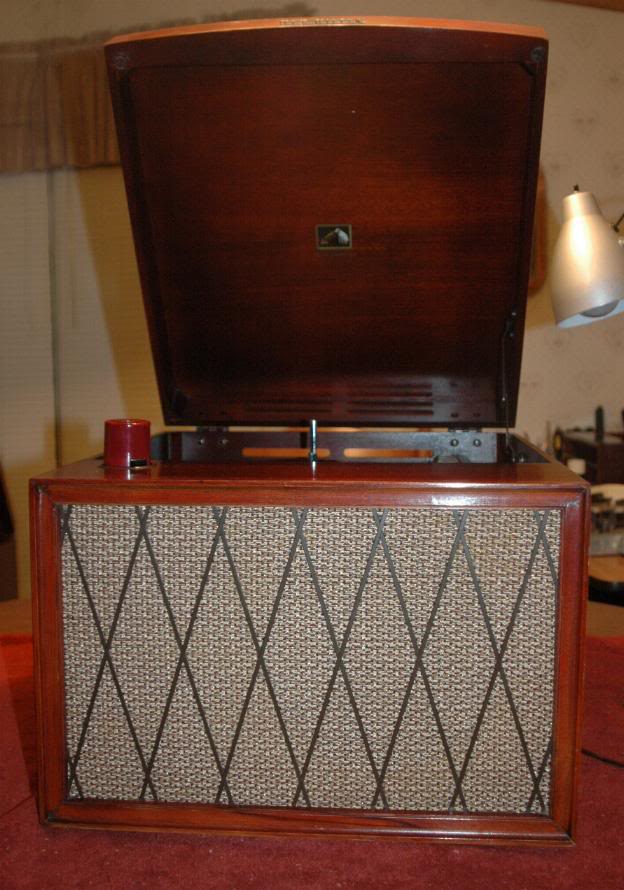
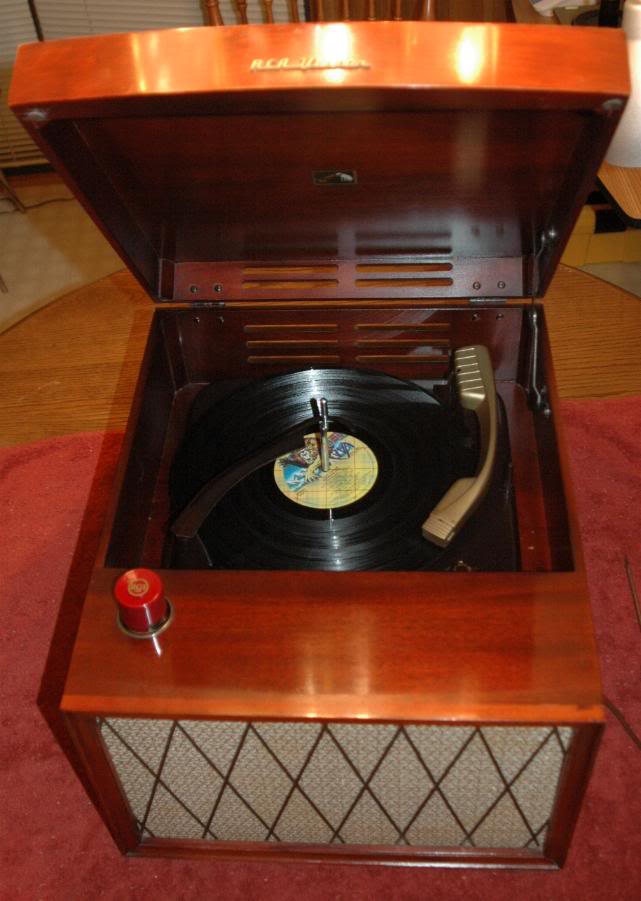
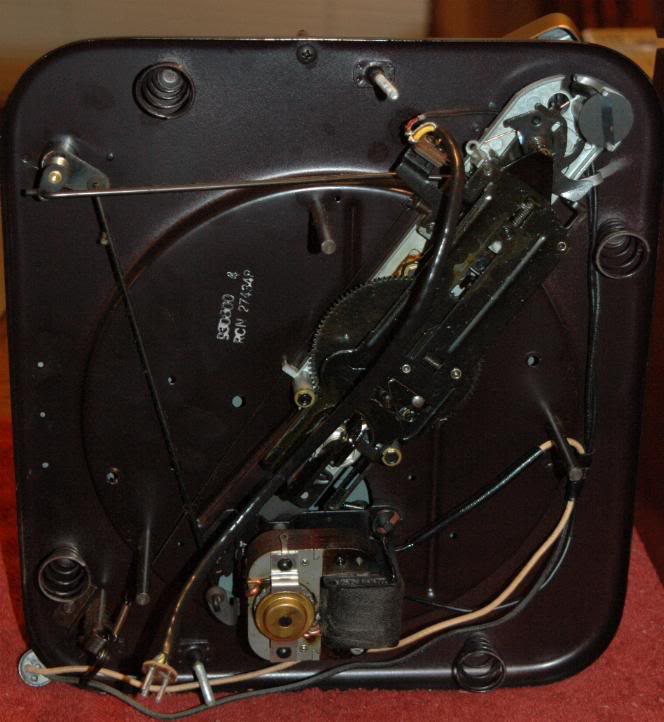
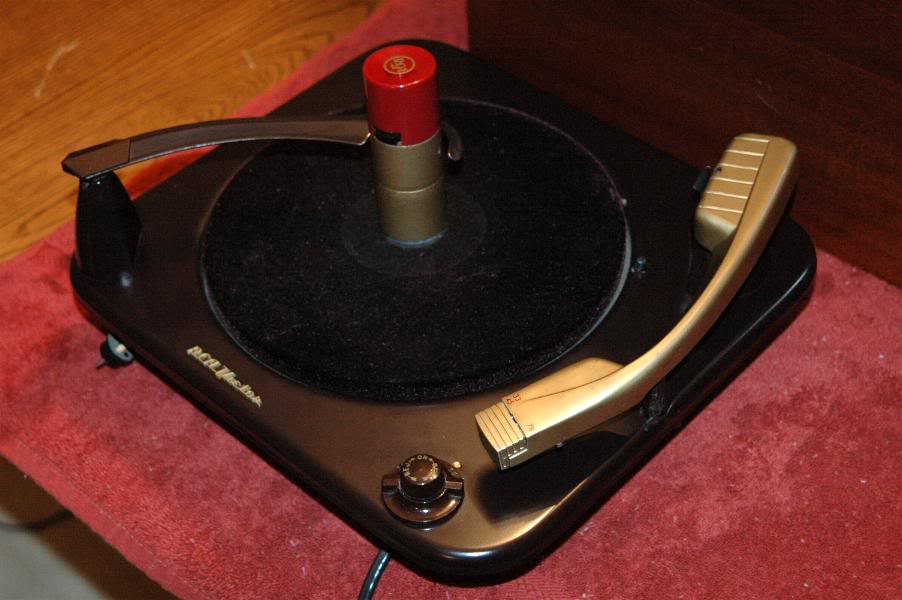
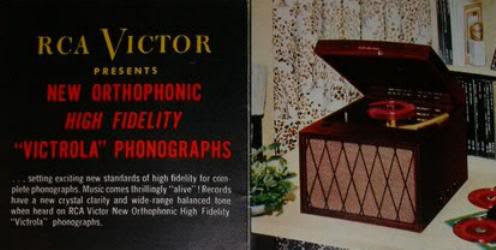
I have a 3-HES-5 also that I have restored. I replaced the original Sonotone cartridge with an Astatic 89T which is stereo compliant and a lot gentler on your records. You positively can't play stereo records with that original Sonotone cartridge. It doesn't matter how new the needle is. The cartridge is simply not stereo compliant. That spring in the tonearm does slide back and forth on a slide, which adjusts the stylus pressure. This changer was made by VM if it's like the one I have. The 3-HES-5 was the very first multi-speed RCA New Orthophonic phonograph, although it wasn't labeled as such. The earlier production of this set used VM changers (like mine); but the president of VM died during the production run of this phonograph, and RCA lost confidence in VM to supply its changers and started making their own changers. The changers in the latter part of 1953 were made by RCA.
 '
'
'Who is online
Users browsing this forum: No registered users and 6 guests
It is currently Thu Oct 06, 2016 12:10 pm