Hello, everyone,
I am a beginner of collection 45rpm records. I am still don't know much about 45rpm records. Recently, I purchased a Strauss Waltzes and Polkas conducted by ARTHUR FIEDLER. However, my record is having only one disk, which included WIENER BLUT and ARTISTS LIFE WALTZ. DO anyone know how many songs and disks should be contained in this album? My album is come in hard paper sleeve form but not box.
And I also purchased La Mer conducted by Toscanini from ebay. It just contain 2 disks. It also come in hard paper sleeve form, is it usual?
Thank you.

question with some RCA 45 rpm
A category about 45rpm vinyl records (a.k.a. singles) and 33rpm records (a.k.a. LP's).
Generally most classical sets contained from two to 8 or so individual records. The Fiedler records if they were in a box might have been four records, maybe five.. If your records are extended play then it may only need two records for four selections. I have seen them come both ways. Usually the cardboard sleeve sets come in from two to three records, sometimes more. A lot of them are extended play versions and don't need as many sides.
La Mer On 78's only takes if I recall right two records consisting of four sides. So that would probably be right.. Again some classical pieces if short may even only be one record. Usually you can tell by the number on the records too. The first side say #1, should have record #10 on the back, with five total records.. A small set will have #1 with #4 on the reverse so only two records in the set.. Hope this makes sense.
La Mer On 78's only takes if I recall right two records consisting of four sides. So that would probably be right.. Again some classical pieces if short may even only be one record. Usually you can tell by the number on the records too. The first side say #1, should have record #10 on the back, with five total records.. A small set will have #1 with #4 on the reverse so only two records in the set.. Hope this makes sense.
I see. Thank you very much larryh. I bought a 10-inch 33rpm,an album of Christmas music by Mantovani and his orchestra, Decca ffrr. Do you know when do these records were made? The disk is thicker and heavier than the one we have in nowadays.
My guess would be that those heavier pressings are from the early 50's most likely. Seems the LP's get thinner as time goes on and some of the early ones are almost like the 78 material pressings.
-
 Record-changer
- Senior Member
- Posts: 1139
- Joined: Fri Apr 21, 2006 8:11 pm
- Location: Bloomington IN USA
RCA was so confident that its 45 system would beat the Columbia LP system that it started releasing its classical repertoire (already on 78) on 45. The records are one-to-one: One side of the 78 album fit on one side of a 45.
I have the La Mer set on 78. And I have seen the Strauss set on 78. It was a 4-record set. It had The Blue Danube on two sides, and single waltzes on the other 6 sides. And I have the Spike Jones version of The Nutcracker as a three 45 set.
The real travesty was that all of the RCA 45 changers of that time repeated the last record. That was enough to spoil the listening pleasure of a classical album.
Most of the RCA 45 sets were made in drop-automatic sequence. The popular albums were not given sequence numbers. But other companies didn't always plan for use on a record changer. I have a Columbia 45 album in manual sequence, and an Essex album in slide-automatic sequence (even though it would be two more years before anyone made a record changer that could play 45s in slide-automatic sequence).
I have the La Mer set on 78. And I have seen the Strauss set on 78. It was a 4-record set. It had The Blue Danube on two sides, and single waltzes on the other 6 sides. And I have the Spike Jones version of The Nutcracker as a three 45 set.
The real travesty was that all of the RCA 45 changers of that time repeated the last record. That was enough to spoil the listening pleasure of a classical album.
Most of the RCA 45 sets were made in drop-automatic sequence. The popular albums were not given sequence numbers. But other companies didn't always plan for use on a record changer. I have a Columbia 45 album in manual sequence, and an Essex album in slide-automatic sequence (even though it would be two more years before anyone made a record changer that could play 45s in slide-automatic sequence).
The Christmas Music Rcord is this one,


Compare with a 12-inch record :

The Decca label looks dim under normal light condition but it is bright blue under flash. And quite a number of my collection also like this. Why?
It seems that collecting 45 rpms record is not an easy job, especially when you find the one that in box or pack form.
Compare with a 12-inch record :
The Decca label looks dim under normal light condition but it is bright blue under flash. And quite a number of my collection also like this. Why?
It seems that collecting 45 rpms record is not an easy job, especially when you find the one that in box or pack form.
This is a UK Decca album which the Mantovani discography site says comes from 1957....but I believe they are misstaken and it really was produced in 1953
-
Record-changer
- Senior Member
- Posts: 1139
- Joined: Fri Apr 21, 2006 8:11 pm
- Location: Bloomington IN USA
The xenon flash produces a bright-line spectrum, not a continuous spectrum. Some colors are altered.
If that record is really 1953 from the UK, then it has the London recording pre-emphasis curve, not the RIAA curve.
If that record is really 1953 from the UK, then it has the London recording pre-emphasis curve, not the RIAA curve.
pre-emphasis curve and RIAA curve? What are they?
I am just a newbie to old records. Can any brother explain them?
I am just a newbie to old records. Can any brother explain them?
-
Record-changer
- Senior Member
- Posts: 1139
- Joined: Fri Apr 21, 2006 8:11 pm
- Location: Bloomington IN USA
Records are made with a pre-emphasis curve, and played back with a de-emphasis curve. Tape and FM radio also have pre-emphasis and de-emphasis curves. This is done with records for two reasons:
1. The bass is reduced so the record side can hold more music.
2. The treble is increased to counteract surface noise.
The problem was that, before 1958, each record company used its own pre-emphasis curve:
With 78s, there were basically 3 pre-emphasis curves:
- European records had no treble boost.
- American and European Decca 78s had a 6 dB boost (measured at 10 KHz).
- Columbia 78s had a 16 dB treble boost.
- This is why tone controls appeared on phonographs.
When the LP was introduced, more than ten curves appeared:
- Columbia modified the NAB radio 33 rpm transcription curve to make the original LP curve.
- Several companies used the unmodified NAB curve to avoid royalties.
- Many phonographs could not reproduce the highs on the LP and NAB records, so the Audio Engineering Society produced another curve, the AES curve.
- Many record companies disliked the AES curve because surface noise was too high, so they made compromise curves. Capitol used the NAB base curve, and the AES treble curve.
- RCA kept changing curves, adding to the confusion.
- European companies made their own curves. Telefunken had no treble boost at all on their early 33s.
- Most quality players from 1951-1958 had selector knobs for these various curves. And usually they left out some of the curves so there were just a few switch positions. The user had to set it for each record, so it made record changers redundant.
Finally, RCA developed the New Orthophonic curve, which the Recording Industry Association of America endorsed in 1953. AES also endorsed it at the same time. It is a compromise curve, almost exactly in between the old LP curve and the old AES curve (in the same vein that synchronous electric motors and broadcasting caused the compromise 78 rpm to be adopted, halfway between Columbia's 80 rpm and Victor's 76 rpm).
It then took until 1958 to convince all of the record companies in the US to convert to the RIAA standard - just in time for stereo!
Western Europe didn't completely change to the RIAA curve (called IEC in Europe) until 1964.
The Soviet block had not comletely changed to RIAA until the late 1970s.
Here is my web page showing what record companies used what curves, and how to equalize them with your RIAA preamp and a graphic equalizer:
http://midimagic.sgc-hosting.com/mixphono.htm
1. The bass is reduced so the record side can hold more music.
2. The treble is increased to counteract surface noise.
The problem was that, before 1958, each record company used its own pre-emphasis curve:
With 78s, there were basically 3 pre-emphasis curves:
- European records had no treble boost.
- American and European Decca 78s had a 6 dB boost (measured at 10 KHz).
- Columbia 78s had a 16 dB treble boost.
- This is why tone controls appeared on phonographs.
When the LP was introduced, more than ten curves appeared:
- Columbia modified the NAB radio 33 rpm transcription curve to make the original LP curve.
- Several companies used the unmodified NAB curve to avoid royalties.
- Many phonographs could not reproduce the highs on the LP and NAB records, so the Audio Engineering Society produced another curve, the AES curve.
- Many record companies disliked the AES curve because surface noise was too high, so they made compromise curves. Capitol used the NAB base curve, and the AES treble curve.
- RCA kept changing curves, adding to the confusion.
- European companies made their own curves. Telefunken had no treble boost at all on their early 33s.
- Most quality players from 1951-1958 had selector knobs for these various curves. And usually they left out some of the curves so there were just a few switch positions. The user had to set it for each record, so it made record changers redundant.
Finally, RCA developed the New Orthophonic curve, which the Recording Industry Association of America endorsed in 1953. AES also endorsed it at the same time. It is a compromise curve, almost exactly in between the old LP curve and the old AES curve (in the same vein that synchronous electric motors and broadcasting caused the compromise 78 rpm to be adopted, halfway between Columbia's 80 rpm and Victor's 76 rpm).
It then took until 1958 to convince all of the record companies in the US to convert to the RIAA standard - just in time for stereo!
Western Europe didn't completely change to the RIAA curve (called IEC in Europe) until 1964.
The Soviet block had not comletely changed to RIAA until the late 1970s.
Here is my web page showing what record companies used what curves, and how to equalize them with your RIAA preamp and a graphic equalizer:
http://midimagic.sgc-hosting.com/mixphono.htm
Last edited by Record-changer on Sat Oct 17, 2009 11:07 pm, edited 1 time in total.
I think 1957 is the right date for your christmas album. I've taken a couple pictures of some decca's I've got, which I'll explain as I go.
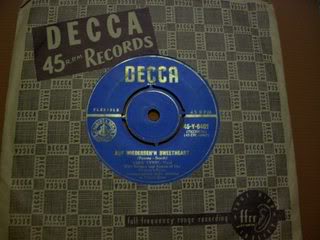
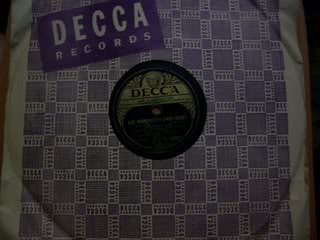
This first one's my earliest Decca single (45) which is from 1952/53- Vera Lynn's "Auf Wiederseh'n Sweetheart" No. 45-Y-6402. The 78rpm version is the same cat/no, minus the "45". The "ffrr" trademark doesn't appear on either label, only on the 45 cover. Next to it, is the 78 version. These are both Australian pressings, but the 78 label used here at the time was very similar to the UK label, except ours was darker in colour, so I'm guessing the UK 45rpm label would also be very similar to ours at the same time.
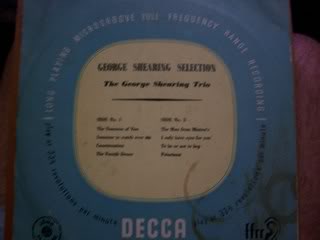
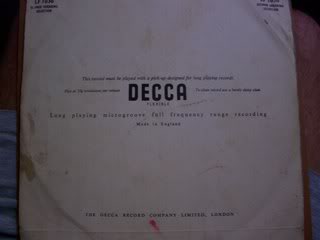
These two pictures are of the cover version Decca used up until about 1955 or 56 from what I can tell, and these covers were printed by James Upton Ltd., of London & Birmingham. I don't know exactly when they changed printers, but from the ones I have, late 55 or early 56 seems about right. They then started to use Crystalate (printing) Ltd., of Tonbridge, Kent to print the new style covers, which had "cover art" and a track listing on the back. The record labels in both cases look basically identical, regardless of which printing company did the covers, and both use the "ffrr" logo. The only difference I have noticed on the labels, is the "N", which appears just near the ear-lobe on the later albums, but is directly above the matrix & catalogue numbers on the earlier plain cover version. Vinyl 10" records have the blue label, and 12" records used a red label.
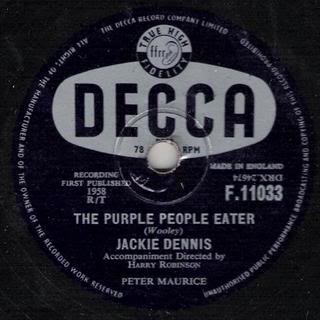
I'm also not sure at what date the "ffrr" started to appear on the 78rpm labels, but I have a couple that are dated 1958.
This first one's my earliest Decca single (45) which is from 1952/53- Vera Lynn's "Auf Wiederseh'n Sweetheart" No. 45-Y-6402. The 78rpm version is the same cat/no, minus the "45". The "ffrr" trademark doesn't appear on either label, only on the 45 cover. Next to it, is the 78 version. These are both Australian pressings, but the 78 label used here at the time was very similar to the UK label, except ours was darker in colour, so I'm guessing the UK 45rpm label would also be very similar to ours at the same time.
These two pictures are of the cover version Decca used up until about 1955 or 56 from what I can tell, and these covers were printed by James Upton Ltd., of London & Birmingham. I don't know exactly when they changed printers, but from the ones I have, late 55 or early 56 seems about right. They then started to use Crystalate (printing) Ltd., of Tonbridge, Kent to print the new style covers, which had "cover art" and a track listing on the back. The record labels in both cases look basically identical, regardless of which printing company did the covers, and both use the "ffrr" logo. The only difference I have noticed on the labels, is the "N", which appears just near the ear-lobe on the later albums, but is directly above the matrix & catalogue numbers on the earlier plain cover version. Vinyl 10" records have the blue label, and 12" records used a red label.
I'm also not sure at what date the "ffrr" started to appear on the 78rpm labels, but I have a couple that are dated 1958.
-
Record-changer
- Senior Member
- Posts: 1139
- Joined: Fri Apr 21, 2006 8:11 pm
- Location: Bloomington IN USA
The ffrr logo first appeared in 1937, when the Decca 78 curve appeared (250 Hz bass turnover, -6 dB rolloff at 10KHz with 3dB/octave rolloff). But that curve was used only for 78s.
In 1950, the first few Decca LPs were made in the NAB curve. Then, because of extra cartridge distortion, they came up with the ffrr long playing curve, used for their 33s and 45s. This curve had a 500 Hz bass turnover, with a 12 dB rumble shelf, and a 10.5 dB rolloff at 10KHz. In the US, it was called the London curve (English Decca had to sell records in the US as London Records, because American Decca had the trademark on the Decca name in the US).
These curves coexisted, until English Decca switched to RIAA sometime in the late 1950s. But they called the RIAA curve the "New ffrr curve." I have a Rolling Stones album with ffrr on the jacket, and it plays RIAA. The RIAA curve has a 500 Hz bass turnover, a 20 dB rumble shelf, and a 13.7 dB rolloff at 10KHz.
In 1950, the first few Decca LPs were made in the NAB curve. Then, because of extra cartridge distortion, they came up with the ffrr long playing curve, used for their 33s and 45s. This curve had a 500 Hz bass turnover, with a 12 dB rumble shelf, and a 10.5 dB rolloff at 10KHz. In the US, it was called the London curve (English Decca had to sell records in the US as London Records, because American Decca had the trademark on the Decca name in the US).
These curves coexisted, until English Decca switched to RIAA sometime in the late 1950s. But they called the RIAA curve the "New ffrr curve." I have a Rolling Stones album with ffrr on the jacket, and it plays RIAA. The RIAA curve has a 500 Hz bass turnover, a 20 dB rumble shelf, and a 13.7 dB rolloff at 10KHz.
Who is online
Users browsing this forum: No registered users and 2 guests
It is currently Thu Oct 06, 2016 8:09 am