I did see your earlier response to my "Japanese question" but I didn't have time to respond until I looked at it again another day when I had more time. It would appear between the two dates that you have modified your reply to eradicate the bit about the RCA take over of Victor in the early 30's?
I'm sure I read something about that in your description? Or am I going barmy and seeing stuff which isn't there?
Hi Steve:
Yes. That was my fault. Because I am an atrocious speller/typist, I always use Outlook Express's New Message box, which comes with a spelling-checker, to compose my posts.
I wanted to embellish the section concerning the various size Orthophonic horns, but when I copied the text back to the post box on this site, I accidentally omitted the "top section" of my original reply. (I didn't notice this until after I clicked on the "submit" button.)
I remember that I speculated that Japanese collectors might be drawn more to the HMV Re-Entrant models because of their quality, durability, and the fact that they are equipped with larger horns than the Orthophonic Victrolas.
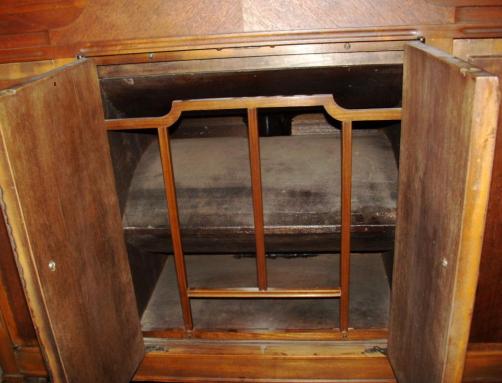
Unlike a pristine HMV model, which is normally "ready to play" -- save for motor adjustments/lubrication, and perhaps a sound box tune-up -- Orthophonic Victrolas often need far more maintenance in order to restore their sonic capabilities. For instance, cracked or swelled pot metal components such as the sound box, the tone arm support, and braces and couplings used to connect the cast iron elbow to the horn, often must be repaired or replaced. In addition, the wooden horns, which were assembled out of gumwood slats and sections glued together, may need extensive repair.
And, while this may have had no impact on the international market for high performance acoustic gramophones, I did point out that the Victor company always had a strong presence in Japan, and a number of discontinued Orthophonic models were produced there after RCA took over in the US.
(Interestingly, Paul Edie has re-done his web site, and the information about the Japanese Victors no longer appears--at least I can't find it. I DID manage to locate the data from the old site using Google's cache' feature, which I've pasted here):
-----------------------------------------------------------------------------
FROM:
http://www.victor-victrola.com/J1.htm
Japanese Victrolas
Victrolas with a "J1" prefix were manufactured by The Victor Talking Machine Company of Japan, Limited, and were intended for distribution and sale in the Far East. The vast majority of "J1" machines were produced in the early 1930's after Victor had been bought by RCA in the United States. Many J1 Victrolas are very similar to earlier US models, making it quite possible that some of the tooling and parts left over from discontinued US Victrola production was sent to Japan so that similar machines could be made in that country. Prior to the early 1930's, Victrolas were exported to Japan from the USA. For example, a recently discovered J1-91 appears to be nearly identical to the US VV 1-90. The cabinet has slightly different trim and carving details, but the components appear virtually identical to the US version. Serial numbers appear on the dataplate similar to their US counterparts.
Selling prices and production quantities of J1 Victrolas are not currently known. Further research is being done on these machines.
Model Serial Number Range Feature Notes
J1-35 501-?? -- Some have 1935 date
J1-40 501-?? -- Some have 1936 date
J1-50 501-?? -- Some have 1935 date
J1-51 501-?? -- Some have 1936 date
J1-60 501-?? -- Some have 1932 date
J1-71 501-?? -- Some have 1934 date
J1-80 501-?? -- Similar to VV-80. Some have 1930 date.
J1-81 501->6400 -- Similar to VV 1-90. Some have 1932 date.
J1-91 501-?? -- Some have 1932 date
J1-92 501-?? -- Some have 1935 date
J1-95 501-?? -- Some have 1938 date