How to reconize a MONO 45rpm

A category about 45rpm vinyl records (a.k.a. singles) and 33rpm records (a.k.a. LP's).


Topic author
NL Guest

How to reconize a MONO 45rpm

by NL Guest » Thu Oct 16, 2008 4:24 pm

I have got a bunch of old 50's/60's & 70's 45rpm records from my recently desiest grandfather including a good working Turntable, raging from 1955 till late 70's.. I want to digitalize them because some records I've never seen on CD... (and I like 60's and 70's sound) but there is a problem wich I can't solve on my own.

How can I regonize the MONO 45's... it's no use to record them stereo on the PC that only takes up space :)

Some say MONO on the label some don't but also don't say they are stereo either... some have a little triangle with 45M in them (are these MONO?).

Can someone explain I was born in the digital world of CD so I don't know how vinyl works exactly.

I would be gratefull for any reply.

Kind Regards,
Chantal.


shane
Senior Member
Posts: 314
Joined: Fri Aug 04, 2006 4:50 pm
Location: brisbane,qld.australia

Re: How to reconize a MONO 45rpm

by shane » Thu Oct 16, 2008 9:34 pm

I'm in Australia, so things might have been a bit different hear, but usually the label will give some sort of indication, and this can vary greatly between different companies.
As far as I know, all 45's from the about 1970 will be stereo, and anything before the late 50's will probably be mono. Normally the early stereo records will have Stereo written on the label, although some companies were producing both mono and stereo discs of the same recording at the same time. In these cases, you should find an extra or different letter included in the record catalogue number on the label. The mono record for example might be 5555-D, and the same stereo recording 5555-DL. Perhaps by looking at labels from the same company you might be able to work out what system that company used. The matrix numbers etc in the dead wax near the label also might include a number or shape to indicate the recording system used. Companies that made a clean break from mono to stereo, and didn't release both at the same time may have started a whole new catalogue numbering system or block of numbers for their stereo records, while others may have just continued in numerical order.
With so many small labels appearing & disappearing during the period in question, and no set rules, it might take a lot of investigating to "break their code". Big companies like RCA are usually pretty easy to work out though.
The 45M probably does mean mono, though I haven't seen this out here before.
I guess the easiest way might be to use the balance knob on your stereo system to see if the same track is coming from both channels, or if they are slightly different.
Perhaps you could post a few of the label names & someone might know where & what to look for.


Topic author
NL Guest

Re: How to reconize a MONO 45rpm

by NL Guest » Sat Oct 18, 2008 12:23 pm

Thanks for the reply.

I thought so it should be difficult to tell from the record itself, but someone mentioned a method to me on another forum and that will help (I think)

In Adobe Audition you can use a view (Phase Analisys) to see wether a record is mono or stereo..
I can record all in stereo, and by doing a Phase Analisys I can see if it's a MONO or Stereo record somehow (he would help me on that, so I can learn).
and then change the channels from stereo to mono if indeed the record is mono.

User avatar

Record-changer
Senior Member
Posts: 1139
Joined: Fri Apr 21, 2006 8:11 pm
Location: Bloomington IN USA

Re: How to reconize a MONO 45rpm

by Record-changer » Mon Oct 20, 2008 2:15 am

If you have a component stereo, you can hook a third loudspeaker to the left and right + terminals on the speaker outputs, in addition to the normal speaker connections. Connect one terminal of the speaker to the left + terminal, and the other terminal of the speaker to the right + terminal. Adjust the balance control of the stereo with a known mono record to null out any music in this speaker.

This speaker will now play music if the record is stereo, but only noise if the record is mono.

Incidentally, this speaker is now playing the same thing the surround speakers play on a non-Pro-Logic Dolby Surround system. So if you have a non-Pro-Logic Dolby Surround system, you can use that.
http://midimagic.sgc-hosting.com

Daylight-stupid time uses more gasoline.


Kent T
Regular Member
Posts: 82
Joined: Thu Sep 01, 2011 12:43 am
Location: Athens, Tennessee, USA

Re: How to reconize a MONO 45rpm

by Kent T » Sat Sep 03, 2011 4:32 am

45M in a triangle is the common German designation for 45 RPM Mono single. Same with LP M means mono LP.


Bobby Basham
Senior Member
Posts: 498
Joined: Sat Aug 26, 2006 2:50 pm
Location: Tucson, Arizona, USA

Re: How to reconize a MONO 45rpm

by Bobby Basham » Fri Sep 16, 2011 4:01 am

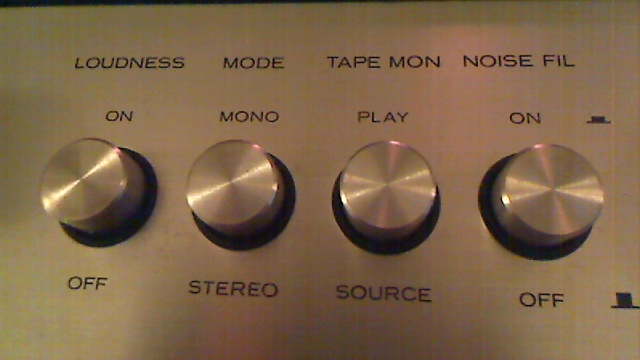
How about listening through a set of headphones. You will definitely hear the sound "centered" in a mono recording. It's just like switching from FM to FM/Stereo while wearing headphones, the sound will broaden. Some component amps/receivers back in the day have a Stereo/Mono switch, and you can toggle that back and forth to hear any differences.

You may get quicker results with less effort. --BB

Bobby Basham
Tucson, Arizona
Attachments
Kenwood KR-3400.jpg
Kenwood KR-3400.jpg (61.47 KiB) Viewed 4315 times


Kent T
Regular Member
Posts: 82
Joined: Thu Sep 01, 2011 12:43 am
Location: Athens, Tennessee, USA

Re: How to reconize a MONO 45rpm

by Kent T » Mon Nov 26, 2012 3:50 am

Post 1968 Mono records require a Stereo cartridge with vertical compliance and tracking at 5 grams or under with a .7 mil stylus. Earlier mono records are true mono and play with normal mono playback equipment. In 1968, many older Scully lathes and older cutting heads were replaced with Neumann SX 68 and 71 cutting heads and Neumann cutting lathes.

User avatar

DoghouseRiley
Senior Member
Posts: 630
Joined: Thu Apr 16, 2009 9:48 pm
Location: North-West England

Re: How to reconize a MONO 45rpm

by DoghouseRiley » Mon Nov 26, 2012 12:16 pm

If you just want to play these to convert to mp3 format, unless they are very obscure titles then you might find the same recording on YouTube. So there's no need to use the records you've inherited.

I'm in the process of building up an mp3 library in the hopes of using a Rock-Ola wall box to select tracks via an iPod to play through my hifi, if I can get a kit from Datasync Engineering. I've a few thousand mp3s and a lot of CDs, a few of which I've used to to build up an iTunes library in readiness.
Of the tracks I've wanted but not got in either format, I've yet to fail to find one on YouTube and some are pretty obscure, neither available now on vinyl or CD. Many have been uploaded by more than one person so you can choose the best quality version.
I use the Firefox downloader and convert an audio track with a photo or even a video of a live performance to mp3 (128k) with success every time.

It's worth checking this out even if you only find a few.

______________________________________________________________________________________________________

I don't mind if you don't like my manners, I don't like them myself, they're pretty bad, I grieve over them on long winter evenings.


jukeboxexpress
Junior Member
Posts: 7
Joined: Sun Apr 08, 2012 5:00 am
Location: Fresno,CA U.S.A.

Re: How to reconize a MONO 45rpm

by jukeboxexpress » Wed Dec 19, 2012 7:25 pm

How do you tell the difference between mono and stereo records?

First, as a correction, stereo 45's began reappearing in 1968 on BUDDAH AND ELEKTRA releases. Most other 45's were still mono only. BUDDAH had usually "DUAL 45" printed on the label and ELEKTRA had "STEREO PLAYABLE IN STEREO AND MONO" all in small letters.
As mentioned before, there should always be some sort of indication in the numbers printed on the labels or in the trail-off of the record. Most stereo 45's will have stereo printed on the label. On promo 45's, when the same song is on both sides, if there is a stereo/mono difference, it should be printed on the labels. On Warner/Reprise commercial issues of 1970 and later, there will be an "S" after the matrix number. On a few that used the CSG stereo process, usually "COMP." will be in the trail-off. Atlantic/Atco will have an "ST" prefix in the matrix number. Most Atlantic/Atco 45's were only available in stereo on the promo copies until 1973.

A&M started issuing commercial stereo 45's in 1970 also. One of the first was "Close To You" by The Carpenters(issued in both stereo and mono). A&M will usually have "STEREO" printed on the label and an "S" after both the record and matrix numbers. As an early pioneer user of the CSG-Haeco system, these are always stereo(if you can call it that), and will indicate the use of the system on the label but will only have "CSG" in the matrix number scratched into the trail-off. Atlantic/Atco also experimented with "CSG", but mostly in mono, with an indication printed on the labels. CSG recordings will have a rough texture to the groove surface that you can both see and feel, plus the grooves will appear darker.

Most all Bell 45's were mono only, unless promo copies. Bell had an "S" at the end of the matrix numbers on their stereo 45's. Even some of the Bell promo copies that had stereo printed on them were actually mono. Virtually all Arista 45's are stereo only, unless they are promo copies. When Bell distributed the Big Tree label, most of the commercial copies were stereo. Before Bell, BT 45's were all mono(Ampex...etc.). After Bell, Atlantic/Atco distributed, all commercial 45's were stereo.

You can also usually tell by looking at the grooves. On a mono recording, the grooves will resemble a snake pattern with the groove wall following a pattern traveling in unison side to side. On a stereo groove, especially wide separation, there will be differences in the left and right groove walls, if you can imagine a constant series of figure longitudinal 8's.
-Dan S.

User avatar

Record-changer
Senior Member
Posts: 1139
Joined: Fri Apr 21, 2006 8:11 pm
Location: Bloomington IN USA

Re: How to reconize a MONO 45rpm

by Record-changer » Thu Jul 11, 2013 1:55 am

The CSG Haeco system is NOT compatible with a mono cartridge without vertical compliance. It ALWAYS has vertical motion.

An interesting fact is that, if you play one of these records through an SQ quadraphonic system, the stereo image looks like this:

left - left front
center - left back (and out of phase)
right - right front

If you happen to have a UMX, BMX or UD4 quadraphonic decoder, the stereo image is up front, where it belongs.
http://midimagic.sgc-hosting.com

Daylight-stupid time uses more gasoline.


Kent T
Regular Member
Posts: 82
Joined: Thu Sep 01, 2011 12:43 am
Location: Athens, Tennessee, USA

Re: How to reconize a MONO 45rpm

by Kent T » Sat Oct 19, 2013 8:24 pm

Most post 1968 45 RPM records are cut on a Stereo cutting head, even if advertised to be mono (many a mastering studio switched to Neumann SX 68 and later on Neumann SX 74 and Haeco Stereo cutting heads.). Which require a vertically compliant stylus suited for Stereo records for safe playback. And 5 grams or less tracking force.


rgr1973
Junior Member
Posts: 4
Joined: Mon Jan 27, 2014 8:54 pm
Location: Holland, MO, USA

Re: How to reconize a MONO 45rpm

by rgr1973 » Tue Jan 28, 2014 6:23 pm

I wouldn't go the MP3 route but rather save them as WAV files. MP3 is a "lossy" format in that it compresses the recording to make room. Some of the detail can get lost in the MP3 format but a WAV file is uncompressed and won't degrade each time a copy is made. If space is at a premium on your computer, you can invest in an external hard drive for fairly cheap these days. As a matter of fact, I would suggest doing that anyway. CD's get scratched or lost and hard drives fail. You're just adding that extra layer of protection by investing in an external HD.

YouTube isn't always the best approach. Some stuff on YouTube isn't bad at all while other stuff sounds absolutely terrible. It's a hit and miss approach. If the 45's are in good shape, I would record from them as opposed to YouTube but to each his own. Another avenue would be mp3's from Amazon or iTunes if a record isn't in good shape. You can usually download a song anywhere from 69¢ to $1.29 with most songs either 89¢ or 99¢ on Amazon. You're almost guaranteed to get a listenable version that way.

What software are you using to digitize them? I use Polderbits, a program no one seems to be familiar with. The big thing I love is you can choose to record/save as mono and it comes out very clean. If you've ever listened to a mono recording in Dolby Pro-Logic you'll usually notice the l/r channels sound crappy while the center channel sounds clean. That's the same thing that Polderbits does.
Image

Image

Who is online

Users browsing this forum: No registered users and 1 guest

It is currently Thu Oct 06, 2016 8:12 am