
New to Phonographs
Q&A about Talking Machines from the pre-electronic era (approx. 1885-1928).
Hi there, my name is Jake. I am 27, and I really like working on old things. I came across this old hand crank player at a thrift shop. I took it home and I beleive after researching it is a Victrola VV-210 from 1922. I cant believe that this thing works! Im going to need to rebuild the sound head but this thing is so cool! I had my kids dancing around to some old records that came with it. I am totally new to this thing, but I really like to be a part of forums when I have a hobby, so I just wanted to say hey!
oh and here is a picture 

-
 DoghouseRiley
- Senior Member
- Posts: 630
- Joined: Thu Apr 16, 2009 9:48 pm
- Location: North-West England
Hi and welcome!
You'll find plenty of knowledgeable people on here and those who are familiar with this fine looking machine you've found will tell you where you can get the kit and how best to approach the renovation.
Best of luck with it.
You'll find plenty of knowledgeable people on here and those who are familiar with this fine looking machine you've found will tell you where you can get the kit and how best to approach the renovation.
Best of luck with it.
______________________________________________________________________________________________________
I don't mind if you don't like my manners, I don't like them myself, they're pretty bad, I grieve over them on long winter evenings.
-
Joe_DS
- Forum Moderator
- Posts: 1056
- Joined: Thu Jun 08, 2006 4:23 pm
- Location: San Francisco, California, USA
Hi Jake:
The VV-210 -- http://www.victor-victrola.com/210.htm -- is a great little console Victrola, and one of the most popular models ever produced.
In case you need it, there's a copy of an online VV-210 owner's manual on this page -- http://www.nipperhead.com/old/vic210.htm -- Just click on the thumbnail images to make them full size for viewing or printing. Copies of manuals also come up for sale from time to time on sites such as eBay.
I noticed from the photo that it's missing some knobs. Fortunately, authentic original, as well as new-production, Victrola knobs are available from a number of sellers such as the Antique Phonograph Supply Company -- http://www.antiquephono.com/accessor.htm -- and via eBay.
The nice thing about these pre-1926 Victrola models is that they don't have any pot-metal parts, and are relatively easy to service. Along this line, another resource to check out is a book called "The Compleat Talking Machine," by Eric Reiss, available from most major booksellers. It walks you through most repair and maintenance steps required to keep your Victrola running for another 91 years.
I noticed you mentioned the reproducer or "sound box" needs an overhaul. This should be done before playing too many records, since a frozen needle bar can quickly eat away the record groove. Also, replacing the gaskets will greatly enhance the Victrola's sound quality. You can either do the job yourself, or have it done by one of the many shops specializing in antique phonograph repair, normally for a nominal fee. This video shows the steps involved with rebuilding a Victor #2 sound box, which was the type that was originally supplied with the VV-210 -- http://www.youtube.com/watch?v=2rhh5_7UYGY
HTH,
Joe_DS
The VV-210 -- http://www.victor-victrola.com/210.htm -- is a great little console Victrola, and one of the most popular models ever produced.
In case you need it, there's a copy of an online VV-210 owner's manual on this page -- http://www.nipperhead.com/old/vic210.htm -- Just click on the thumbnail images to make them full size for viewing or printing. Copies of manuals also come up for sale from time to time on sites such as eBay.
I noticed from the photo that it's missing some knobs. Fortunately, authentic original, as well as new-production, Victrola knobs are available from a number of sellers such as the Antique Phonograph Supply Company -- http://www.antiquephono.com/accessor.htm -- and via eBay.
The nice thing about these pre-1926 Victrola models is that they don't have any pot-metal parts, and are relatively easy to service. Along this line, another resource to check out is a book called "The Compleat Talking Machine," by Eric Reiss, available from most major booksellers. It walks you through most repair and maintenance steps required to keep your Victrola running for another 91 years.
I noticed you mentioned the reproducer or "sound box" needs an overhaul. This should be done before playing too many records, since a frozen needle bar can quickly eat away the record groove. Also, replacing the gaskets will greatly enhance the Victrola's sound quality. You can either do the job yourself, or have it done by one of the many shops specializing in antique phonograph repair, normally for a nominal fee. This video shows the steps involved with rebuilding a Victor #2 sound box, which was the type that was originally supplied with the VV-210 -- http://www.youtube.com/watch?v=2rhh5_7UYGY
HTH,
Joe_DS
Thanks for the information! I ordered all of the pieces that I will need after watching the video. I like to fix my own car, motorcycle, whatever, so I am going to try to figure this out too. I won't be playing any more records until it is fixed. I was working on the speed with a chipped record that came with the record player. It was a real steal because the shop owner thought that the speed control was broken. After checking out a manual, I figured out that he just didn't have things set up right. Is there a good way to reliably calibrate these though? I have a good ear, so I kind of tuned it based off of that so far. I think the hardest thing for me to find is going to be the screw for the springs for the needle. I am missing one. I ordered a new pair of springs, so I will have to find one somewhere! I am so excited to get this thing working! I just want to find a bunch of christmas songs for next winter. 
-
Joe_DS
- Forum Moderator
- Posts: 1056
- Joined: Thu Jun 08, 2006 4:23 pm
- Location: San Francisco, California, USA
For the missing screw, you might try one of the shops I mentioned in this post -- viewtopic.php?f=7&t=5434
For calibrating the turntable speed, you might try a strobe disc. There are a number available online, which you can find by doing a google search for
78 strobe disc
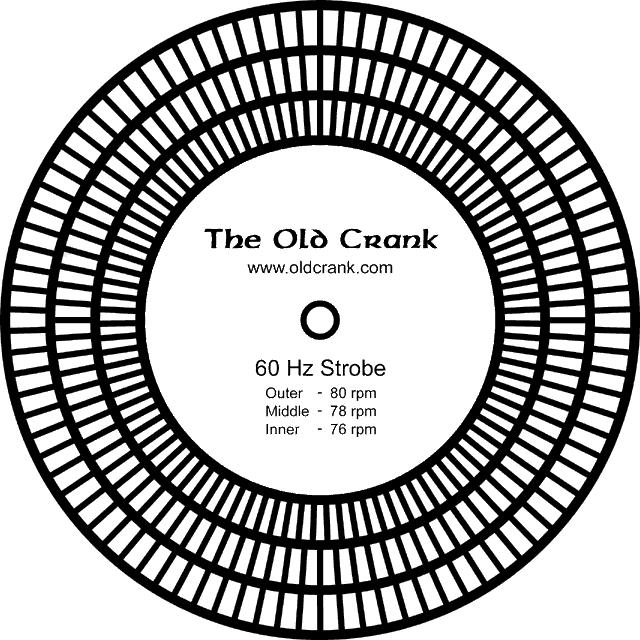
Here's the one I normally use, which you can copy and print if you want:
(Right click, select VIEW IMAGE, Print)
I don't know if you're familiar with how a strobe works, but all you have to do is cut it out, punch a hole for the spindle, set it on your turntable, and shine a 60 watt light bulb on it. Adjust the speed of your turntable and when it reaches 78 rpm, the middle "graph" will appear to stand still. (The bars won't move.) Slowing down or speeding up the turntable will cause the inner or outer graphs to stand still when you reach their respective speeds.
Not to throw too much at you, but you should know that many early 78s--those made before about 1930-- were not always recorded exactly at 78 rpm. Some spun as slowly as 60 rpm, and some as fast as 90 rpm, but the average range is about 76-80 rpm. It often takes a musician's ear to get the speed just right. You can download an application from this site that allows you to create strobe discs for just about every speed imaginable -- http://www.78rpm.com/rescat/strobe_info.htm
Along this line, since you're new to the hobby, I'll also mention the fact that to minimize record wear, you should never play more than one or two sides of a record with the same steel needle. And never remove a used needle, turn it and reinsert it to play another record. That will instantly destroy the record groove.
HTH,
Joe_DS
For calibrating the turntable speed, you might try a strobe disc. There are a number available online, which you can find by doing a google search for
78 strobe disc
Here's the one I normally use, which you can copy and print if you want:
- strobe60-hz.JPG (101.89 KiB) Viewed 1895 times
(Right click, select VIEW IMAGE, Print)
I don't know if you're familiar with how a strobe works, but all you have to do is cut it out, punch a hole for the spindle, set it on your turntable, and shine a 60 watt light bulb on it. Adjust the speed of your turntable and when it reaches 78 rpm, the middle "graph" will appear to stand still. (The bars won't move.) Slowing down or speeding up the turntable will cause the inner or outer graphs to stand still when you reach their respective speeds.
Not to throw too much at you, but you should know that many early 78s--those made before about 1930-- were not always recorded exactly at 78 rpm. Some spun as slowly as 60 rpm, and some as fast as 90 rpm, but the average range is about 76-80 rpm. It often takes a musician's ear to get the speed just right. You can download an application from this site that allows you to create strobe discs for just about every speed imaginable -- http://www.78rpm.com/rescat/strobe_info.htm
Along this line, since you're new to the hobby, I'll also mention the fact that to minimize record wear, you should never play more than one or two sides of a record with the same steel needle. And never remove a used needle, turn it and reinsert it to play another record. That will instantly destroy the record groove.
HTH,
Joe_DS
-
DoghouseRiley
- Senior Member
- Posts: 630
- Joined: Thu Apr 16, 2009 9:48 pm
- Location: North-West England
Does the number of hz matter?
We're on 50hz in the UK.
Surely it's just a test of the turntable speed, the number of cycles in alternating current shouldn't make any difference?
We're on 50hz in the UK.
Surely it's just a test of the turntable speed, the number of cycles in alternating current shouldn't make any difference?
______________________________________________________________________________________________________
I don't mind if you don't like my manners, I don't like them myself, they're pretty bad, I grieve over them on long winter evenings.
-
Joe_DS
- Forum Moderator
- Posts: 1056
- Joined: Thu Jun 08, 2006 4:23 pm
- Location: San Francisco, California, USA
DoghouseRiley wrote:Does the number of hz matter?
We're on 50hz in the UK.
Surely it's just a test of the turntable speed, the number of cycles in alternating current shouldn't make any difference?
I don't know if it matters or not, but I often see the option of 50 HZ for the discs for people on the "European system."
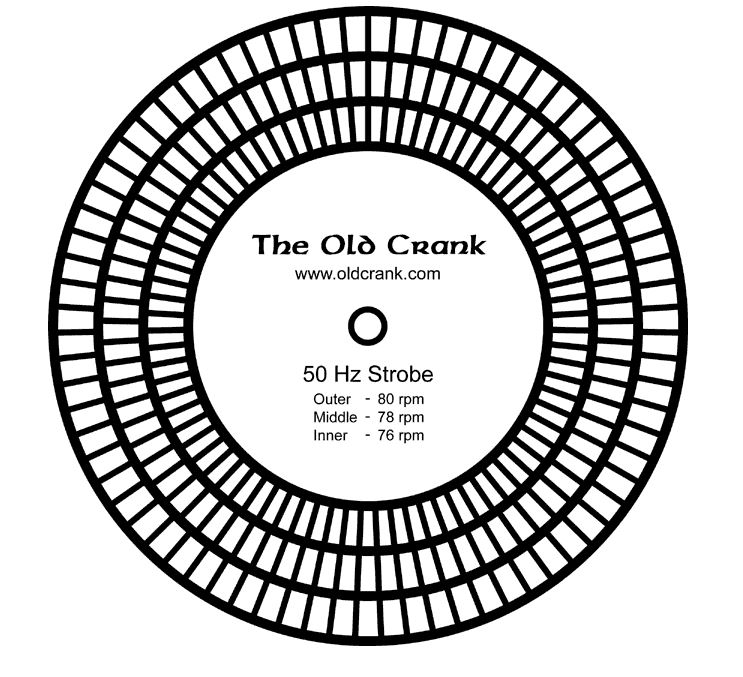
Here's the Old Crank strobe for 50 HZ:
- 50 HZ strobe disc.JPG (110.22 KiB) Viewed 1888 times
FROM: http://www.oldcrank.com/articles/strobes/50hz.html
JDS
-
DoghouseRiley
- Senior Member
- Posts: 630
- Joined: Thu Apr 16, 2009 9:48 pm
- Location: North-West England
Err..
What about one for "wind-ups?"
Sorry!
I guess that was a "wind up!"
What about one for "wind-ups?"
Sorry!
I guess that was a "wind up!"
______________________________________________________________________________________________________
I don't mind if you don't like my manners, I don't like them myself, they're pretty bad, I grieve over them on long winter evenings.
-
Ron Rich
- Forum Moderator
- Posts: 8193
- Joined: Sun May 06, 2007 11:31 pm
- Location: Millbrae (San Francisco area)CA, USA
Riley,
Yes "Hertz matters"--You are comparing the lines on the disc to the "flicker" of the power, in order to judge the speed. It makes a difference if you have different "flicker" rates.
BTW--an old style (magnetic ballast) with a fluorescent lamp works better then an incandescent lamp. New style electronic ballasts are useless for this--
Ron Rich
Yes "Hertz matters"--You are comparing the lines on the disc to the "flicker" of the power, in order to judge the speed. It makes a difference if you have different "flicker" rates.
BTW--an old style (magnetic ballast) with a fluorescent lamp works better then an incandescent lamp. New style electronic ballasts are useless for this--
Ron Rich
-
DoghouseRiley
- Senior Member
- Posts: 630
- Joined: Thu Apr 16, 2009 9:48 pm
- Location: North-West England
I can understand that now, I thought it had something to do with the way your eyes conveyed messages to the brain, in the same way as Victorian Zeotropes work
So how does it work on "wind ups?"
So how does it work on "wind ups?"
______________________________________________________________________________________________________
I don't mind if you don't like my manners, I don't like them myself, they're pretty bad, I grieve over them on long winter evenings.
-
Joe_DS
- Forum Moderator
- Posts: 1056
- Joined: Thu Jun 08, 2006 4:23 pm
- Location: San Francisco, California, USA
DoghouseRiley wrote:So how does it work on "wind ups?"
It works very well. Just center it on the spindle, so it lays flat on the turntable, then give the machine a full winding, release the turntable brake, shine the light on the strobe disc, and then move the speed control lever (or turn the knob) to speed up or slow down the turntable until the strobe shows the correct speed. (Virtually all spring motor gramophones have a speed control knob or lever.)
JDS
-
Ron Rich
- Forum Moderator
- Posts: 8193
- Joined: Sun May 06, 2007 11:31 pm
- Location: Millbrae (San Francisco area)CA, USA
Riley,
It maters not what powers the turn table--wind-up, electricity, steam, "Petrol"--
The strobe disc is setup to allow your eyes, to compare the turntables speed in relation to the flicker ( Hertz) of the lamp. The difference between a 60 and 50 Hz is the distance between lines.
Ever hold your hands up, and move them in front of a "strobe light"--same thing--
Ron Rich
It maters not what powers the turn table--wind-up, electricity, steam, "Petrol"--
The strobe disc is setup to allow your eyes, to compare the turntables speed in relation to the flicker ( Hertz) of the lamp. The difference between a 60 and 50 Hz is the distance between lines.
Ever hold your hands up, and move them in front of a "strobe light"--same thing--
Ron Rich
-
DoghouseRiley
- Senior Member
- Posts: 630
- Joined: Thu Apr 16, 2009 9:48 pm
- Location: North-West England
Thanks for that, folks
______________________________________________________________________________________________________
I don't mind if you don't like my manners, I don't like them myself, they're pretty bad, I grieve over them on long winter evenings.
Who is online
Users browsing this forum: No registered users and 1 guest
It is currently Thu Oct 06, 2016 9:46 am