Here where I live, people think Victrola's are rare and worth a small fortune. I routinely see common units selling for over $1000 in questionable mechanical but halfway decent woodwork.
So yesterday I paid a bit more than I should have for a Consolette VV 4-3. It's the later model with the fancier front, grill cloth and a %#$@* pot metal tone arm bracket. So in the end I have a unit with a decent selection of records, some rungs-tone needles (all suspect - but one looks OK) and scratches.
A bit of orange oil and restor-a-finish and the consolette looks presentable. Some JB Weld placed carefully here the retaining screw goes in the tone arm support now has the tone arm working well enough until a replacement is ordered. I fixed the auto brake, cleaned some of the caked-on grease (now the motor runs practically silent).
So now there's only one thing left to do: get the Orthophonic reproducer serviced. The current one plays very loud, but loud passages has it distort and break up. Otherwise it sounds very nice.
I'm pretty much looking at this to play back records, look presentable and work well. I doubt I'd pick up another, but if an external horn unit drops in my lap I won't turn it away.
Question:
How do I remove the reproducer? I see where it is attached to the tonearm and there is a small screw. This screw is seized. So how to remove it?

New member restoring a Consolette
Q&A about Talking Machines from the pre-electronic era (approx. 1885-1928).
-
Ron Rich
- Forum Moderator
- Posts: 8193
- Joined: Sun May 06, 2007 11:31 pm
- Location: Millbrae (San Francisco area)CA, USA
For removing screws seized to "pot metal", I prefer "Liquid Wrench", in the "(Plastic--today,  ) CAN"--not spray !
Soak, (wipe up excess quickly) re-soak, and wait--A small amount of heat--more LW, and more "waiting"--
try turning the screw in both directions--still won't move--more LW--waiting, OR, if you're tired of that -- Di-no-mite--works quickly, EVERY time !! Ron Rich
) CAN"--not spray ! Soak, (wipe up excess quickly) re-soak, and wait--A small amount of heat--more LW, and more "waiting"--
try turning the screw in both directions--still won't move--more LW--waiting, OR, if you're tired of that --
Di-no-mite--works quickly, EVERY time !! Ron Rich -
Joe_DS
- Forum Moderator
- Posts: 1056
- Joined: Thu Jun 08, 2006 4:23 pm
- Location: San Francisco, California, USA
The screw in the throat area of the sound box basically holds the rubber washer in place, and has nothing to do with removing the sound box from the tonearm.
The Orthophonic sound box comes off the end of the tone arm by turning it and then pulling it off--the same way you remove any Victor sound box.
Stand in front of the cabinet, grab the the front portion of the tonearm with your left hand, and grab the throat area of the sound box with your right hand, and turn it clockwise--so the needle moves away from you--until it stops, and then gently pull it off the end of the tone arm. (Some people will grab the sound box's outer shell to twist it, but this should only be done if there are no visible stress cracks running through the pot metal.)
Inside the throat of the Orthophonic sound box is a brass ring with a small pin or lug protruding from the top:
That fits into the slot in the tonearm:
If it won't budge, DON'T force it. You can try spraying a little liquid wrench around the area to see if that will loosen it enough to turn it.
HTH,
Joe
The Orthophonic sound box comes off the end of the tone arm by turning it and then pulling it off--the same way you remove any Victor sound box.
Stand in front of the cabinet, grab the the front portion of the tonearm with your left hand, and grab the throat area of the sound box with your right hand, and turn it clockwise--so the needle moves away from you--until it stops, and then gently pull it off the end of the tone arm. (Some people will grab the sound box's outer shell to twist it, but this should only be done if there are no visible stress cracks running through the pot metal.)
Inside the throat of the Orthophonic sound box is a brass ring with a small pin or lug protruding from the top:
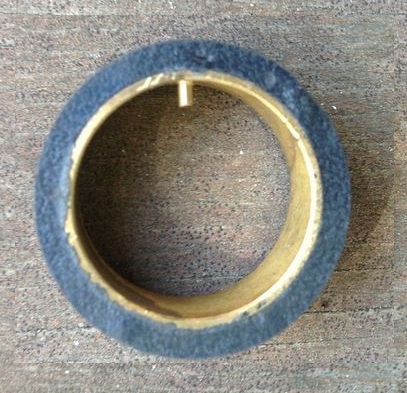
- throat.JPG (78.85 KiB) Viewed 2199 times
That fits into the slot in the tonearm:
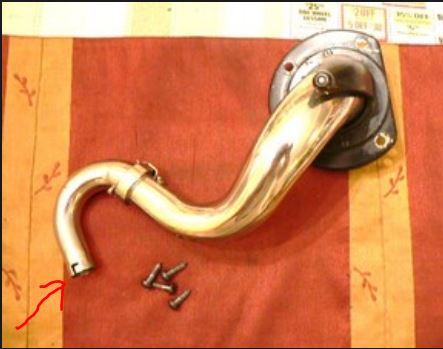
- OrthoTonearm.JPG (31.47 KiB) Viewed 2203 times
If it won't budge, DON'T force it. You can try spraying a little liquid wrench around the area to see if that will loosen it enough to turn it.
HTH,
Joe
Thanks. I'll need to get it rebuilt or replaced. The buzzing at volume is annoying.
-
Joe_DS
- Forum Moderator
- Posts: 1056
- Joined: Thu Jun 08, 2006 4:23 pm
- Location: San Francisco, California, USA
rworne wrote:Thanks. I'll need to get it rebuilt or replaced. The buzzing at volume is annoying.
If the diaphragm looks to be in good condition, with no noticeable dents or tears, and the needle-bar's foot is attached firmly to the center of the "spider," and the spider's feet are all attached to the surface of the diaphragm, then most likely cause of buzzing or rattling is the needle bar's pivot. The pivot posts are held in place with magnetized ball bearings, normally covered with a rubber washer:
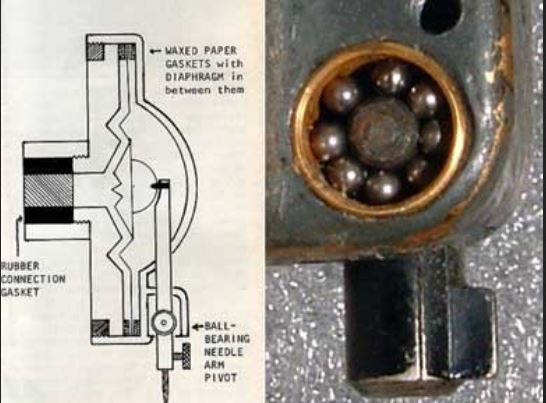
- Orthoballbearings.JPG (45.93 KiB) Viewed 2228 times
(FROM: http://americandad.biz/ts/Orthophonic.jpg )
This article explains what's going on, and how to do a quick-fix type repair:
http://www.gracyk.com/orthosound.shtml
However, to get the most out of your Consolette, it's always a good idea to have the sound box refurbished by someone who has the experience & tools needed to do a good job.
Once restored, the Consolette has an amazing sound quality for its size. The (non-folded) Orthophonic exponential horn used in that model is far more efficient than the Morning Glory style horns used on earlier Victor models.
JDS
Thanks for the tips.
The diaphragm looks to be in really good shape and the soldiered connection also looks good. This consolette was kept in a living room and played infrequently over the years. No rust, a few scratches, and the reproducer is pot metal but it has no cracks. The restor-a-finish did such a good job my skeptical wife now agrees it looks great.
Overall the unit is in spectacular condition and when I lifted out the motor board I was greeted with a nice wood smell with no dust or cobwebs. Original grill cloth that looks new.
Now for how much? I've been watching for months and the cheapest complete unit that appeared was $175. That was for a common upright and it disappeared in minutes. This was the first Orthophonic I saw that was below $525. I paid $200 for this unit mostly because of the good condition and the fact it worked. Also, it was the right size.
The coolest thing about it is that the nondescript cabinet in the corner of the living room has a crank on the side.
The diaphragm looks to be in really good shape and the soldiered connection also looks good. This consolette was kept in a living room and played infrequently over the years. No rust, a few scratches, and the reproducer is pot metal but it has no cracks. The restor-a-finish did such a good job my skeptical wife now agrees it looks great.
Overall the unit is in spectacular condition and when I lifted out the motor board I was greeted with a nice wood smell with no dust or cobwebs. Original grill cloth that looks new.
Now for how much? I've been watching for months and the cheapest complete unit that appeared was $175. That was for a common upright and it disappeared in minutes. This was the first Orthophonic I saw that was below $525. I paid $200 for this unit mostly because of the good condition and the fact it worked. Also, it was the right size.
The coolest thing about it is that the nondescript cabinet in the corner of the living room has a crank on the side.
-
Joe_DS
- Forum Moderator
- Posts: 1056
- Joined: Thu Jun 08, 2006 4:23 pm
- Location: San Francisco, California, USA
rworne wrote: This was the first Orthophonic I saw that was below $525. I paid $200 for this unit mostly because of the good condition and the fact it worked...
Actually, $200 for this model, in the condition you've described, is right in the ballpark, based on what I've seen. I paid the equivalent of $275 for the one I used to own 25 years ago in San Francisco. (That's around $500 in today's inflated money.) I had to spend an additional $100 for a replacement, good condition Orthophonic sound box.
Generally, prices for Victrolas along the California Coast are about double or tripple what they are in the Midwest and other areas, but I've seen plenty of Consolettes in the $500+ price range in places like Ohio and Minnesota (craigslist).
My goal is to eventually find another mid to large size Orthophonic Victrola to replace my VV-4-40, which is missing the stretcher used to connect the legs, and has a poorly refinished lid, etc. The cheapest I've seen in this area is around $1000 for a not so great condition Credenza, so I'll probably be waiting for a long time, or as a friend of mine often says, "if not in this world, than in the next."

Joe
Did you check CL over the past few weeks? Two credenzas showed up in Ventura county from the mid 4's to low 5's a week or three ago. One of which stated that the pot metal tone arm support was still strong. I was very interested in these, but they are twice as wide as the consolette.
Any hints as to do the following:
Some rough patches on the top - look like water rings. They aren't bad, but you can feel them and see them when looking from an angle.
Two 2" scratches on the front door - looks like a dog jumped on it. You can feel these, but I wanted to know if there was a good way to hide them. The other flaws are minor and add to the charm of the unit.
Any hints as to do the following:
Some rough patches on the top - look like water rings. They aren't bad, but you can feel them and see them when looking from an angle.
Two 2" scratches on the front door - looks like a dog jumped on it. You can feel these, but I wanted to know if there was a good way to hide them. The other flaws are minor and add to the charm of the unit.
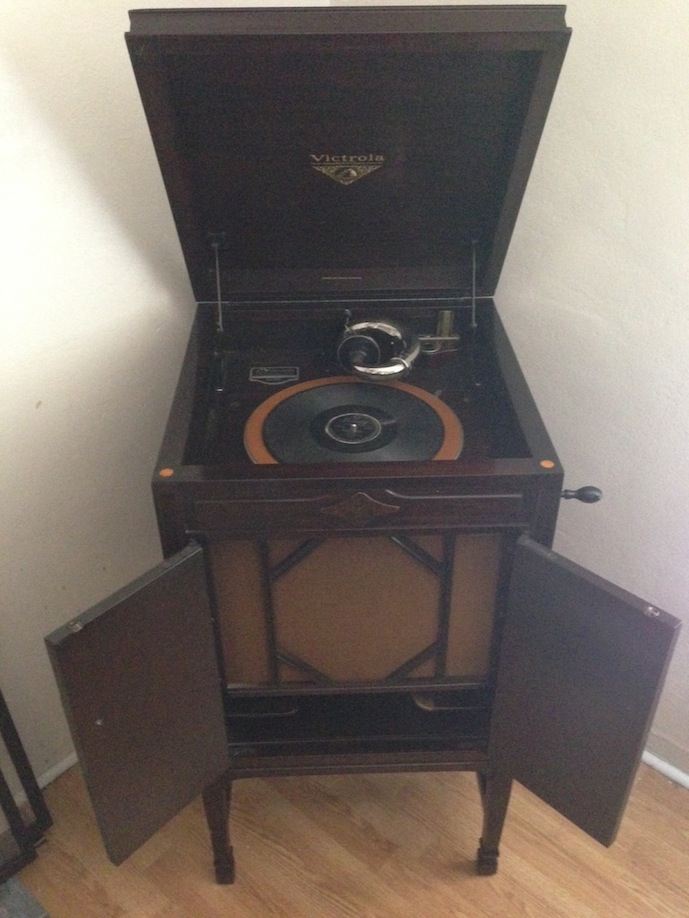
Got some pics. This is it cleaned up.
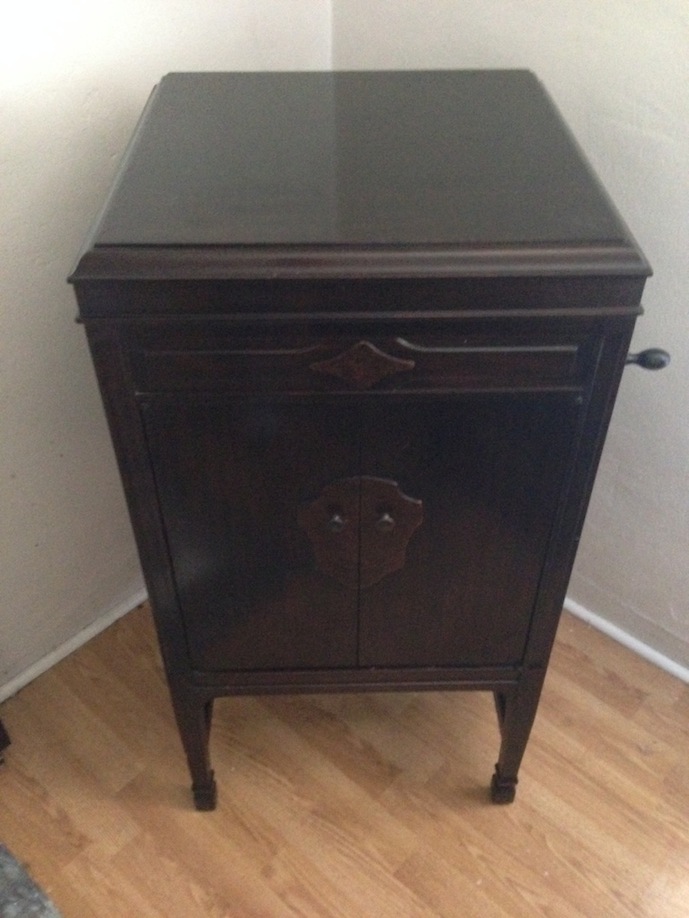
- Closed up
- photo.JPG (139.33 KiB) Viewed 2202 times
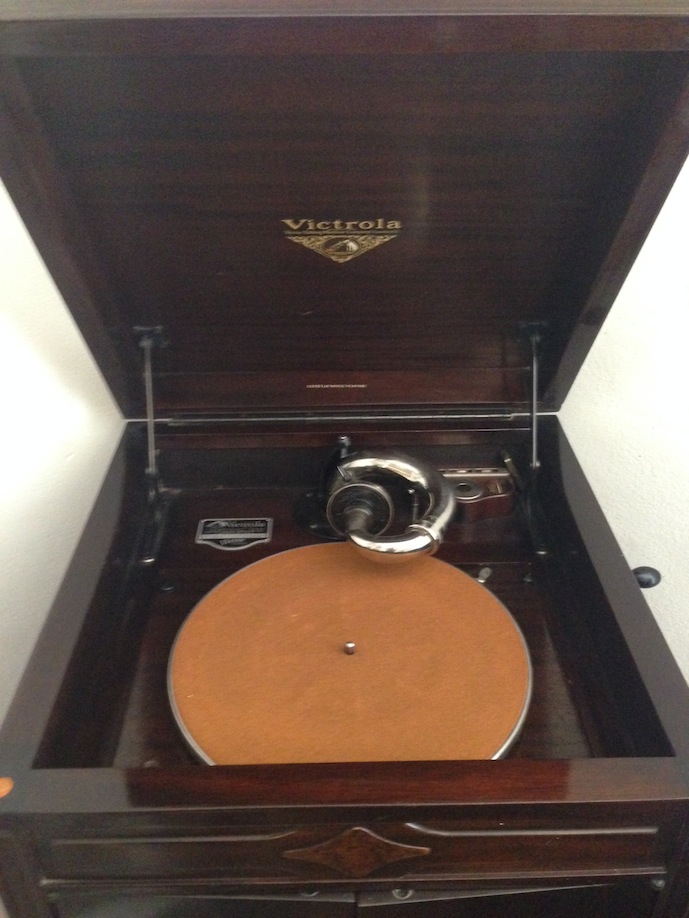
- Opened up
- photo copy 2.JPG (152.02 KiB) Viewed 2202 times
- Inside
- photo copy.JPG (148.35 KiB) Viewed 2202 times
-
Joe_DS
- Forum Moderator
- Posts: 1056
- Joined: Thu Jun 08, 2006 4:23 pm
- Location: San Francisco, California, USA
rworne wrote:Did you check CL over the past few weeks? Two credenzas showed up in Ventura county from the mid 4's to low 5's a week or three ago. One of which stated that the pot metal tone arm support was still strong. I was very interested in these, but they are twice as wide as the consolette.
I have to admit, I haven't looked in awhile. I've got a few priorities to take care of before I spend for anything fun or hobby related. (It's during these periods that the bargains show up, unfortunately...)
The Credenza is about twice as wide as the Consolette because it's horn is twice the length. I don't know if you've ever heard a Credenza, but they come very close to an electrically amplified phonograph, with about as much bass and treble as AM radio. Actually, a well restored model is very "concert hall like" when the right recording is played.
Still, except for bass, the Consolette does hold its own, and was originally sold by Victor as being the perfect model for a smaller apartment.
rworne wrote:Any hints as to do the following:
Some rough patches on the top - look like water rings. They aren't bad, but you can feel them and see them when looking from an angle.
Two 2" scratches on the front door - looks like a dog jumped on it. You can feel these, but I wanted to know if there was a good way to hide them. The other flaws are minor and add to the charm of the unit.
The one you have looks to be an excellent condition! If its only got a few scratches and water rings, it's best to try to mask them and preserve the original finish. A lot of people have had good results with Howard's Restor-A-Finish -- http://www.howardproducts.com/prod-restor-a-finish.php --which is available at most hardware and paint stores.
It comes in a variety of colors--Dark Walnut would probably match your cabinet best--and you just wipe it on and wipe it off.
JDS
You are seeing it post-cleanup.
Spray down with orange oil cleaner/conditioner, let sit, scrub lightly with 0000 steel wool.
This was followed up by Howard's (Mahogany) and steel wool on the top and lightly on the sides. Then it got a good rub-down several times after that. Now this is what you see above. Wish I had some before photos, it looked a lot more scary - rings were grey, looks like a cat was jumping off and onto the top at one point. I'm thrilled it doesn't need refinishing, just want to smooth out the rings and two front scratches some more.
George Vollema from Great Lakes Antique Phonograph is hooking me up on the few parts I need.
Spray down with orange oil cleaner/conditioner, let sit, scrub lightly with 0000 steel wool.
This was followed up by Howard's (Mahogany) and steel wool on the top and lightly on the sides. Then it got a good rub-down several times after that. Now this is what you see above. Wish I had some before photos, it looked a lot more scary - rings were grey, looks like a cat was jumping off and onto the top at one point. I'm thrilled it doesn't need refinishing, just want to smooth out the rings and two front scratches some more.
George Vollema from Great Lakes Antique Phonograph is hooking me up on the few parts I need.
I got the soundbox off (finally). The brass ring was nearly seized, but some penetrating oil convinced it to come off.
Looks like I got lucky and have a pot metal reproducer with no cracks in it. I took off the bearing covers and found that the rubber seals were rock hard and fused to the bearings - but no rust. So a bearing kit was ordered. There were seven bearings on each side, and they look like they were just packed in there, not all at the same depth forming a ring around the cross-member of the needle bar. is this right?
Looks like I got lucky and have a pot metal reproducer with no cracks in it. I took off the bearing covers and found that the rubber seals were rock hard and fused to the bearings - but no rust. So a bearing kit was ordered. There were seven bearings on each side, and they look like they were just packed in there, not all at the same depth forming a ring around the cross-member of the needle bar. is this right?
-
Joe_DS
- Forum Moderator
- Posts: 1056
- Joined: Thu Jun 08, 2006 4:23 pm
- Location: San Francisco, California, USA
rworne wrote:There were seven bearings on each side, and they look like they were just packed in there, not all at the same depth forming a ring around the cross-member of the needle bar. is this right?
They don't necessarily have to be all at the same depth, as long as they form a ring around each post, and the needle bar is situated in the center as much as possible. They're kind of self-adjusting once they're seated, anyway. As noted in the article I posted a link to above, they should allow the needle bar to move as freely as possible, in the direction required to play the record, but there should be no "side play," or movement of the needle bar toward the end-caps, as shown in the photo below. Side play always causes buzzing and rattling on loud or high notes.
Along this line, make sure that the tiny stop screw does not come into contact with the needle bar. If it does, it can cause blasting and rattling.
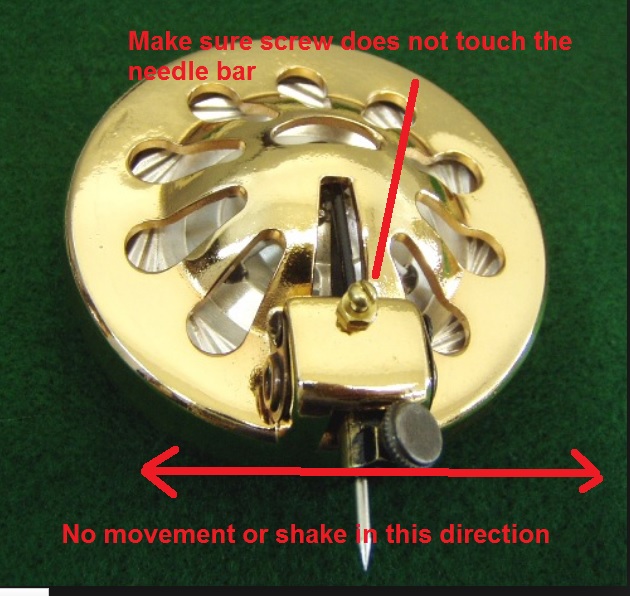
- sound box.jpg (118.75 KiB) Viewed 2178 times
(click or double-click photo to make it full size)
HTH,
Joe
The parts came in today.
First thing to do was try to fix the soundbox. I had already pulled out the crusty old rubber and bearings previously, so all that was left to do was put some "Judy Butter" (a type of thick yellow grease used by cyclists) in a light layer inside the "race" where the bearings go. Then they just went in, one by one, and I pushed them into place with a toothpick. No falling out here. Flipped it over and did the other side. Came out with the needle bar centered and the whole job took less than 15 minutes.
An incredible difference. All the distortion is gone, the only thing left is a slight buzz on very high frequencies at high volumes. I thought this meant that the box needed more work, but I found a record that appeared unplayed and tossed that on and I was greeted with incredible sound. So I think the noise I hear is due to a worn track on the records.
Next up was the tonearm support. My "fix" was working really well, but I decided to press on with it. The pot metal support most definitely did NOT want to come out, so using a vice and some chiseling, I got it out.
Cleaned all the old grease and lubed it up with more Judy Butter. I found an old needle encrusted in the gunk that probably was causing some playback issues at one point. It certainly gave me problems when I was test-fitting the pieces and was wondering what the excessive binding was and why the tonearm kept popping out.
After cleaning it out, I now have a 100% operational and complete consolette.
Thanks for the help!
First thing to do was try to fix the soundbox. I had already pulled out the crusty old rubber and bearings previously, so all that was left to do was put some "Judy Butter" (a type of thick yellow grease used by cyclists) in a light layer inside the "race" where the bearings go. Then they just went in, one by one, and I pushed them into place with a toothpick. No falling out here.
Flipped it over and did the other side. Came out with the needle bar centered and the whole job took less than 15 minutes.An incredible difference. All the distortion is gone, the only thing left is a slight buzz on very high frequencies at high volumes. I thought this meant that the box needed more work, but I found a record that appeared unplayed and tossed that on and I was greeted with incredible sound. So I think the noise I hear is due to a worn track on the records.
Next up was the tonearm support. My "fix" was working really well, but I decided to press on with it. The pot metal support most definitely did NOT want to come out, so using a vice and some chiseling, I got it out.
Cleaned all the old grease and lubed it up with more Judy Butter. I found an old needle encrusted in the gunk that probably was causing some playback issues at one point. It certainly gave me problems when I was test-fitting the pieces and was wondering what the excessive binding was and why the tonearm kept popping out.
After cleaning it out, I now have a 100% operational and complete consolette.
Thanks for the help!
-
Joe_DS
- Forum Moderator
- Posts: 1056
- Joined: Thu Jun 08, 2006 4:23 pm
- Location: San Francisco, California, USA
That's great news.
One thing you'll probably find is that the more records you play, the better it will sound. I discovered this when I got my first Consolette and replaced the ball bearings, etc. I've been told that the aluminum diaphragm, itself, tends to stiffen up with non-use--sitting for decades, in many cases--but when used regularly, will limber up again. Whatever.
One thing I did do to my 4-40's Orthophonic sound box, of an unconventional nature, was to put a few drops of "Goo Gone," the stuff you use to remove price stickers, onto the very edge of the diaphragm, and swish it around so it coated its outer rim. I made sure not to get it onto the area where the spider's feet are sealed (with shellac) to the diaphragm. I think that this may have made the paper-backed gaskets swell somewhat, and provide a better seal, because the bass was more noticeable after I did this.
In any event, good luck, going forward.
Joe
One thing you'll probably find is that the more records you play, the better it will sound. I discovered this when I got my first Consolette and replaced the ball bearings, etc. I've been told that the aluminum diaphragm, itself, tends to stiffen up with non-use--sitting for decades, in many cases--but when used regularly, will limber up again. Whatever.
One thing I did do to my 4-40's Orthophonic sound box, of an unconventional nature, was to put a few drops of "Goo Gone," the stuff you use to remove price stickers, onto the very edge of the diaphragm, and swish it around so it coated its outer rim. I made sure not to get it onto the area where the spider's feet are sealed (with shellac) to the diaphragm. I think that this may have made the paper-backed gaskets swell somewhat, and provide a better seal, because the bass was more noticeable after I did this.
In any event, good luck, going forward.
Joe
Who is online
Users browsing this forum: No registered users and 0 guests
It is currently Thu Oct 06, 2016 9:43 am