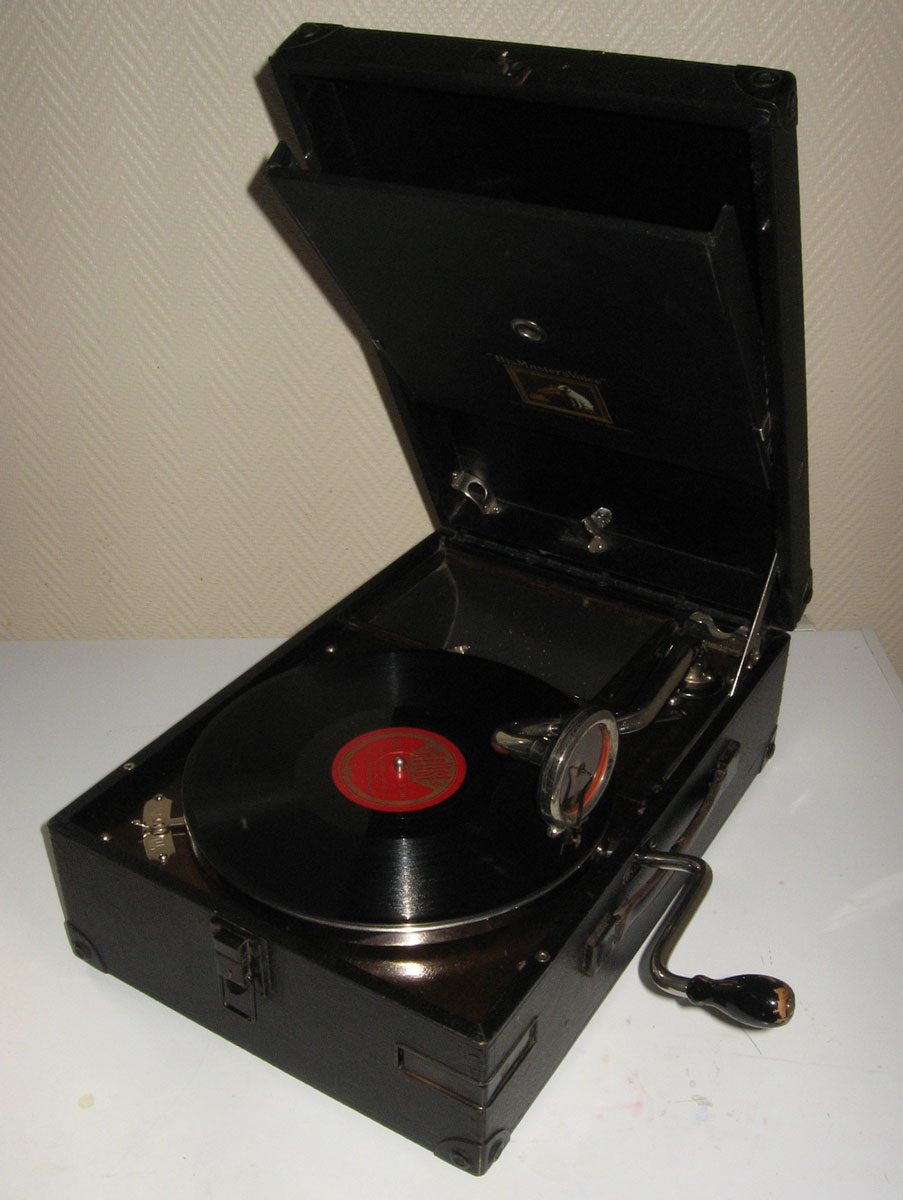
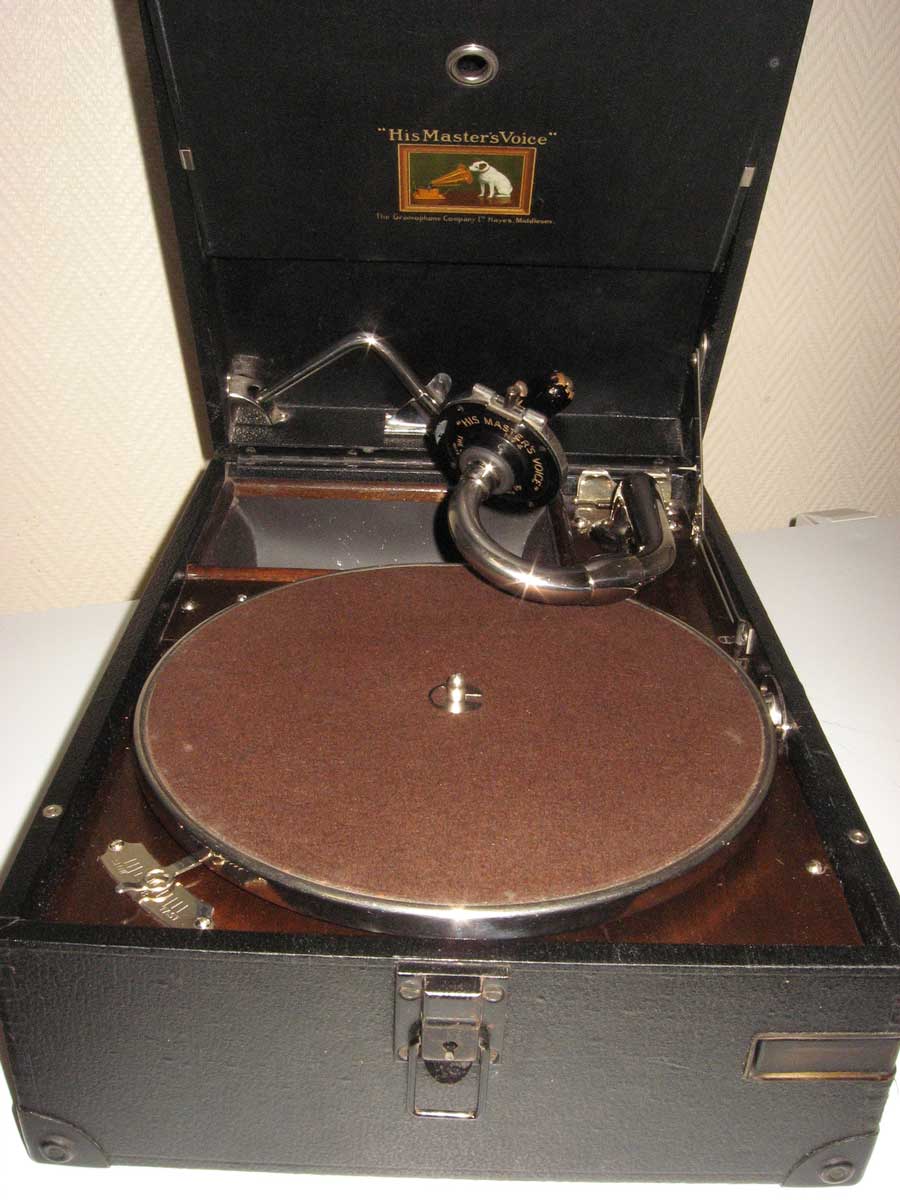
Hello everyone. I'm new to this forum and this is my first post. I just bought myself a His Master's Voice 101 gramophone. It is in very good condition (in my opinion) and works perfectly. It had a stuck speed regulator when I got it but a little oil cured that. I own a few 78s but I have never actually heard them played on a wind-up gramophone before and I was quite surprised how good it sounds. I have always thought that these things sound tinny and aren't particularly loud. The truth was quite opposite! I wish there was a volume control somewhere. The needles I got with the machine are marked "medium". I dare not think what a loud needle would sound like. I knew nothing about the subject before but I have done a lot of searches on the internet and at least now I know the basics, for example that needles can be used only once (what a waste). Anyway, my question is about the age of my HMV 101. Mine has the crank on the side near the handle. I have discovered that this dates it between late 1926 and 1931. But is it possible to find a more accurate date? I took some pictures of it and also the innards when I lubed the motor. I'll post them when I get them on my computer. If it helps with the dating, the machine has an automatic stop that is operated by the tone arm (or whatever it is called). I would be grateful if someone could help me with this. Thanks.
Timo

How old is my HMV 101?
Q&A about Talking Machines from the pre-electronic era (approx. 1885-1928).
Here's a picture of the HMV 101. Also a picture of the text found on the horn under the motorboard and of the motor. The motor had a metal cover on it which is removed in the picture. I hope these'll help with the identification.
One additional question springs to my mind. What is that bracket thingy behind the tone arm near the hinge?
One additional question springs to my mind. What is that bracket thingy behind the tone arm near the hinge?
- Attachments
-
- hmv101.jpg
- (127.91 KiB) Not downloaded yet
-
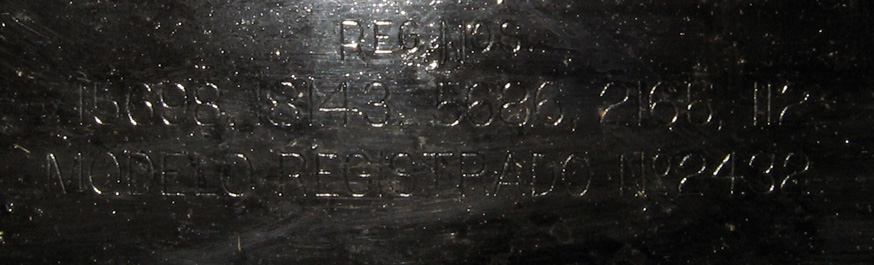
- hmv101_text.jpg (89.18 KiB) Viewed 10916 times
-
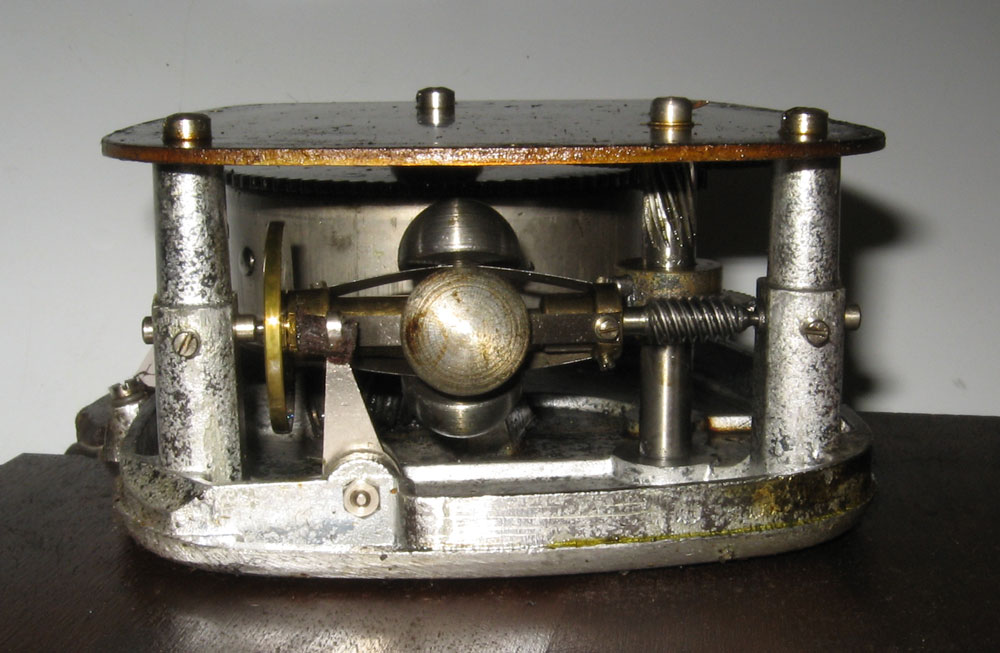
- hmv_motor.jpg (114.55 KiB) Viewed 10916 times
-
Joe_DS
- Forum Moderator
- Posts: 1056
- Joined: Thu Jun 08, 2006 4:23 pm
- Location: San Francisco, California, USA
Hi Timo:
I know that there are a lot of clues to look for, from a components standpoint, when dating these. In addition to the position of the crank, there is the type of motor used, as well as sound box, etc. So post as many photos as you like.
Since my own knowledge of HMV products is limited, I've checked with a couple of UK-based experts to see if they can help, so please be sure to check back here for new responses.
JDS
I know that there are a lot of clues to look for, from a components standpoint, when dating these. In addition to the position of the crank, there is the type of motor used, as well as sound box, etc. So post as many photos as you like.
Since my own knowledge of HMV products is limited, I've checked with a couple of UK-based experts to see if they can help, so please be sure to check back here for new responses.
JDS

Joe_DS kindly pointed me to your question from my own specialist Vintage Gramophones & Music Forum (simply click on the link in my signature below to access) of which he is also a member.
Your question is easily answered by virtue of the automatic brake. The 101 did not have an auto brake until the very last version was intro'd in 1930/31. I assume it is also safe to say that the metalwork is also CHROMIUM plated as opposed to being nickel plated as all the earlier models were? Chrome was effectively used after 1929. Your model is a late and final version of this portable and it will probably have a mazak back No. 4 soundbox. These are identifiable by the cracks (crazing) that appear in the black enamelled back-plate. I would suggest not attempting to strip down and rebuild the soundbox (a usual must) because these backs can fracture and crumble into pieces very easily. If you have a nickel plated No. 4 with a BRASS back, then your soundbox has been incorrectly replaced at some time BUT it will be a cinch to restore back to its former glory. However good you think it might sound currently, it would sound significantly better if the soundbox was professionally rebuilt, assuming of course, that it hasn't been already by its former owner?
Dave Cooper's book called "The Perfect Portable" might also interest you and in there you might an even more specific production date for your machine given the serial numbers etc.
BTW, one correction to make in your first post: the production run was actually late 1925 to 1931. Considering that it was made for a relatively short period (approx. 6 years), it is amazing how many have survived. Indeed it is a far more common machine than its successor, the 102, which was made from 1931 through 1960! It just goes to prove that the late 1920's was THE classic period of the portable machine, in part largely due to the introduction of the 101 itself. Before this model was intro'd by HMV, arguably the best portable machine on the market was the "Decca" with its Dulciflex (reflecting bowl in the lid for amplification) system but by 1925 the design was getting a little "long in the tooth" and was considered inadequate to cope with the new electrically recorded records. The 101 design was revolutionary and nearly every other competitor product opted to "clone" it shortly thereafter, so its influence on the design of future portable machines is almost impossible to overstate. As a mass produced commercial product its legacy is somewhat legendary.
HTH
Steve
Your question is easily answered by virtue of the automatic brake. The 101 did not have an auto brake until the very last version was intro'd in 1930/31. I assume it is also safe to say that the metalwork is also CHROMIUM plated as opposed to being nickel plated as all the earlier models were? Chrome was effectively used after 1929. Your model is a late and final version of this portable and it will probably have a mazak back No. 4 soundbox. These are identifiable by the cracks (crazing) that appear in the black enamelled back-plate. I would suggest not attempting to strip down and rebuild the soundbox (a usual must) because these backs can fracture and crumble into pieces very easily. If you have a nickel plated No. 4 with a BRASS back, then your soundbox has been incorrectly replaced at some time BUT it will be a cinch to restore back to its former glory. However good you think it might sound currently, it would sound significantly better if the soundbox was professionally rebuilt, assuming of course, that it hasn't been already by its former owner?
Dave Cooper's book called "The Perfect Portable" might also interest you and in there you might an even more specific production date for your machine given the serial numbers etc.
BTW, one correction to make in your first post: the production run was actually late 1925 to 1931. Considering that it was made for a relatively short period (approx. 6 years), it is amazing how many have survived. Indeed it is a far more common machine than its successor, the 102, which was made from 1931 through 1960! It just goes to prove that the late 1920's was THE classic period of the portable machine, in part largely due to the introduction of the 101 itself. Before this model was intro'd by HMV, arguably the best portable machine on the market was the "Decca" with its Dulciflex (reflecting bowl in the lid for amplification) system but by 1925 the design was getting a little "long in the tooth" and was considered inadequate to cope with the new electrically recorded records. The 101 design was revolutionary and nearly every other competitor product opted to "clone" it shortly thereafter, so its influence on the design of future portable machines is almost impossible to overstate. As a mass produced commercial product its legacy is somewhat legendary.
HTH
Steve
I used to be looking for things but now I've found them I don't look at them!
Thank you very much for the kind help Joe_DS and STEVE. I really appreciate it. And thanks for the link to the another forum.
It certainly looks like chromium but I don't really have anything to compare with. Does the automatic brake or some other feature make this any more desirable model than the earlier ones? I guess I'm really asking how valuable it is. Not that I'm ever going to sell it. I paid 80 euros for it (about 112 US dollars) + postage. Was it too much?
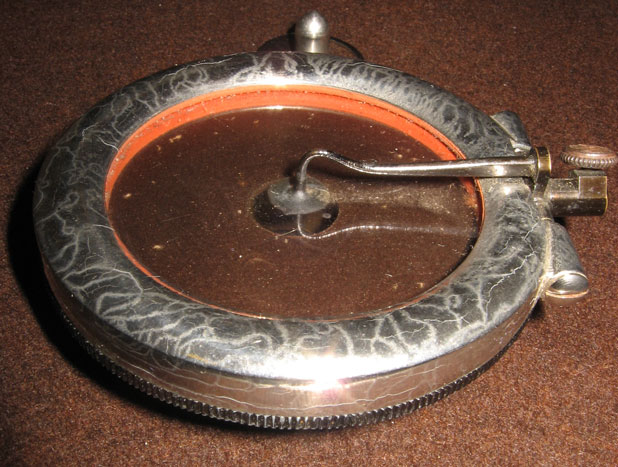
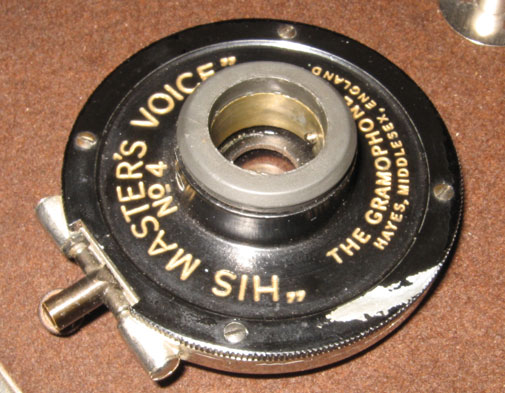
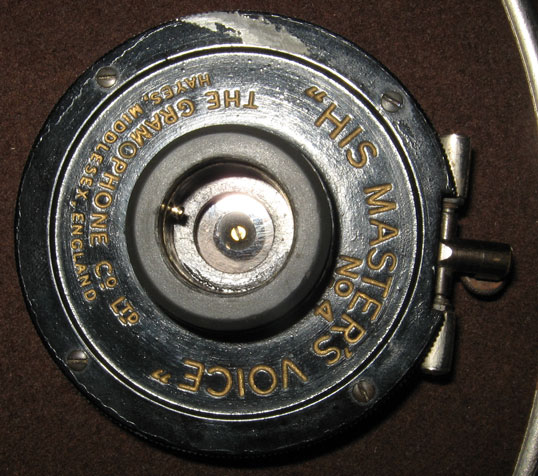
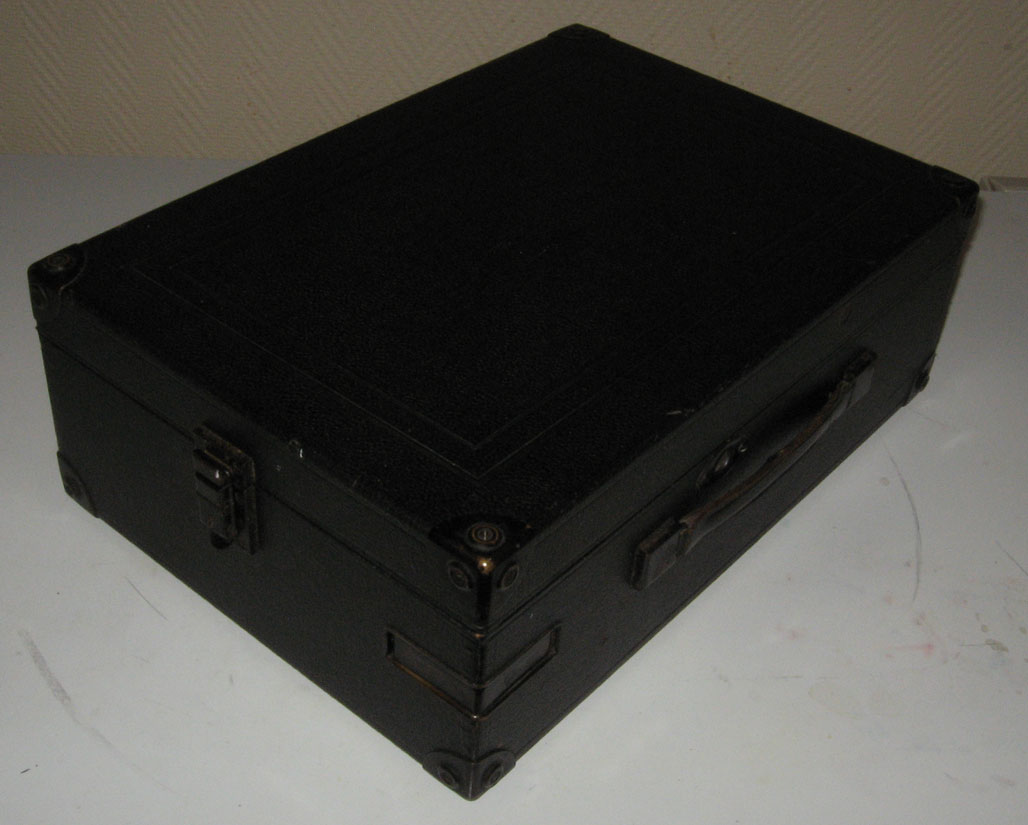
I'll attach some pictures of the machine and of the sound box. What is mazak? I tried to google it but I didn't find anything useful. There are some cracks in the chromed part of the sound box as can be seen from the photos (the camera makes the cracks more visible than they are in real life) but I guess you didn't mean that. The "back plate" is the black part with the writing, right? I couldn't se any cracks in that but there is a scratch where the paint is missing and the revealed surface is definately not brass. It has a silvery/grey metal color. There is what seems to be brass, however, in the inside of the hole where the tone arm attaches. I'm quite sure that it hasn't been rebuilt before but I don't know that for sure. The sound is perfect in my opinion but it does distort a little with very loud bits of music. How can you tell when a sound box needs to be rebuilt? Not that I'm going to do it if it is of the crumbling sort.
Timo
STEVE wrote:Your question is easily answered by virtue of the automatic brake. The 101 did not have an auto brake until the very last version was intro'd in 1930/31. I assume it is also safe to say that the metalwork is also CHROMIUM plated as opposed to being nickel plated as all the earlier models were? Chrome was effectively used after 1929.
It certainly looks like chromium but I don't really have anything to compare with. Does the automatic brake or some other feature make this any more desirable model than the earlier ones? I guess I'm really asking how valuable it is. Not that I'm ever going to sell it. I paid 80 euros for it (about 112 US dollars) + postage. Was it too much?
STEVE wrote:Your model is a late and final version of this portable and it will probably have a mazak back No. 4 soundbox. These are identifiable by the cracks (crazing) that appear in the black enamelled back-plate. I would suggest not attempting to strip down and rebuild the soundbox (a usual must) because these backs can fracture and crumble into pieces very easily. If you have a nickel plated No. 4 with a BRASS back, then your soundbox has been incorrectly replaced at some time BUT it will be a cinch to restore back to its former glory. However good you think it might sound currently, it would sound significantly better if the soundbox was professionally rebuilt, assuming of course, that it hasn't been already by its former owner?
I'll attach some pictures of the machine and of the sound box. What is mazak? I tried to google it but I didn't find anything useful. There are some cracks in the chromed part of the sound box as can be seen from the photos (the camera makes the cracks more visible than they are in real life) but I guess you didn't mean that. The "back plate" is the black part with the writing, right? I couldn't se any cracks in that but there is a scratch where the paint is missing and the revealed surface is definately not brass. It has a silvery/grey metal color. There is what seems to be brass, however, in the inside of the hole where the tone arm attaches. I'm quite sure that it hasn't been rebuilt before but I don't know that for sure. The sound is perfect in my opinion but it does distort a little with very loud bits of music. How can you tell when a sound box needs to be rebuilt? Not that I'm going to do it if it is of the crumbling sort.
Timo
- Attachments
-
- hmv5.jpg (86.64 KiB) Viewed 10891 times
-
- hmv4.jpg (61.87 KiB) Viewed 10891 times
-
- hmv3.jpg (83.25 KiB) Viewed 10891 times
-
- hmv2.jpg
- (93.53 KiB) Not downloaded yet
-
- hmv1.jpg (85.83 KiB) Viewed 10891 times
-
Joe_DS
- Forum Moderator
- Posts: 1056
- Joined: Thu Jun 08, 2006 4:23 pm
- Location: San Francisco, California, USA
Hi Timo:
I can answer one of your questions. Mazak is a zinc based alloy, basically a type of pot-metal, used in the construction of the sound box, as Steve noted. SEE: http://en.wikipedia.org/wiki/ZAMAK#Mazak
Unfortunately, over time, pot-metal components tend to swell, crack and crumble. I noticed a few line cracks in the one you have.
As noted, the earlier #4 sound boxes used all-brass components, and can therefore be easily disassembled for installation of fresh diaphragm gaskets, and correct adjustment of the needle-bar pivot.
It looks like the gaskets in your sound box may be original. If they are hard, they are original, and have dried out with time. While it may sound very good, it will sound even better--not just loud, but full--once fresh gaskets are installed. You'll hear more of a 3-D sound quality, for lack of a better way of explaining it. Also, the bass response will be more defined, there will be less surface noise, and there will be less needle wear on the records, themselves.
The reason for this is that soft, fresh gaskets allow a greater area of the mica diaphragm to plunge back and forth with the movement of the needle-bar, as it tracks the zig-zag shaped record groove. Less restriction is put on the needle bar's movement, as well. In addition, the soft rubber dampens excessive vibrations which, otherwise, make their way to the shell of the sound box, and tonearm, causing distortion to some extent.
The HMV 101 was actually a very expensive machine in its day--costing over 5 Pounds, or $45.00 US. Factoring in for inflation, that would around $550-$600 in today's money! As such, many people bought these to be their "primary gramophone" and not just a take-along portable. For that reason, the sound quality should not be under-estimated.
If the gramophone is in overall good condition, it would be worth tracking down another, earlier model (brass) #4 sound box and having it restored, especially if you plan to play it much.
As for price, these come up for sale all the time on the UK eBay site, and others. I think if you paid 80 Euros for it, you did pretty well. In the US, these normally sell for (at least) a couple of hundred dollars, but they are far less common over here.
Take care,
JDS
I can answer one of your questions. Mazak is a zinc based alloy, basically a type of pot-metal, used in the construction of the sound box, as Steve noted. SEE: http://en.wikipedia.org/wiki/ZAMAK#Mazak
Unfortunately, over time, pot-metal components tend to swell, crack and crumble. I noticed a few line cracks in the one you have.
As noted, the earlier #4 sound boxes used all-brass components, and can therefore be easily disassembled for installation of fresh diaphragm gaskets, and correct adjustment of the needle-bar pivot.
It looks like the gaskets in your sound box may be original. If they are hard, they are original, and have dried out with time. While it may sound very good, it will sound even better--not just loud, but full--once fresh gaskets are installed. You'll hear more of a 3-D sound quality, for lack of a better way of explaining it. Also, the bass response will be more defined, there will be less surface noise, and there will be less needle wear on the records, themselves.
The reason for this is that soft, fresh gaskets allow a greater area of the mica diaphragm to plunge back and forth with the movement of the needle-bar, as it tracks the zig-zag shaped record groove. Less restriction is put on the needle bar's movement, as well. In addition, the soft rubber dampens excessive vibrations which, otherwise, make their way to the shell of the sound box, and tonearm, causing distortion to some extent.
The HMV 101 was actually a very expensive machine in its day--costing over 5 Pounds, or $45.00 US. Factoring in for inflation, that would around $550-$600 in today's money! As such, many people bought these to be their "primary gramophone" and not just a take-along portable. For that reason, the sound quality should not be under-estimated.
If the gramophone is in overall good condition, it would be worth tracking down another, earlier model (brass) #4 sound box and having it restored, especially if you plan to play it much.
As for price, these come up for sale all the time on the UK eBay site, and others. I think if you paid 80 Euros for it, you did pretty well. In the US, these normally sell for (at least) a couple of hundred dollars, but they are far less common over here.
Take care,
JDS
Don't worry, you did okay. Everything in the Euro Zone as far as HMV is concerned, is always a little pricier than it would be in the Uk but the most important thing is the condition and not price. Your machine appears to be a clean example and that is critical for a 101 - as I said previously, they are very common so no one wants an ugly or battered example.
Your machine is definitely chrome plated and post 1930. I have to say though that your No. 4 is an ugly brute and is very badly distorted due to the growth of the back-plate AND the front bezzel (which is also mazak!). I'm surprised that it hasn't busted apart already. The pot metal soundbox is not worth restoring, even if it could be done? As Joe_DS has already said, you would be well advised to not use it to play good records with. I would personally advise you to get hold of a brass version of the No. 4 and get it rebuilt, preferably after getting the nickel plating redone and / or chrome plated. I personally find the look of a nickel No. 4 on a chrome tone-arm very jarring. See how you feel once you've got one.
I completely agree with Joe_DS about the rebuild though. Leaving as is would not be an option for me.
As for desirability, it makes little difference which version of the 101 it is if it's in a standard black case. Many years ago the early versions with the front winder were considered far more desirable but since Ebay has shown that even these versions are fairly common, it is no longer true. Get yourself a nickel plated / all brass bodied No. 4 a.s.a.p. and after the replating / rebuild, you will have a terrific black 101 worth every penny (or cent) you paid for it.
Regards
Steve
Your machine is definitely chrome plated and post 1930. I have to say though that your No. 4 is an ugly brute and is very badly distorted due to the growth of the back-plate AND the front bezzel (which is also mazak!). I'm surprised that it hasn't busted apart already. The pot metal soundbox is not worth restoring, even if it could be done? As Joe_DS has already said, you would be well advised to not use it to play good records with. I would personally advise you to get hold of a brass version of the No. 4 and get it rebuilt, preferably after getting the nickel plating redone and / or chrome plated. I personally find the look of a nickel No. 4 on a chrome tone-arm very jarring. See how you feel once you've got one.
I completely agree with Joe_DS about the rebuild though. Leaving as is would not be an option for me.
As for desirability, it makes little difference which version of the 101 it is if it's in a standard black case. Many years ago the early versions with the front winder were considered far more desirable but since Ebay has shown that even these versions are fairly common, it is no longer true. Get yourself a nickel plated / all brass bodied No. 4 a.s.a.p. and after the replating / rebuild, you will have a terrific black 101 worth every penny (or cent) you paid for it.
Regards
Steve
I used to be looking for things but now I've found them I don't look at them!
-
Ron Rich
- Forum Moderator
- Posts: 8193
- Joined: Sun May 06, 2007 11:31 pm
- Location: Millbrae (San Francisco area)CA, USA
Hi guys,
I know nothing about these--but have heard the word (pronounced) "Zee-mack". I was told, many years ago that it referred to the words "zinc" and "magnesium" which were combined to make "pot metal". I was told that the quality was dependent on the mixture--I don't recall which way was less expensive, poorer quality, or more expensive, better quality--- Ron Rich
I know nothing about these--but have heard the word (pronounced) "Zee-mack". I was told, many years ago that it referred to the words "zinc" and "magnesium" which were combined to make "pot metal". I was told that the quality was dependent on the mixture--I don't recall which way was less expensive, poorer quality, or more expensive, better quality--- Ron Rich
Hi Ron
That's interesting! I've been told that the main problem is the "impurities" in the alloy mixture that causes "growth" problems later on and metal expansion / cracking etc.
What do you know about this?
Steve
That's interesting! I've been told that the main problem is the "impurities" in the alloy mixture that causes "growth" problems later on and metal expansion / cracking etc.
What do you know about this?
Steve
I used to be looking for things but now I've found them I don't look at them!
Thanks again for the very informative answers, everyone! And thanks for reassuring me that I didn't pay too much for it.
I have started to notice the slight distortion now that the first exitement of owning the gramophone has worn off and you guys have pointed it out to me. I would have been completely happy with it if you hadn't spoiled it for me Just kidding. I would definately want the machine to work as good as it was intended.
It doesn't look that frightening in nature. The camera exaggerates the cracks a little. But you got me convinced. I'll start looking for a brass one then. Is this what I'm looking for:
http://cgi.ebay.com/ws/eBayISAPI.dll?Vi ... K:MEWAX:IT
It seems to have the text written on the diapraghm. Is this normal for the brass sound box?
Where can I get new gaskets and whatever is needed for the rebuild? Or is there any place I could buy it readily restoder/plated (and still not pay more than I paid for the whole machine). I'm sure that with a little advice I could restore it myself. I have some experiece in that sort of tinkering and I have for example restored many old tube radios.
Is there any hope for the old sound box? It would be nice to keep it since it (probably) is original to this machine.
Timo
I have started to notice the slight distortion now that the first exitement of owning the gramophone has worn off and you guys have pointed it out to me. I would have been completely happy with it if you hadn't spoiled it for me
Just kidding. I would definately want the machine to work as good as it was intended. STEVE wrote:I have to say though that your No. 4 is an ugly brute and is very badly distorted due to the growth of the back-plate AND the front bezzel (which is also mazak!). I'm surprised that it hasn't busted apart already. The pot metal soundbox is not worth restoring, even if it could be done? As Joe_DS has already said, you would be well advised to not use it to play good records with. I would personally advise you to get hold of a brass version of the No. 4 and get it rebuilt, preferably after getting the nickel plating redone and / or chrome plated. I personally find the look of a nickel No. 4 on a chrome tone-arm very jarring. See how you feel once you've got one.
I completely agree with Joe_DS about the rebuild though. Leaving as is would not be an option for me.
It doesn't look that frightening in nature. The camera exaggerates the cracks a little. But you got me convinced. I'll start looking for a brass one then. Is this what I'm looking for:
http://cgi.ebay.com/ws/eBayISAPI.dll?Vi ... K:MEWAX:IT
It seems to have the text written on the diapraghm. Is this normal for the brass sound box?
Where can I get new gaskets and whatever is needed for the rebuild? Or is there any place I could buy it readily restoder/plated (and still not pay more than I paid for the whole machine). I'm sure that with a little advice I could restore it myself. I have some experiece in that sort of tinkering and I have for example restored many old tube radios.
Is there any hope for the old sound box? It would be nice to keep it since it (probably) is original to this machine.
Timo
-
Joe_DS
- Forum Moderator
- Posts: 1056
- Joined: Thu Jun 08, 2006 4:23 pm
- Location: San Francisco, California, USA
Is this what I'm looking for:
http://cgi.ebay.com/ws/eBayISAPI.dll?Vi ... K:MEWAX:IT
It seems to have the text written on the diapraghm. Is this normal for the brass sound box?
That looks to be exactly what you'll need, but I'll defer to Steve's opinion. The diaphragm, itself, is clear mica, so the text that you see in the photo is actually etched/printed on the sound box's casing--on the "front part" of the back plate, to be exact--and showing through the mica.
JDS
Yes, that is a brass No. 4 on Ebay but NO, IT IS NOT CORRECT for your machine. The No. 4's with the words: "His Master's Voice etc..." etched into the inside of the back-plate and therefore visible through the mica diaphragm (as Joe_DS correctly points out) are the VERY early type. As you have one of the latest period 101's that would be completely WRONG and inappropriate.
You need the same identical looking No. 4 as the one that is currently on your machine with the words "His Master's Voice" etched into the circumference on the outside of the back-plate. I mentioned in an earlier post about the "front winding 101"; that Ebay No. 4 would be appropriate for that machine and not yours. The later No. 4's are far more commonly available than this early type so don't panic and buy the first one you spot. Check a few out on Ebay first and see how much they're going for today and when you spot another one that has a good back-plate (think, unmarked black enamel and bold clear lettering etc), go for it. As you will be rebuilding the s/box anyway, the condition of the mica and the nickel plating is almost of secondary importance.
Of course, you could just as easily opt for a rebuilt No. 4 if you see one and simply pay more for it and save yourself the effort. A very bright looking nickel might satisfy you as a chrome substitute. Please note: chrome has a mirror finish and almost bluey silver tint to it; nickel is very much duller and has a brownish tint, so it is easy to spot the difference between the two. I'm also prepared to guess that 90% of No. 4's that come up for sale will be nickel plated. It was used on a number of cabinet and table model machines in that form (as well as the vast majority of 101's) so the chrome version is exclusively for the late 101 and therefore a) quite rare in itself and b) more likely than not going to turn up in a swollen distorted / cracked state of repair - similar to yours anyway.
It appears that most collectors are happy to trade their chrome No. 4's for nickel No.4's when faced with the same situation as yours. I wonder how many don't know the difference between chrome and nickel, though? Even so, it seems the only probable realistic scenario for someone with a good late 101 who wants to play it and get the best out of it whilst not damaging their records.
A "litmus test" for chrome / nickel if you don't already know this:
Try polishing the front bezzel with a clean white rag with a spot of Brasso on it. Nickel will turn the cloth black very quickly as it is removing a layer of oxidation from the plating and it will shine the plating up in the process. On the contrary, chrome will NOT make the cloth blacken. It does not "polish up" as it stays bright for all its life anyway. You might see a grey tint to the cloth as it removes dust, grease and dirt, but that is all.
Rebuilding a NO. 4 is an absolute cinch! All you have to do is remove the four screws from the back-plate to unfasten the bezzel. Gaskets are available from Ebay sellers like "soundgen" but I would recommend using ordinary gasket instead as I have obtained better results this way myself. All you are looking to end up with is a ring of very soft rubber material around the circumference of the front and back of the mica (once you have removed the dried hard rubber from the original mica - it will probably break off in small pieces). Being pivot based bearings, the stylus bar can be easily removed by taking out the end screws or "caps" from each pivot cylindrical housing (barrel shape). The pointed rods will simply then push out. Once the stylus bar has been detached (don't forget to remove the tiny grub screw which holds it to the diaphragm) you can freely remove the diaphragm and clean it up and re-gasket the soundbox.
There are numerous "do's and don'ts" regarding soundbox re-building so perhaps when you have found your perfect (cheap) brass bodied, nickel plated No. 4 with writing on the BACK, perhaps you might want to get in contact with me directly and I'll talk you through it. The No. 4 has very few component parts. If you carefully pull it down and store the parts carefully to one side whilst the replating is being done on the bezzel (if you go that far), when you come to re-assemble it, you shouldn't have too much difficulty. There may be a bit of trial and error involved but you are unlikely to go far wrong or damage anything. It really is very simple and with one "rebuild" under your belt you will be confident to tackle the more challenging soundboxes out there.
You need the same identical looking No. 4 as the one that is currently on your machine with the words "His Master's Voice" etched into the circumference on the outside of the back-plate. I mentioned in an earlier post about the "front winding 101"; that Ebay No. 4 would be appropriate for that machine and not yours. The later No. 4's are far more commonly available than this early type so don't panic and buy the first one you spot. Check a few out on Ebay first and see how much they're going for today and when you spot another one that has a good back-plate (think, unmarked black enamel and bold clear lettering etc), go for it. As you will be rebuilding the s/box anyway, the condition of the mica and the nickel plating is almost of secondary importance.
Of course, you could just as easily opt for a rebuilt No. 4 if you see one and simply pay more for it and save yourself the effort. A very bright looking nickel might satisfy you as a chrome substitute. Please note: chrome has a mirror finish and almost bluey silver tint to it; nickel is very much duller and has a brownish tint, so it is easy to spot the difference between the two. I'm also prepared to guess that 90% of No. 4's that come up for sale will be nickel plated. It was used on a number of cabinet and table model machines in that form (as well as the vast majority of 101's) so the chrome version is exclusively for the late 101 and therefore a) quite rare in itself and b) more likely than not going to turn up in a swollen distorted / cracked state of repair - similar to yours anyway.
It appears that most collectors are happy to trade their chrome No. 4's for nickel No.4's when faced with the same situation as yours. I wonder how many don't know the difference between chrome and nickel, though? Even so, it seems the only probable realistic scenario for someone with a good late 101 who wants to play it and get the best out of it whilst not damaging their records.
A "litmus test" for chrome / nickel if you don't already know this:
Try polishing the front bezzel with a clean white rag with a spot of Brasso on it. Nickel will turn the cloth black very quickly as it is removing a layer of oxidation from the plating and it will shine the plating up in the process. On the contrary, chrome will NOT make the cloth blacken. It does not "polish up" as it stays bright for all its life anyway. You might see a grey tint to the cloth as it removes dust, grease and dirt, but that is all.
Rebuilding a NO. 4 is an absolute cinch! All you have to do is remove the four screws from the back-plate to unfasten the bezzel. Gaskets are available from Ebay sellers like "soundgen" but I would recommend using ordinary gasket instead as I have obtained better results this way myself. All you are looking to end up with is a ring of very soft rubber material around the circumference of the front and back of the mica (once you have removed the dried hard rubber from the original mica - it will probably break off in small pieces). Being pivot based bearings, the stylus bar can be easily removed by taking out the end screws or "caps" from each pivot cylindrical housing (barrel shape). The pointed rods will simply then push out. Once the stylus bar has been detached (don't forget to remove the tiny grub screw which holds it to the diaphragm) you can freely remove the diaphragm and clean it up and re-gasket the soundbox.
There are numerous "do's and don'ts" regarding soundbox re-building so perhaps when you have found your perfect (cheap) brass bodied, nickel plated No. 4 with writing on the BACK, perhaps you might want to get in contact with me directly and I'll talk you through it. The No. 4 has very few component parts. If you carefully pull it down and store the parts carefully to one side whilst the replating is being done on the bezzel (if you go that far), when you come to re-assemble it, you shouldn't have too much difficulty. There may be a bit of trial and error involved but you are unlikely to go far wrong or damage anything. It really is very simple and with one "rebuild" under your belt you will be confident to tackle the more challenging soundboxes out there.
I used to be looking for things but now I've found them I don't look at them!
-
Joe_DS
- Forum Moderator
- Posts: 1056
- Joined: Thu Jun 08, 2006 4:23 pm
- Location: San Francisco, California, USA
Hi Steve:
Many thanks for your input. Glad I deferred to your opinion, since I would have steered Toby in the wrong direction! I agree that it's best to have something with the correct components in place.
One of these years, I'm going to try to find an affordable, good condition 101, hopefully, when my finances are a little better. The only ones I spot in my neck of the woods (San Francisco) are priced by sellers with rather unrealistic expectations -- we're talking the $500-$1000 range!!! The last one I came across, about five years ago, was priced $675.00. The seller eventually gave it to his daughter, because "no one was interested in buying it." ("Well, Duh," as the young folks say!)
JDS
Many thanks for your input. Glad I deferred to your opinion, since I would have steered Toby in the wrong direction! I agree that it's best to have something with the correct components in place.
One of these years, I'm going to try to find an affordable, good condition 101, hopefully, when my finances are a little better. The only ones I spot in my neck of the woods (San Francisco) are priced by sellers with rather unrealistic expectations -- we're talking the $500-$1000 range!!! The last one I came across, about five years ago, was priced $675.00. The seller eventually gave it to his daughter, because "no one was interested in buying it." ("Well, Duh," as the young folks say!)
JDS
Hello again. I must say that you've been really helpful to me and I'm forever grateful. What a wealth of knowledge you have.
I understand that the sound box on ebay that I mentioned is the wrong type. But I went and bought it anyway Don't worry, I'm not going to put it (permanently) in my 101. It would be a good specimen to practice on and I can always sell it later. And perhaps I'll own another gramophone in the future... I'll still keep my eyes open for the correct type. And I shall take up on your offer, Steve, and contact you when the time comes for the rebuild.
I'll find out if there's a place near me that does chroming but I have a feeling that it's not going to be cheap
Could you give me the dimensions of the rubber gaskets so that I can go ahead and buy some while I'm waiting the sound box to arrive? Does it need to be a flat or will an o-ring suffice? I think they make o-rings out of silicone. That would be quite soft and silicone probably doesn't harden very much over time. What do you think?
Also there is a rubber piece where the tone arm connects to the sound box. It is rock hard. Does this part need to be changed also? I ask because I've spotted them in Ebay. Not for the HMV no 4, though, but for some other models.
Bytheway, I poked the front gasket in my current sound box with a screw driver and it felt quite soft so it must not be totally gone yet. What do you think, should I try to rebuild that one too if it is more or less useless anyway or should I sell it after I've obtained a replacement for it? I would think someone would happily accept it as it is. I still argue that the sound from it is very good, it doesn't sound tinny at all. The only thing is that it distorts a little with loud music.
Yesterday, I had the opportunity to hear another gramophone and it sounded horrible. The record and the needle were very probably well worn but I think that the sound box might have been to blame too. The owner didn't seem to think that there was anything wrong with it, though
Timo
I understand that the sound box on ebay that I mentioned is the wrong type. But I went and bought it anyway
Don't worry, I'm not going to put it (permanently) in my 101. It would be a good specimen to practice on and I can always sell it later. And perhaps I'll own another gramophone in the future... I'll still keep my eyes open for the correct type. And I shall take up on your offer, Steve, and contact you when the time comes for the rebuild. I'll find out if there's a place near me that does chroming but I have a feeling that it's not going to be cheap
Could you give me the dimensions of the rubber gaskets so that I can go ahead and buy some while I'm waiting the sound box to arrive? Does it need to be a flat or will an o-ring suffice? I think they make o-rings out of silicone. That would be quite soft and silicone probably doesn't harden very much over time. What do you think?
Also there is a rubber piece where the tone arm connects to the sound box. It is rock hard. Does this part need to be changed also? I ask because I've spotted them in Ebay. Not for the HMV no 4, though, but for some other models.
Bytheway, I poked the front gasket in my current sound box with a screw driver and it felt quite soft so it must not be totally gone yet. What do you think, should I try to rebuild that one too if it is more or less useless anyway or should I sell it after I've obtained a replacement for it? I would think someone would happily accept it as it is. I still argue that the sound from it is very good, it doesn't sound tinny at all. The only thing is that it distorts a little with loud music.
Yesterday, I had the opportunity to hear another gramophone and it sounded horrible. The record and the needle were very probably well worn but I think that the sound box might have been to blame too. The owner didn't seem to think that there was anything wrong with it, though
Timo
-
Joe_DS
- Forum Moderator
- Posts: 1056
- Joined: Thu Jun 08, 2006 4:23 pm
- Location: San Francisco, California, USA
One thing you could try with your sound box is to check for what is known as "side play" of the needle bar. In order to work properly, the needle should move freely--back and forth--only in the direction required to track the record groove. If it moves or gives slightly in the direction of either of the posts holding it in place, that's what's commonly known as side play.
If you detect side play, loosen each of the end-cap (pivot) screws a few turns, and then, applying equal pressure with your thumb and index finger, push both screws gently toward the center so they form a firmer grip on the needle bar. Using a tiny wrench, needle-nose pliers, or good quality tweezers, gently tighten the tiny lock nuts on each side of the needle bar. Re-screw the end-cap screws and test again for side play.
Here's an illustration of the needle-bar joint for a Victor #4 sound box, which is identical to the HMV model:
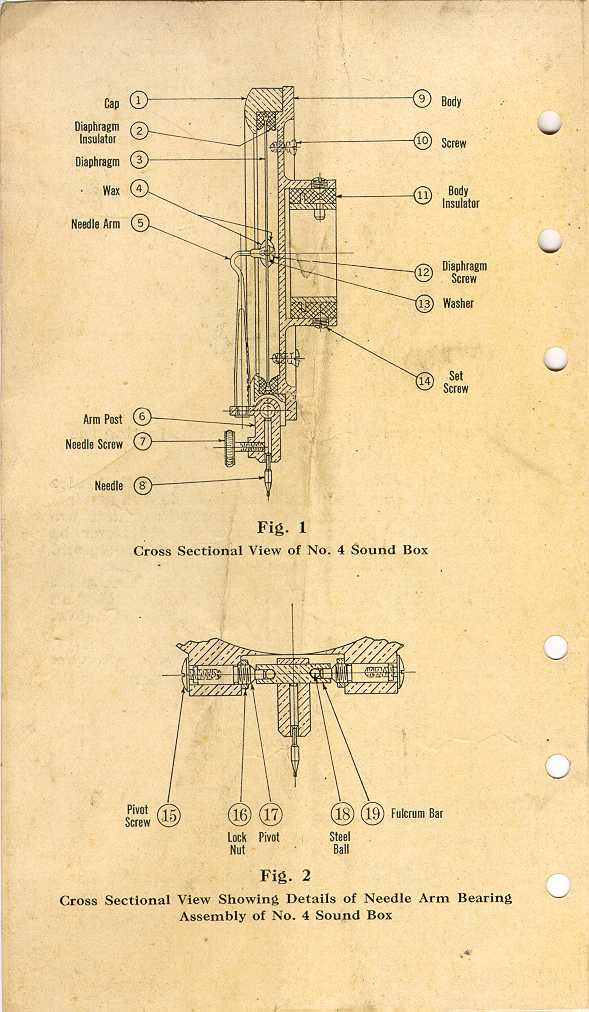
Now, a disclaimer. If the lugs that hold the needle bar screws are cracked or swollen, or you see other signs of pot metal fatigue, DON'T TRY THIS, because you can easily break them when you turn the end-cap screws.
If you detect side play, loosen each of the end-cap (pivot) screws a few turns, and then, applying equal pressure with your thumb and index finger, push both screws gently toward the center so they form a firmer grip on the needle bar. Using a tiny wrench, needle-nose pliers, or good quality tweezers, gently tighten the tiny lock nuts on each side of the needle bar. Re-screw the end-cap screws and test again for side play.
Here's an illustration of the needle-bar joint for a Victor #4 sound box, which is identical to the HMV model:
Now, a disclaimer. If the lugs that hold the needle bar screws are cracked or swollen, or you see other signs of pot metal fatigue, DON'T TRY THIS, because you can easily break them when you turn the end-cap screws.
Who is online
Users browsing this forum: No registered users and 1 guest
It is currently Thu Oct 06, 2016 2:39 pm