I was wondering if any collectors ever swap sound boxes from one machine to another in order to get the best performance out of their gramophones? For instance, have any of you, lucky enough to own an EMG or Ginn gramophone ever tried the sound box on an HMV Re-Entrant gramophone (using an adapter, of course) or visa-versa?
Along this line, have you ever tried a #2 or # 4 sound box on a Re-Entrant style gramophone (again, rigged with an adapter)?
A number of years ago, for instance, I tried out a restored #2 sound box on an Orthophonic Victrola 4-3 (Consolette), which is equipped with a non-folded exponential type horn.
I did this, specifically, to see what the difference between the Consolette's improved horn design would be compared to the older style, pre-1925 horns when playing acoustically recorded records. I was amazed by the results. While the overall volume was the same for both types of horns, the Consolette's horn gave the records a sense of placement. For instance, those instruments that were farther away from the recording horn, sounded farther away. I could also hear, on some records, the echo of room reflection of voices as well as instruments. Overall, the acoustically recorded records sounded more life-like, as if the range had been greatly expanded.
-----------------------------------------------
BTW, I spotted a post on another board--on which some of this site's regular members post--which may have lead to the impression that Victor Exhibition, #2, and #4 sound boxes were not interchangeable. This is simply not true!
The same diameter coupling was used throughout the production until the introduction of the Orthophonic series Victrolas--as is the case with the sound boxes/tone arms produced by the Gramophone Co. prior to the introduction of the Re-Entrant models. What I think the OP is trying to state is that because the rubber flange differed from the Exhibition and #2/#4 sound boxes, installing an Exhibition sound box onto a tone arm designed for the #2 will not provide as air-tight a fit. I disagree with this, based on personal experience. Some Exhibition heads I've tried on later style (pre-1925) Victrolas have fit more tightly than the original #2s did. (Since I'm a fanatic about air tight seals, I normally wrap the end of the tone arm with a single layer of Teflon (plumber's) tap prior to installing any sound box.)
Paul Edie's site does a pretty good job of describing the various Victor sound boxes -- http://victor-victrola.com/Brakes%20and%20Sound%202.htm

Swapping Sound Boxes
Q&A about Talking Machines from the pre-electronic era (approx. 1885-1928).

Hi JoeDS
The straight answer to your question regarding the swapping of soundboxes would have to be NO, I've never tried it, but one thing I have done is to see how improved an early HMV table model would be without the Exhibition s/box and something like a Seymour Concert soundbox in its place (the latter has the standard Victor / HMV "L slot" type fitting).
The Seymour is a larger diameter and closer to the No. 4 in size. Well, to say my table machine became a DIFFERENT gramophone would be no exaggeration. The bass, the tonal balance, the sheer forwardness of the midrange, clarity and depth were all very much improved. I don't know how successful Henry Seymour was (commercially speaking) in the early '20's selling soundboxes as stand alone parts, but if the performance I've heard is anything to go by, every single person with an HMV table/cabinet or moreover, horn machine with Exhibition simply should have upgraded to get the best from their machines. Of course, any machine equipped with the Victor goose-neck would also have been suitably upgraded.
It did look and feel a bit out of place though so I soon retired my Seymour back to its drawer amongst my other prized s/boxes and the original Exhibition got reinstated. Ah, the purist in me won over (again!!!).
But as to putting a soundbox intended for a specific maker's machine onto another maker's machine, no I haven't tried it yet but if I can couple the two, I might try the HMV 5a on the Expert!
Steve
The straight answer to your question regarding the swapping of soundboxes would have to be NO, I've never tried it, but one thing I have done is to see how improved an early HMV table model would be without the Exhibition s/box and something like a Seymour Concert soundbox in its place (the latter has the standard Victor / HMV "L slot" type fitting).
The Seymour is a larger diameter and closer to the No. 4 in size. Well, to say my table machine became a DIFFERENT gramophone would be no exaggeration. The bass, the tonal balance, the sheer forwardness of the midrange, clarity and depth were all very much improved. I don't know how successful Henry Seymour was (commercially speaking) in the early '20's selling soundboxes as stand alone parts, but if the performance I've heard is anything to go by, every single person with an HMV table/cabinet or moreover, horn machine with Exhibition simply should have upgraded to get the best from their machines. Of course, any machine equipped with the Victor goose-neck would also have been suitably upgraded.
It did look and feel a bit out of place though so I soon retired my Seymour back to its drawer amongst my other prized s/boxes and the original Exhibition got reinstated. Ah, the purist in me won over (again!!!).
But as to putting a soundbox intended for a specific maker's machine onto another maker's machine, no I haven't tried it yet but if I can couple the two, I might try the HMV 5a on the Expert!
Steve
I used to be looking for things but now I've found them I don't look at them!
While I never actually heard the results myself, the guy I bought my 202 from once told me he tried swapping a 5a & emg soundbox around. He said both machines performed best with the right soundbox, though the EMG sounded better on the re-entrant than the 5a on the EMG. Unfortunately I have no idea which EMG soundbox he used, or what size EMG machine.
After reading that post on the other board, I decided to do some soundbox swaps yesterday to make sure I wasn't imaging it. Most of my HMV's except one use a no.4 or better anyway, so I didn't touch them.
My little Excello came with a no.2 soundbox when I got it, but then Steve informed me that these originally had an exhibition, so I swapped it over. Unfortunately all my exhibitions have good shiny plating, so after over a year of having the right S/B back on the Excello, I put the no.2 back on it a couple months back, purely because the plating matches the tonearm perfectly. With this machine, I can't hear any difference at all in sound quality between the two.
Anyway, I decided to experiment with V-IX, and removed the exhibition, and tried both a no.2 & no.4.
For the first time ever, I actually got the hear the difference between the exhibition & no.2 & was quite surprized by the results after hearing no difference on the Excello. Although it wasn't a vast diffence in sound quality, it was definately an improvement, and I can see why people may have changed them.
Then I tried the no.4, and it gave brilliant results compared to the other two. The sound is completely different, and makes the exhibition sound very old & dated. After playing a few records with the 4, I put the exhibition back on, & it almost sounded like the needle was plowing through the shellac & damaging the disc. It wasn't of course, but after being happy with the sound of the V-IX with the right soundbox for so long, and then hearing what it "could" sound like with the no.4, the exhibition was very disappointing.
The V-IX is the only machine I can get to & play downstairs, so the Exhibition is now in the no.4 box behind the machine, and the no.4 is on the tonearm & there it will stay!
It does look funny & will take some getting used to, but with the vast improvement in sound quality, plus being able to play later electrical recordings, there's no way I could ever go back to listening to it with an exhibition.
After reading that post on the other board, I decided to do some soundbox swaps yesterday to make sure I wasn't imaging it. Most of my HMV's except one use a no.4 or better anyway, so I didn't touch them.
My little Excello came with a no.2 soundbox when I got it, but then Steve informed me that these originally had an exhibition, so I swapped it over. Unfortunately all my exhibitions have good shiny plating, so after over a year of having the right S/B back on the Excello, I put the no.2 back on it a couple months back, purely because the plating matches the tonearm perfectly. With this machine, I can't hear any difference at all in sound quality between the two.
Anyway, I decided to experiment with V-IX, and removed the exhibition, and tried both a no.2 & no.4.
For the first time ever, I actually got the hear the difference between the exhibition & no.2 & was quite surprized by the results after hearing no difference on the Excello. Although it wasn't a vast diffence in sound quality, it was definately an improvement, and I can see why people may have changed them.
Then I tried the no.4, and it gave brilliant results compared to the other two. The sound is completely different, and makes the exhibition sound very old & dated. After playing a few records with the 4, I put the exhibition back on, & it almost sounded like the needle was plowing through the shellac & damaging the disc. It wasn't of course, but after being happy with the sound of the V-IX with the right soundbox for so long, and then hearing what it "could" sound like with the no.4, the exhibition was very disappointing.
The V-IX is the only machine I can get to & play downstairs, so the Exhibition is now in the no.4 box behind the machine, and the no.4 is on the tonearm & there it will stay!
It does look funny & will take some getting used to, but with the vast improvement in sound quality, plus being able to play later electrical recordings, there's no way I could ever go back to listening to it with an exhibition.
Shane
Yes, as I've said repeatedly (on the other board ) before, the Exhibition is a great soundbox and capable of reproducing all types of music and recordings (even electrically recorded ones!) with equal success BUT when coupled to a short horn system and "dead-end" goose neck tone-arm arrangement, it can sound very tinny, pinched and nasally compared to the later soundboxes. I'm not sure about the surface noise issue?
We all seem to agree that the larger diameter mica types give better results when you have a straight swap with an Exhibition. However, the Exhibition can excel when it is on an improved tone-arm design and is coupled to a long horn system like the Balmain idea or EMG Wilson Horn models. I can play 1940's jazz records on my EMG with Wilson horn which has an early (modified) Exhibition s/box on it and it sounds great. Believe it or not, but I can hardly improve on it when I substitute the later 4-spring aluminium diaphragm "Long-bar" EMG s/box! Of course, it then becomes a balance of improving the horn system again. IOW, if I put the long bar on the tone-arm, the improvement is slight with the Wilson Horn but if I was to place a large Mark 10a/b horn onto the system, the differences between the two s/boxes would become far clearer and the gap in performance somewhat widened.
These (sometimes subtle) differences fascinate me.
Steve
Steve
Yes, as I've said repeatedly (on the other board
) before, the Exhibition is a great soundbox and capable of reproducing all types of music and recordings (even electrically recorded ones!) with equal success BUT when coupled to a short horn system and "dead-end" goose neck tone-arm arrangement, it can sound very tinny, pinched and nasally compared to the later soundboxes. I'm not sure about the surface noise issue?We all seem to agree that the larger diameter mica types give better results when you have a straight swap with an Exhibition. However, the Exhibition can excel when it is on an improved tone-arm design and is coupled to a long horn system like the Balmain idea or EMG Wilson Horn models. I can play 1940's jazz records on my EMG with Wilson horn which has an early (modified) Exhibition s/box on it and it sounds great. Believe it or not, but I can hardly improve on it when I substitute the later 4-spring aluminium diaphragm "Long-bar" EMG s/box! Of course, it then becomes a balance of improving the horn system again. IOW, if I put the long bar on the tone-arm, the improvement is slight with the Wilson Horn but if I was to place a large Mark 10a/b horn onto the system, the differences between the two s/boxes would become far clearer and the gap in performance somewhat widened.
These (sometimes subtle) differences fascinate me.
Steve
Steve
I used to be looking for things but now I've found them I don't look at them!
-
Joe_DS
Topic author - Forum Moderator
- Posts: 1056
- Joined: Thu Jun 08, 2006 4:23 pm
- Location: San Francisco, California, USA
Hi Shane:
I'm not surprised by the results, since, as you know, the #4 sound box was sold as an upgrade component--specifically for playing electrical recordings on older style Victrolas, in addition to its standard usage on portables, and the VV-1-70.
For me, this begs the question: considering the improvement in performance, why don't more turn up today? I've never come across a pre-1925 Victrola with a number #4 sound box in place of it's original Exhibition or #2 sound box, nor have most collectors I've known. Since they were made out of the same horrible pot metal as the Orthophonic sound boxes, it's possible--I guess--that many might have been sold for upgrade purposes, but after a few decades sitting in "grandma's" attic or cellar, they cracked and crumbled to dust, and were replaced by the original sound boxes when the machines were put up for sale. (Unfortunately, no sales figures indicating how many #4 sound boxes were sold for upgrade purposes exist--that I know of.)
But, I think another--more likely--reason has to do with the fact that, as upgrade components, these weren't exactly cheap. Victor normally sold sound boxes, on an individual basis, for about $5.00 each. (I've seen ads indicating that buyers could purchase a #4 sound box for that price.) In the late 1920s, $5.00 was a day's salary for many well-paid workers; for others, such as my grandfather, it was a week's wages!
Along this line, $5.00 was about 1/3 the cost of Victor's cheapest table model at the time, the VV-1-1, which sold for $17.50. And, of course, the same $5 used to buy a #4 sound box could also be used as a down-payment for an Orthophonic model, which, I feel, is most likely what happened.
-----------------------------------------------
As for the Exhibition sound box, as Steve noted, the type of sound chamber--tone arm/horn, etc.--can have a tremendous impact on its performance. Just as important, I've found, is how the sound box has been restored. If the mica diaphragm is clamped too tightly between the gaskets, for instance, its movement will be substantially restricted, and only the very center of the diaphragm will vibrate to any extent in sympathy to the movement of the needle bar. (This results in an annoying "mica tone" or high pitched blast on loud passages.) For the best results, soft gasketing material which allows the diaphragm to more or less "float" in position should be used. One should be able to LIGHTLY flex the needle bar and see the entire surface of the diaphragm move, to some extent.
Along this line, the needle bar, itself, should be adjusted for maximum compliance, and the needle bar foot should exert no pressure or pull on the diaphragm, once mounted. "Pull" results in a "ringing" tone, while "push" results in a mushy, distorted soft "buzzing" tone. (Of course, an improperly adjusted needle bar also does substantial damage to the record groove.)
Of all the Exhibition sound boxes I've heard, the best, by far, was one that was overhauled by the late Bob Waltrip. While he installed a conventional neoprene gasket for the front, in place of the back gasket, he used a bead of non-hardening silicone calk. In terms of sound quality, it comes very close to a #4, though not quite as loud and full. I've used it for 20 years on my (outside horn) Vic.V and it sounds as good today as when I first got it.
I'm not surprised by the results, since, as you know, the #4 sound box was sold as an upgrade component--specifically for playing electrical recordings on older style Victrolas, in addition to its standard usage on portables, and the VV-1-70.
For me, this begs the question: considering the improvement in performance, why don't more turn up today? I've never come across a pre-1925 Victrola with a number #4 sound box in place of it's original Exhibition or #2 sound box, nor have most collectors I've known. Since they were made out of the same horrible pot metal as the Orthophonic sound boxes, it's possible--I guess--that many might have been sold for upgrade purposes, but after a few decades sitting in "grandma's" attic or cellar, they cracked and crumbled to dust, and were replaced by the original sound boxes when the machines were put up for sale. (Unfortunately, no sales figures indicating how many #4 sound boxes were sold for upgrade purposes exist--that I know of.)
But, I think another--more likely--reason has to do with the fact that, as upgrade components, these weren't exactly cheap. Victor normally sold sound boxes, on an individual basis, for about $5.00 each. (I've seen ads indicating that buyers could purchase a #4 sound box for that price.) In the late 1920s, $5.00 was a day's salary for many well-paid workers; for others, such as my grandfather, it was a week's wages!
Along this line, $5.00 was about 1/3 the cost of Victor's cheapest table model at the time, the VV-1-1, which sold for $17.50. And, of course, the same $5 used to buy a #4 sound box could also be used as a down-payment for an Orthophonic model, which, I feel, is most likely what happened.
-----------------------------------------------
As for the Exhibition sound box, as Steve noted, the type of sound chamber--tone arm/horn, etc.--can have a tremendous impact on its performance. Just as important, I've found, is how the sound box has been restored. If the mica diaphragm is clamped too tightly between the gaskets, for instance, its movement will be substantially restricted, and only the very center of the diaphragm will vibrate to any extent in sympathy to the movement of the needle bar. (This results in an annoying "mica tone" or high pitched blast on loud passages.) For the best results, soft gasketing material which allows the diaphragm to more or less "float" in position should be used. One should be able to LIGHTLY flex the needle bar and see the entire surface of the diaphragm move, to some extent.
Along this line, the needle bar, itself, should be adjusted for maximum compliance, and the needle bar foot should exert no pressure or pull on the diaphragm, once mounted. "Pull" results in a "ringing" tone, while "push" results in a mushy, distorted soft "buzzing" tone. (Of course, an improperly adjusted needle bar also does substantial damage to the record groove.)
Of all the Exhibition sound boxes I've heard, the best, by far, was one that was overhauled by the late Bob Waltrip. While he installed a conventional neoprene gasket for the front, in place of the back gasket, he used a bead of non-hardening silicone calk. In terms of sound quality, it comes very close to a #4, though not quite as loud and full. I've used it for 20 years on my (outside horn) Vic.V and it sounds as good today as when I first got it.
-
BERT
My experience is that a 5a or 5b plays wonderful on an oversize EMG !
emg just was not able to produce a high quality soundbox as the 5a or 5b.
But then again,if you have the right emg soundbox for the right EMG there is no match.
That's when the "tuning of the soundbox" was so important.It all had to be in balance in order to give the best performance.I would not be surprised emg (ginn)even tuned the soundbox to your record collection..piano,violin,vocals, etc..
emg just was not able to produce a high quality soundbox as the 5a or 5b.
But then again,if you have the right emg soundbox for the right EMG there is no match.
That's when the "tuning of the soundbox" was so important.It all had to be in balance in order to give the best performance.I would not be surprised emg (ginn)even tuned the soundbox to your record collection..piano,violin,vocals, etc..
Bert
You're certainly right about one thing there - Ginn did tune s/boxes to a customer's room for whatever music they regularly played!
AS for whether the HMV is better, I wouldn't be so sure to say either way. The EMG / Expert s/boxes were all handmade brass which is better than the factory produced pot metal backed HMV's. The EMG's had conventional rubber gaskets which I personally prefer to the flimsy felt HMV used and they were tunable as you've said. HMV's simply are setup to pivot on two rods and have no adjustment. Better? Hmm, don't know!
i haven't tried putting the 5a on an Expert yet. If i get blown away I'll be back to tell you!
BTW, I haven't sent any 5a parts to you yet - I've had another dilemma: I'm not sure any of the silver 5a's ever had those small "eyelets" in the front shield or fascia? The one I WAS going to send was originally chrome and it has them. I might try to find another 5a to dismantle first which has the plain fascia similar to all the pictures of the silver 5a's I've seen to date.
Steve
You're certainly right about one thing there - Ginn did tune s/boxes to a customer's room for whatever music they regularly played!
AS for whether the HMV is better, I wouldn't be so sure to say either way. The EMG / Expert s/boxes were all handmade brass which is better than the factory produced pot metal backed HMV's. The EMG's had conventional rubber gaskets which I personally prefer to the flimsy felt HMV used and they were tunable as you've said. HMV's simply are setup to pivot on two rods and have no adjustment. Better? Hmm, don't know!
i haven't tried putting the 5a on an Expert yet. If i get blown away I'll be back to tell you!
BTW, I haven't sent any 5a parts to you yet - I've had another dilemma: I'm not sure any of the silver 5a's ever had those small "eyelets" in the front shield or fascia? The one I WAS going to send was originally chrome and it has them. I might try to find another 5a to dismantle first which has the plain fascia similar to all the pictures of the silver 5a's I've seen to date.
Steve
I used to be looking for things but now I've found them I don't look at them!
-
BERT
By accident I used the right 5a to get silverplated.I noticed that it did not have the little holes after the plating
the 5a was actually a nice design I believe. it used the bettini spider system.It had a complicated pattern in the alu diaphram.Sure they used potmetal and softcloth rings, but at the time it was good enough.they did not realize we would still be using them after 80 years
I made a thin leather ring to fit the 5a to the emg needle arm.
I'm pretty sure you'll be impressed! no more re-tuning for many many years
bert
belgium
the 5a was actually a nice design I believe. it used the bettini spider system.It had a complicated pattern in the alu diaphram.Sure they used potmetal and softcloth rings, but at the time it was good enough.they did not realize we would still be using them after 80 years
I made a thin leather ring to fit the 5a to the emg needle arm.
I'm pretty sure you'll be impressed! no more re-tuning for many many years
bert
belgium
-
Joe_DS
Topic author - Forum Moderator
- Posts: 1056
- Joined: Thu Jun 08, 2006 4:23 pm
- Location: San Francisco, California, USA
BERT wrote:it used the bettini spider system.It had a complicated pattern in the alu diaphram.
The spider used in the 5a sound box actually differed greatly from the one that Bettini designed--over 30 years earlier--in both form and function.
See: http://www.talkingmachine.org/Bettini.html
Also: http://www.worldofgramophones.com/bettini.html
Bettini actually designed a number of diaphragms/reproducers, some of which were fitted with legs of varying sizes.
To view an online description of the spider's purpose, see:
http://www.google.com/patents?id=xEV2AA ... aph+spider
The diaphragm used in the 5a sound box, of course, was initially designed for what would become the Orthophonic reproduction system (in the United States) and was developed by Joseph P Maxfield and Henry C. Harrison at Bell Labs. It is described in their paper, "Methods of High Quality Recording and Reproducing of Music and Speech Based on Telephone Research;" (AKA, "Theory of Matched Impedance") a copy of which appears in the book "From Tinfoil to Stereo." Also SEE: http://history.sandiego.edu/gen/recording/ortho.html
Unlike the spider(s) designed by Bettini, the one used in the Orthophonic/5 & 5a & 5b sound boxes is fitted with uniform sized, evenly spaced legs which cause the entire active area of the diaphragm to plunge with the movement of the needle-bar.
According the information provided in the "Theory of Matched Impedance," the corrugations along the edge of the diaphragm were used to "eliminate a tendency (of the diaphragm) to rattle."
I sold my EMG oversize to a happy German collector.
Now I stumbled upon a Mark 9 emg with mark 8 (straight horn) emg.
Again I fit a 5b soundbox to it and I couldn't believe my ears...
The quality of soundreproduction is so pleasing to me,I went over all of my favorite 78rpm electric recordings.
I believe that the straight horn design was actually the best way to go...
The bass reproduction is more or less the same as the oversize.
I know it's hard to believe,but maybe there's even a difference in the way each horn was made.
Maybe they used more layers of papiermaché in the early machines.
Can anyone tell me by looking at the signature on the photo of the wooden board of my emg if this is the
signature of EMGinn himself? Did emg already exist as a 'company' in 1925 ?
Was the mark 9 already produced in 1925?
Now I stumbled upon a Mark 9 emg with mark 8 (straight horn) emg.
Again I fit a 5b soundbox to it and I couldn't believe my ears...
The quality of soundreproduction is so pleasing to me,I went over all of my favorite 78rpm electric recordings.
I believe that the straight horn design was actually the best way to go...
The bass reproduction is more or less the same as the oversize.
I know it's hard to believe,but maybe there's even a difference in the way each horn was made.
Maybe they used more layers of papiermaché in the early machines.
Can anyone tell me by looking at the signature on the photo of the wooden board of my emg if this is the
signature of EMGinn himself? Did emg already exist as a 'company' in 1925 ?
Was the mark 9 already produced in 1925?
- Attachments
-
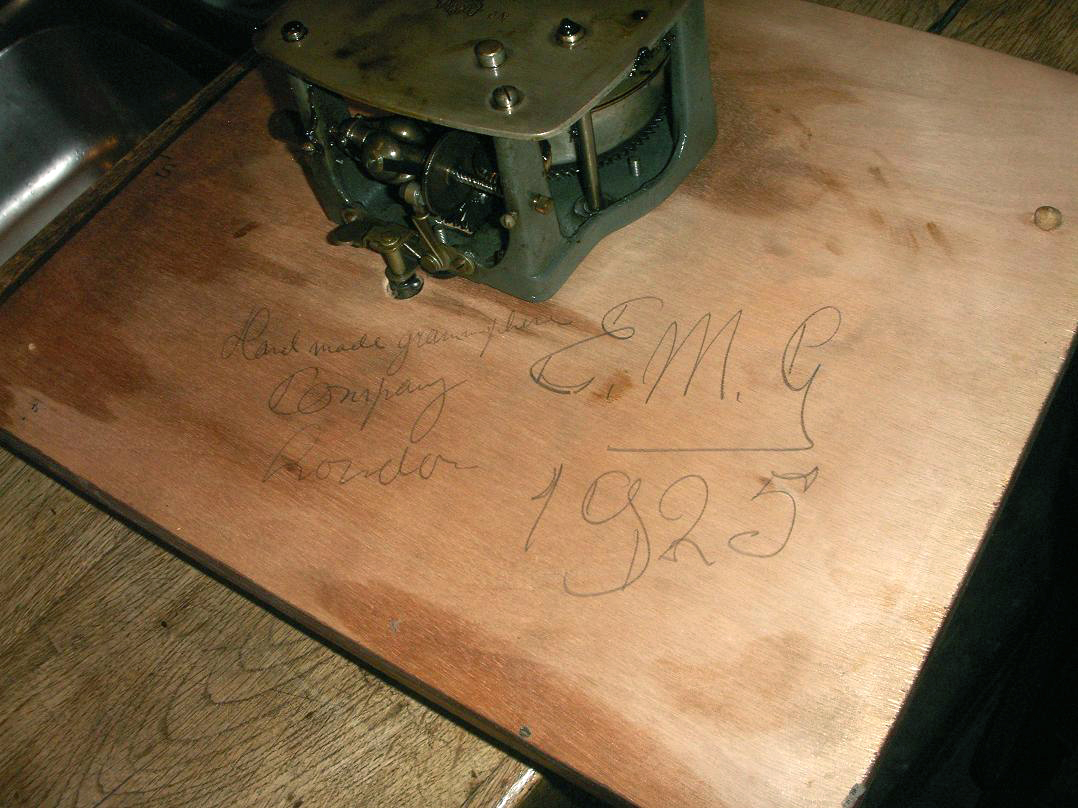
- emg pencil signature
- emg.JPG (487.54 KiB) Viewed 3740 times
Who is online
Users browsing this forum: No registered users and 1 guest
It is currently Thu Oct 06, 2016 2:36 pm
