Hi I have a couple of questions?
One: I have an audio-technica AT-PL 120 which has no ground wire. Never came with one. So I can only play it though a pair of TEAC PowerMax 160/2 powered speakers. Since there is no ground wire, I can not hook it to other stereo equipment. Also, sometimes, I will get a home form the 78 cartridge, due to a loose wire, that I just pop back into place. I have never come across a turntable with no ground wire before? Also there is no place for one. I have had the turntable for a few years, and never bothered with a ground wire, since it plays through, my powered speakers just fine.
Two: How do I reduce the surface noise form early 78 records? I have a 78 stylus, and I have cleaned the records, but due to record ware, I still have noise? Is there a way to eliminate that apart from software. I am not transferring them. I saw a video on how to play early 78's, but he did not say what type of amp too use? Also there was no talking just text!
Any help would be great?
Paul

Turntable help?
Electrically amplified phonographs or radio/phonographs and related components (approx. 1928-1990).
-
Edisonfans19
Topic author - Junior Member
- Posts: 14
- Joined: Tue Aug 03, 2010 2:59 pm
- Location: Frederick Maryland
-
 MattTech
- Senior Member
- Posts: 1461
- Joined: Tue Apr 29, 2008 7:38 am
- Location: Philadelphia Pa USA - Home Electronics - Service Technician
The Audio-Technica AT-PL 120 is a knock-off version of the famous Technics SL-1200 series.
Being self-preamplified, it apparently doesn't need a grounding wire for installation.
As for the surface noise of old worn records, you just have to live with it, because once records are worn, they're worn.
Being self-preamplified, it apparently doesn't need a grounding wire for installation.
As for the surface noise of old worn records, you just have to live with it, because once records are worn, they're worn.
The Internet is a marvelous thing, however it's not a good substitute for actually being there.
-
Edisonfans19
Topic author - Junior Member
- Posts: 14
- Joined: Tue Aug 03, 2010 2:59 pm
- Location: Frederick Maryland
Thank You for the information!
Paul, the issue of noise reduction on old recordings depends on what equipment you have available.
As Matt said worn records can not be fully restored, it basically becomes an exercise in covering up the flaws.
First, if you are going for simple straight analog playback the easiest device is a graphic equalizer. A standard one-octave is least expensive and probably adequate for your needs. A quarter-octave will allow you to "pinpoint" the areas where noise is most objectionable while leaving other nearby frequencies relatively intact. Very often records are 'torn up" due to crude pickups that can not track well at certain frequencies. The ability to filter the parts of the spectrum that are damaged in this way can allow a more sophisticated restoration.
Often damage is caused by worn styli and too-heavy weight, however sometime too little weight was allowed the styli ride up on the groove edges and score them. In either of these cases special, custom styli can make a big difference by tracking either further down in the groove (in the case of too little weight) or a wider styli will stay higher in the grrove walls where too much weight caused 'dredging" of the bottom of the groove.
Since the turntable you have has it's own preamp it can be readily used on -any- stereo, home theater or other amp as long as it has one of the following inputs: line, aux, tape, TV, cd. That covers essentially anything in the consumer market and also allows the following suggestion:
You can connect the output of that TT to the "Line" input on your computer and record a .WAV file. One popular free program that facilitates this is Audacity: http://audacity.sourceforge.net/
This prog includes a suite of editing, filtering and noise reduction effects that can be applied to the .WAV file then once you like the results they can be burned onto a CD or converted to an MP3 via a converter (search WAV to MP3 for free ones). In the case of transient noise reducers (click and pop) I have found that two passes at lower noise reduction settings yield better, less artifacted results then a single pass at a high setting
In fact, there are a number of free WAV recorders available so try a few. Search: WAV recorder free.
The cheapest approach is to digitize your records and use the free software to clean up and enhance what remains.
Rob/NYC
As Matt said worn records can not be fully restored, it basically becomes an exercise in covering up the flaws.
First, if you are going for simple straight analog playback the easiest device is a graphic equalizer. A standard one-octave is least expensive and probably adequate for your needs. A quarter-octave will allow you to "pinpoint" the areas where noise is most objectionable while leaving other nearby frequencies relatively intact. Very often records are 'torn up" due to crude pickups that can not track well at certain frequencies. The ability to filter the parts of the spectrum that are damaged in this way can allow a more sophisticated restoration.
Often damage is caused by worn styli and too-heavy weight, however sometime too little weight was allowed the styli ride up on the groove edges and score them. In either of these cases special, custom styli can make a big difference by tracking either further down in the groove (in the case of too little weight) or a wider styli will stay higher in the grrove walls where too much weight caused 'dredging" of the bottom of the groove.
Since the turntable you have has it's own preamp it can be readily used on -any- stereo, home theater or other amp as long as it has one of the following inputs: line, aux, tape, TV, cd. That covers essentially anything in the consumer market and also allows the following suggestion:
You can connect the output of that TT to the "Line" input on your computer and record a .WAV file. One popular free program that facilitates this is Audacity: http://audacity.sourceforge.net/
This prog includes a suite of editing, filtering and noise reduction effects that can be applied to the .WAV file then once you like the results they can be burned onto a CD or converted to an MP3 via a converter (search WAV to MP3 for free ones). In the case of transient noise reducers (click and pop) I have found that two passes at lower noise reduction settings yield better, less artifacted results then a single pass at a high setting
In fact, there are a number of free WAV recorders available so try a few. Search: WAV recorder free.
The cheapest approach is to digitize your records and use the free software to clean up and enhance what remains.
Rob/NYC
"If we believe absurdities, we shall commit atrocities" -- Voltaire
-
 Record-changer
- Senior Member
- Posts: 1139
- Joined: Fri Apr 21, 2006 8:11 pm
- Location: Bloomington IN USA
I have used many techniques to remove noise from 78 records.
1. Make sure you have a stylus that fits the groove. Normal 78s need a stylus of about 2.7 mil. Vertical Pathe's need a stylus about 7 mil. And Edison's work better with a microgroove stylus of about .7 mil. Also note that shellac records need about half the antiskating of vinyl records.
2. Determine the direction of modulating the groove in the recording - lateral, vertical, or diagonal, and remove all sounds from other modulation planes.
-- For lateral records, mix the two channels together to cancel any noise in other directions. The MONO switch can do this.
-- For vertical records reverse the phase of one channel and then mix the two channels together:
---- One way to do this is to reverse the leads to one side of the pickup. Switch the pair that does not have the ground strap.
---- Another way is to insert a phase reversing transformer into one lead.
-- For diagonal records (some Emerson records), just use the stereo channel with the music on it.
3, Properly equalize the record for the recording curve used to make it. RIAA was not used on any 78s except some made in the mid and late 1950s. A graphic equalizer is needed. Most 78s need a bass cut between 500Hz and 200 Hz, and a treble boost between around 2 KHz and the upper limit of the recorded material. Adjust it so the record sounds natural.
Exceptions: Columbia records made after about 1938 require a treble cut instead, and some Victor records need no treble adjustment. Some Victor records also need no bass adjustment.
4. I have a DNR (dynamic noise reduction) device connected after the phase and mono switch, but before the equalizer. This removes noise when program material is absent.
5. In some cases, I also use an expander.
6. I record the result on a CD-R and then process it with a computer. I have Magix Music Studio, which can also remove characteristic types of noises, including cassette hiss and record noise. You can even create a noise profile for an individual disc. I also have a technique to remove clicks with it.
1. Make sure you have a stylus that fits the groove. Normal 78s need a stylus of about 2.7 mil. Vertical Pathe's need a stylus about 7 mil. And Edison's work better with a microgroove stylus of about .7 mil. Also note that shellac records need about half the antiskating of vinyl records.
2. Determine the direction of modulating the groove in the recording - lateral, vertical, or diagonal, and remove all sounds from other modulation planes.
-- For lateral records, mix the two channels together to cancel any noise in other directions. The MONO switch can do this.
-- For vertical records reverse the phase of one channel and then mix the two channels together:
---- One way to do this is to reverse the leads to one side of the pickup. Switch the pair that does not have the ground strap.
---- Another way is to insert a phase reversing transformer into one lead.
-- For diagonal records (some Emerson records), just use the stereo channel with the music on it.
3, Properly equalize the record for the recording curve used to make it. RIAA was not used on any 78s except some made in the mid and late 1950s. A graphic equalizer is needed. Most 78s need a bass cut between 500Hz and 200 Hz, and a treble boost between around 2 KHz and the upper limit of the recorded material. Adjust it so the record sounds natural.
Exceptions: Columbia records made after about 1938 require a treble cut instead, and some Victor records need no treble adjustment. Some Victor records also need no bass adjustment.
4. I have a DNR (dynamic noise reduction) device connected after the phase and mono switch, but before the equalizer. This removes noise when program material is absent.
5. In some cases, I also use an expander.
6. I record the result on a CD-R and then process it with a computer. I have Magix Music Studio, which can also remove characteristic types of noises, including cassette hiss and record noise. You can even create a noise profile for an individual disc. I also have a technique to remove clicks with it.
-
Edisonfans19
Topic author - Junior Member
- Posts: 14
- Joined: Tue Aug 03, 2010 2:59 pm
- Location: Frederick Maryland
Thanks for the help? I'll need to get a better stylus for playing my early 78's. I have a SHURE M78S, which plays the 78's after 1930 really well, but I would like a better one for playing 78's prior to 1930. I stopped by Jerry Raskins's Needle Doctor, and saw, that they carry a wide range of styli for playing 78 records. I did not see any equalizers though. A lot of amps and pre amps though. I do recall sometime back finding a company that produces amp/filters that remove the pops clicks and surface noise. For between $300-$400.00
Paul
Paul
Paul, since you mentioned that your T-T has a built-in preamp all changes to response must be done downstream. Go to Ebay and search "graphic equalizer". You should be able to find a good one-octave eq for under $100. Going to an external preamp won't really make a difference in this case. One example of an eq/and noise reducer is the DBX 2231. It is 1/3rd octave and has a dynamic type noise reducer(DNR). These are single channel (mono) and you would need two for stereo, for work with 78's obviously this isn't important.
If you digitize the records into WAV files editors such as Audacity have a graphic eq function that is as, or more flexible than a simple hardware eq.
Another hint is to "Y" the output of the T-T into mono. This will effectively eliminate a lot of surface noise since it is inherently out of phase and strapping the channels in parallel causes those to self-cancel.
I digitized a little over 200 78's for my Father and the father of my business partner. This was back in the late 90's and early 2000's. I used an Empire 598 TT w/Stanton 680 and 78 stylus wired mono, a Harman Kardon Citation control unit (tube) as preamp into a simple one octave eq followed by a Unimetrics limiter. That last unit was just there to keep all recordings at the same relativity level It was set for fast attack and slow release based on the characteristics of each recording.
Even without any sort of dedicated noise reduction the results were very good.
Good luck,
Rob
If you digitize the records into WAV files editors such as Audacity have a graphic eq function that is as, or more flexible than a simple hardware eq.
Another hint is to "Y" the output of the T-T into mono. This will effectively eliminate a lot of surface noise since it is inherently out of phase and strapping the channels in parallel causes those to self-cancel.
I digitized a little over 200 78's for my Father and the father of my business partner. This was back in the late 90's and early 2000's. I used an Empire 598 TT w/Stanton 680 and 78 stylus wired mono, a Harman Kardon Citation control unit (tube) as preamp into a simple one octave eq followed by a Unimetrics limiter. That last unit was just there to keep all recordings at the same relativity level It was set for fast attack and slow release based on the characteristics of each recording.
Even without any sort of dedicated noise reduction the results were very good.
Good luck,
Rob
"If we believe absurdities, we shall commit atrocities" -- Voltaire
-
Edisonfans19
Topic author - Junior Member
- Posts: 14
- Joined: Tue Aug 03, 2010 2:59 pm
- Location: Frederick Maryland
Thank You Rob!
-
Edisonfans19
Topic author - Junior Member
- Posts: 14
- Joined: Tue Aug 03, 2010 2:59 pm
- Location: Frederick Maryland
Hey Rob, I just bought a dbx 1531x from a vintage electronics dealer? it powers up and it seems to be working. Although I don't know how to work the sliders right? I'll keep experimenting!
Paul
Paul
-
Edisonfans19
Topic author - Junior Member
- Posts: 14
- Joined: Tue Aug 03, 2010 2:59 pm
- Location: Frederick Maryland
Here is the EQ I bought today for $84.00. Works well with my vinyl records. It does alright with my 78's although I need something better then my SHURE M78S stylus. Which works okay for my 78's after 1930, but I need a better one for the 78's prior to 1930.
Paul
Paul
- Attachments
-
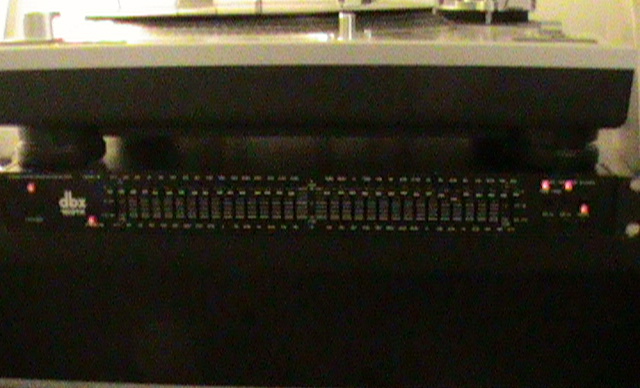
- my DBX graphic EQ
- DSC00121.JPG (115.42 KiB) Viewed 1520 times
Paul, I believe these are the instruction for your eq:
http://www.dbxpro.com/system/documents/ ... 1324060224
Generally, you start with the frequency sliders at the "0" -the midpoint and raised or lowered as needed. A light touch is best. It is likely that uppermost and lowest frequencies will not have any actual music from the old records so those may be set to minimum.
Again, set up the output from the TT for mono. On the 78's I dealt with all were washed with regular hand soap, rinsed with a strong stream of warm water to blast out as much crud from the grooves as possible.
In -some- cases a light amount of water film may be helpful as a lubricant in reducing surface noise on 78's Be careful not to use too much water as it can clog the stylus cantilever and muddy the sound. No big deal -just blow the stylus dry.
Rob
http://www.dbxpro.com/system/documents/ ... 1324060224
Generally, you start with the frequency sliders at the "0" -the midpoint and raised or lowered as needed. A light touch is best. It is likely that uppermost and lowest frequencies will not have any actual music from the old records so those may be set to minimum.
Again, set up the output from the TT for mono. On the 78's I dealt with all were washed with regular hand soap, rinsed with a strong stream of warm water to blast out as much crud from the grooves as possible.
In -some- cases a light amount of water film may be helpful as a lubricant in reducing surface noise on 78's Be careful not to use too much water as it can clog the stylus cantilever and muddy the sound. No big deal -just blow the stylus dry.
Rob
"If we believe absurdities, we shall commit atrocities" -- Voltaire
-
Edisonfans19
Topic author - Junior Member
- Posts: 14
- Joined: Tue Aug 03, 2010 2:59 pm
- Location: Frederick Maryland
Thank You for the help? Rob:
-
Edisonfans19
Topic author - Junior Member
- Posts: 14
- Joined: Tue Aug 03, 2010 2:59 pm
- Location: Frederick Maryland
I was able to remove some of the surface noise, while still hearing the recording!
Who is online
Users browsing this forum: No registered users and 6 guests
It is currently Thu Oct 06, 2016 2:02 pm