Jeremy, the outputs from the amp are the purple-brown and pink wires at the top of the amp in your picture:
http://www.flickr.com/photos/56778241@N ... /lightbox/Do not "poke around" on a live transistor amp if you do not know what you are
doing. While these amps are not as potentially lethal as tube amps, here the danger is to the transistors. Even the briefest short can kill them.
Given that the unit is now 44 years old at least a partial rebuild is in order.
Some preliminary things to check:
With the unit on but no signal, wait a few minutes, turn the volume control through it's range. Ideally, there should be no "static" as you turn it. Same applies to tone and balance controls. Static in this test generally indicates the capacitors that pass audio but block DC from the controls have become leaky.
Set volume at midpoint and turn the function/input switch. It too should be quiet although a little noise is OK.
Static on the controls when audio is being passed just indicates dirty controls.
With balance control set at center do the channels balance in terms of volume and tone in ALL modes?
Again with machine on but no signal carefully feel the heatsinks on the output transistors (the large black fins) after a period of around 10-15 minutes. Slight warmth is normal -but not hot. the two heatsinks represent the outputs of each channel. One should not be much warmer than the other.
If the set passes all above it is probably OK to continue using it, but best performance will likely require a rebuild at some point.
The turntable and tape deck should get a thorough going over with cleaning and lube.
As for replacing the woofer, I agree w/Matt that to retain balance in both tone and level both would need replacement.
It may be possible to --slightly-- bend the woofer frame or simply moisten the cone a bit and place the speaker face down to dry.
If you can find a small transformer that puts out 3 to 5 volts AC connecting that to the woofer will allow you to hear what effect, if any, slight bending will have on the rubbing. Disconnect it from the amp first. On large woofer like this sometimes just turning it 180 degrees (upside) will shift the weight of the cone enough to eliminate the rubbing.
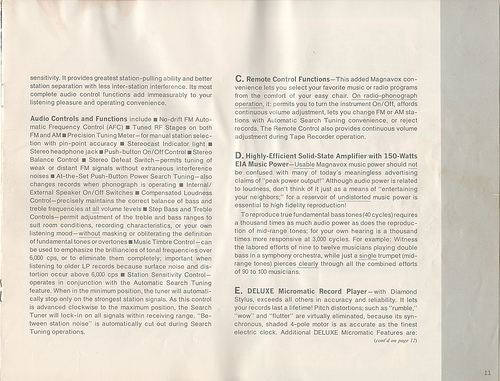
The text you attached about the sets features spec's the output at "EIA Music Power" this was a scheme that the electronics industry developed back in the late 1940's. It is based on the theory that a complex signal such as music is far less demanding than a sine wave in terms of revealing distortion. So the theory goes that one could push more power from an amp at higher measurable distortion levels with music before it became noticeable....O...K...
While this is somewhat true, the businessmen went a little "crazy" with it (I'm being charitable) and things got to the point that by around 1975 the FTC required that continuous RMS into a specified load become the standard. Over the last few 'business friendly" administrations things have deteriorated again (1000 watt HTiB systems, etc).
Typically Music power is twice the RMS so your set is probably capable of around 35 w/ch with both channels driven. With efficient speakers this will still drive you out of the room.
Rob/NYC